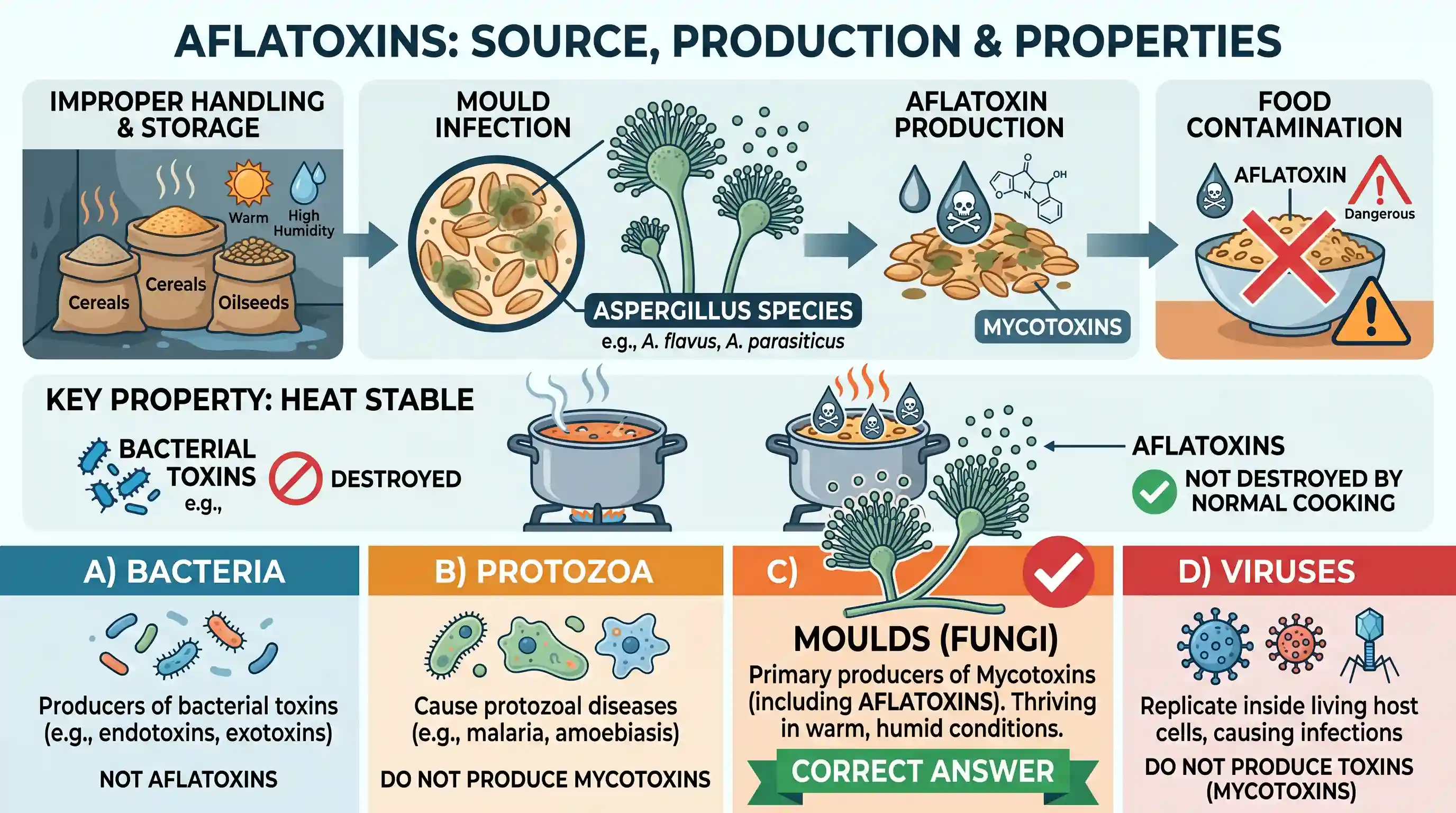
Improper handling and storage of cereal grains and oilseeds result in the production of toxins known as aflatoxins which are not generally destroyed by normal cooking process. Aflatoxins are produced by

- Abacteria
- Bprotozoa
- CmouldsCorrect
- Dviruses
Explanation
Aflatoxins are a family of toxins produced by certain fungi, specifically moulds, that can contaminate food crops like cereal grains and oilseeds. These toxins are highly dangerous and can cause serious health problems, including liver cancer.
Why Moulds (C) is correct: Aspergillus flavus and Aspergillus parasiticus are the primary moulds responsible for aflatoxin production. They thrive in warm, humid conditions and can infect crops before or after harvest.
Why Bacteria (A) is incorrect: Bacteria generally produce different types of toxins, and aflatoxins are not bacterial in origin. Bacterial toxins often involve different mechanisms of production and are typically destroyed by cooking.
Why Protozoa (B) is incorrect: Protozoa are single-celled eukaryotic organisms, and they do not produce aflatoxins. They are associated with diseases like malaria and amoebiasis, not mycotoxin contamination.
Why Viruses (D) is incorrect: Viruses are infectious agents that replicate inside living cells. They do not produce aflatoxins; their pathogenic effects stem from cellular damage during replication.
The question specifically mentions that aflatoxins are not destroyed by normal cooking, which is characteristic of mycotoxins – toxins produced by fungi that are heat-stable.
Related questions
More UPSC Prelims practice from the same subject and topic.
- Prelims 2013GS1science-and-technology
Which of the following diseases can be transmitted from one person to another through tattooing? 1. Chikungunya 2. Hepatitis B 3. HIV-AIDS Select the correct answer using the codes given below.
- Prelims 2013GS1science-and-technology
Fruits stored in a cold chamber exhibit longer storage life because
- Prelims 2013GS1science-and-technology
Rainbow is produced when sunlight falls on drops of rain. Which of the following physical phenomena are responsible for this?
- Prelims 2013GS1science-and-technology
Which of the following statements is/are correct?
- Prelims 2013GS1science-and-technology
The known forces of nature can be divided into four classes, viz., gravity, electromagnetism, weak nuclear force and strong nuclear force. With reference to them, which one of the following statements…
- Prelims 2013GS1science-and-technology
The efforts to detect the existence of Higgs boson particle have become frequent news in the recent past. What is/are the importance/importances of discovering this particle?