The terms 'Marginal Standing Facility Rate' and 'Net Demand and Time Liabilities', sometimes appearing in news, are used in relation to

- Abanking operationsCorrect
- Bcommunication networking
- Cmilitary strategies
- Dsupply and demand of agricultural products
Explanation
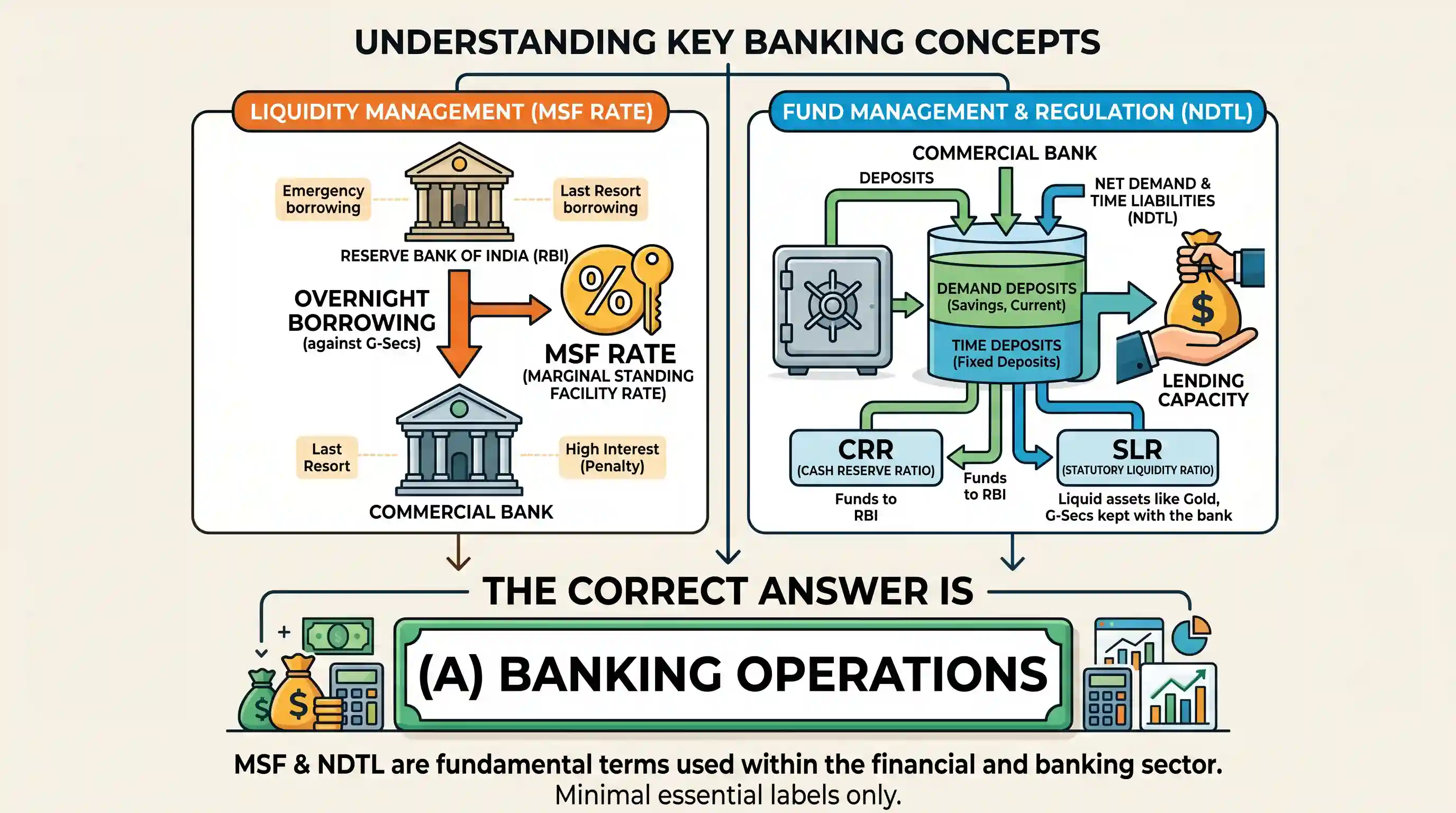
Both 'Marginal Standing Facility (MSF) Rate' and 'Net Demand and Time Liabilities (NDTL)' are fundamental terms used within the financial and banking sector, particularly in the context of central banking and commercial banking operations in India.
Marginal Standing Facility (MSF) Rate: This is a penal rate at which scheduled commercial banks can borrow money from the Reserve Bank of India (RBI) overnight, against government securities, when there is an acute shortage of inter-bank liquidity. It serves as a last resort for banks. Net Demand and Time Liabilities (NDTL): This refers to the total of demand and time deposits (liabilities) of a bank with the public and other banks, minus deposits of other banks with it. NDTL is a crucial figure used by the RBI to calculate key statutory requirements for banks, such as the Cash Reserve Ratio (CRR) and the Statutory Liquidity Ratio (SLR), which directly impact a bank's lending capacity. Given their direct relevance to how banks operate, borrow, and are regulated, these terms are exclusively associated with banking operations.
Related questions
More UPSC Prelims practice from the same subject and topic.
- Prelims 2014GS1economy
What is/are the facility/facilities the beneficiaries can get from the services of Business Correspondent (Bank Saathi) in branchless areas? 1. It enables the beneficiaries to draw their subsidies and…
- Prelims 2014GS1economy
In the context of Indian economy, which of the following is/are the purpose/purposes of 'Statutory Reserve Requirements'? 1. To enable the Central Bank to control the amount of advances the banks can …
- Prelims 2014GS1economy
What does venture capital mean?
- Prelims 2014GS1economy
The main objective of the 12th Five-Year Plan is
- Prelims 2014GS1economy
With reference to Balance of Payments, which of the following constitutes/constitute the Current Account? 1. Balance of trade 2. Foreign assets 3. Balance of invisibles 4. Special Drawing Rights Selec…
- Prelims 2014GS1economy
In India, cluster bean (Guar) is traditionally used as a vegetable or animal feed, but recently the cultivation of this has assumed significance. Which one of the following statements is correct in th…