The most important strategy for the conservation of biodiversity together with traditional human life is the establishment of

- Abiosphere reservesCorrect
- Bbotanical gardens
- Cnational parks
- Dwildlife sanctuaries
Explanation
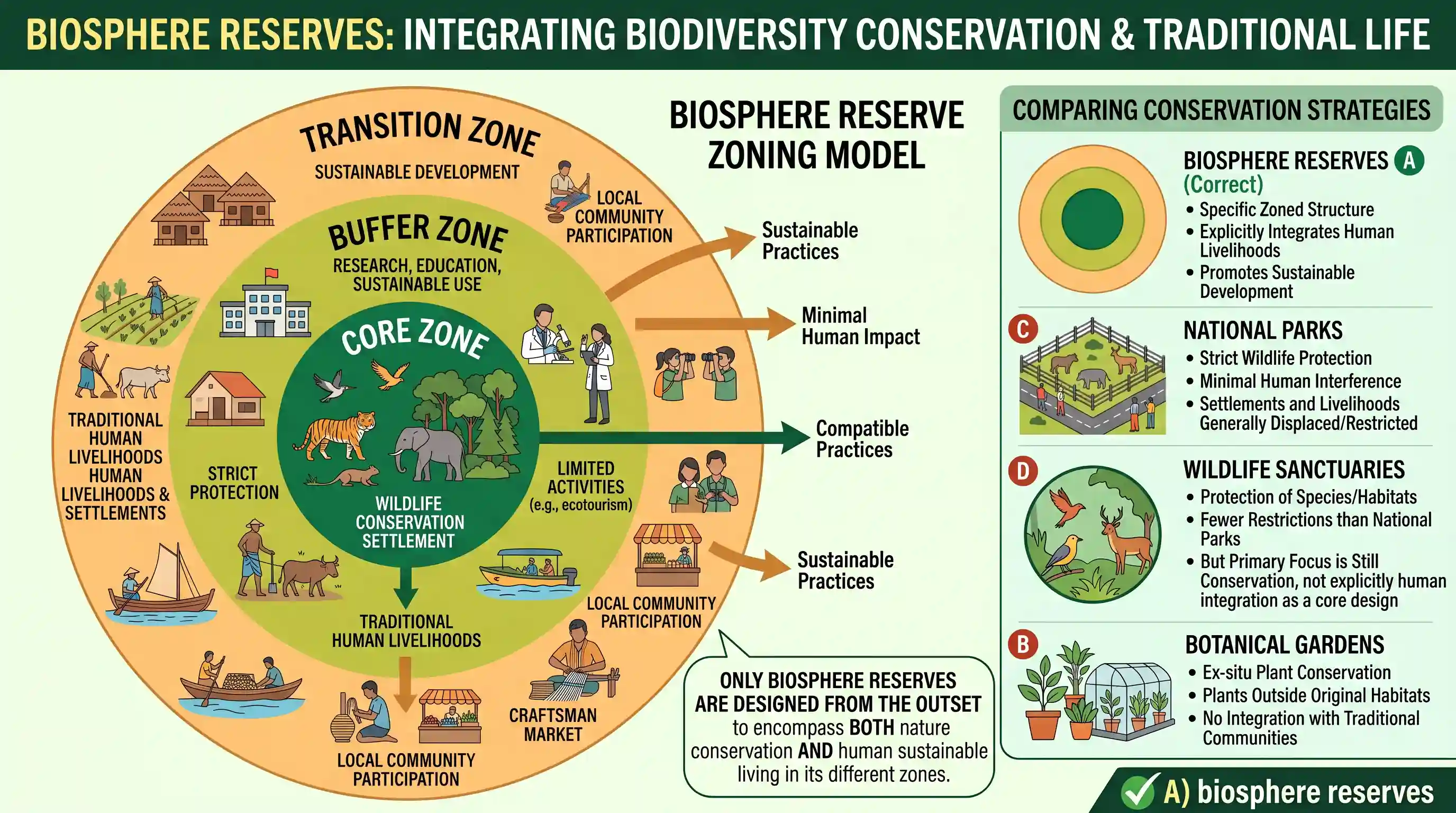
Among the given options, biosphere reserves are specifically established for the conservation of biodiversity along with the maintenance of traditional human life and the promotion of sustainable development. Biosphere reserves are designed with a unique zoning system:
Core Zone: Strictly protected area for conservation. Buffer Zone: Surrounds the core, used for research, education, tourism, and limited human activities compatible with conservation. Transition Zone: The outermost part, where a greater range of human activities and sustainable resource use is permitted, involving local communities in conservation efforts and promoting their socio-economic development. This multi-zoned approach explicitly integrates human populations, their cultural practices, and traditional livelihoods into the conservation framework, distinguishing them from national parks (which primarily focus on wildlife protection with very limited human intervention) and wildlife sanctuaries (also focused on species protection, with more flexible management but generally restricting human activities detrimental to wildlife). Botanical gardens are primarily ex-situ conservation sites for plants.
Related questions
More UPSC Prelims practice from the same subject and topic.
- Prelims 2014GS1geography
If a wetland of international importance is brought under the 'Montreux Record', what does it imply?
- Prelims 2014GS1geography
With reference to Bombay Natural History Society (BNHS), consider the following statements: 1. It is an autonomous organization under the Ministry of Environment and Forests. 2. It strives to conserve…
- Prelims 2014GS1geography
With reference to 'Global Environment Facility', which of the following statements is/are correct?
- Prelims 2014GS1geography
With reference to a conservation organization called 'Wetlands International', which of the following statements is/are correct? 1. It is an intergovernmental organization formed by the countries whic…
- Prelims 2014GS1geography
Which of the following phenomena might have influenced the evolution of organisms? 1. Continental drift 2. Glacial cycles Select the correct answer using the code given below.
- Prelims 2014GS1geography
Other than poaching, what are the possible reasons for the decline in the population of Ganges River Dolphins? 1. Construction of dams and barrages on rivers 2. Increase in the population of crocodile…