The scientific view is that the increase in global temperature should not exceed 2°C above pre-industrial level. If the global temperature increases beyond 3 °C above the pre-industrial level, what can be its possible impact/impacts on the world? 1. Terrestrial biosphere tends toward a net carbon source. 2. Widespread coral mortality will occur. 3. All the global wetlands will permanently disappear. 4. Cultivation of cereals will not be possible anywhere in the world. Select the correct answer using the code given below.

- A1 only
- B1 and 2 onlyCorrect
- C2, 3 and 4 only
- D1, 2, 3 and 4
Explanation
The scientific community, particularly as highlighted by the Intergovernmental Panel on Climate Change (IPCC), projects severe impacts if global temperatures significantly exceed the pre-industrial level. Let's analyze the statements:
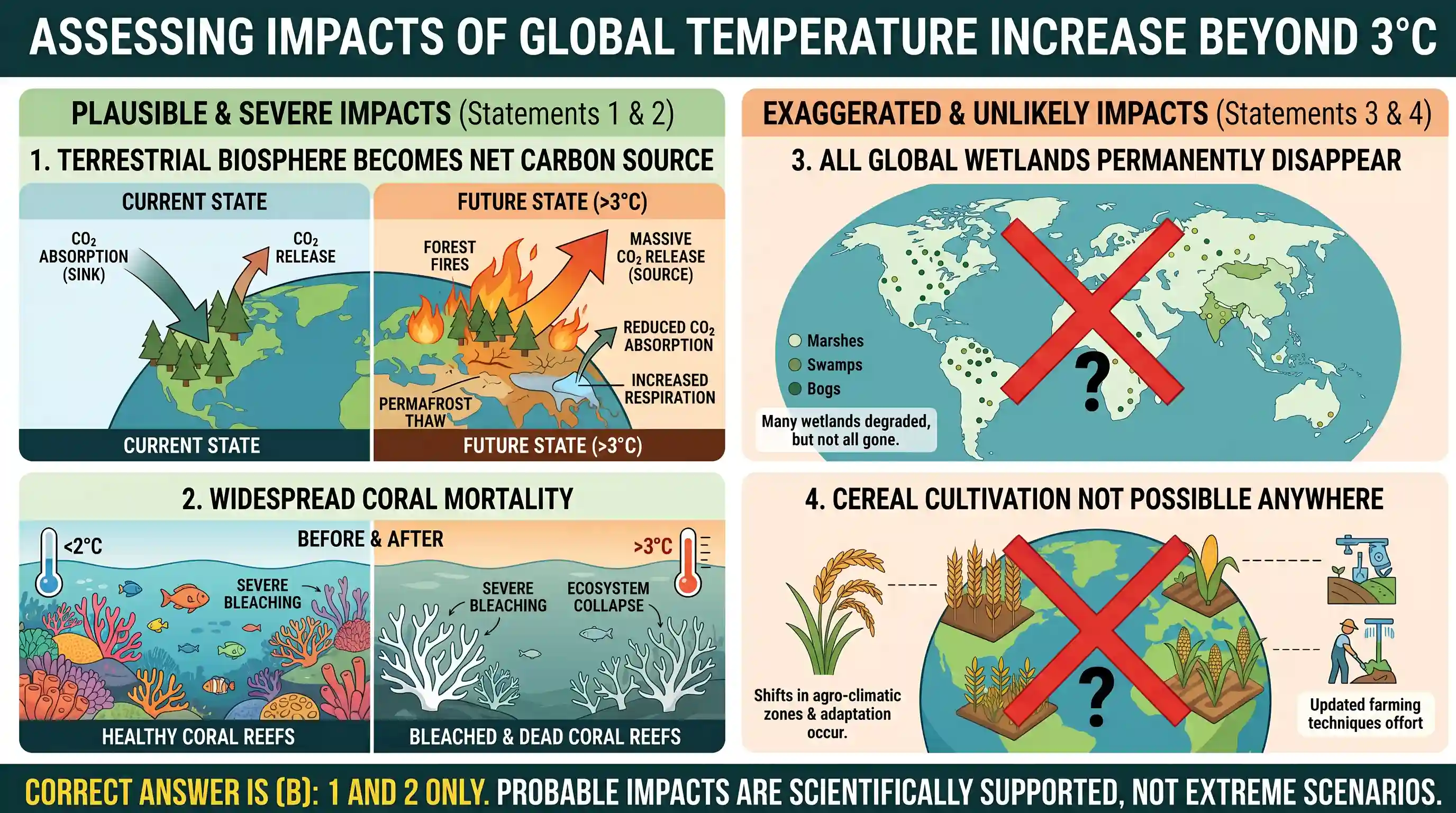
Terrestrial biosphere tends toward a net carbon source: This statement is largely correct. As global temperatures rise beyond certain thresholds (like 3°C), increased respiration by plants and microbes, more frequent and intense forest fires, and the thawing of permafrost (releasing stored carbon) can lead to terrestrial ecosystems releasing more carbon dioxide into the atmosphere than they absorb, thus becoming a net carbon source rather than a sink. Widespread coral mortality will occur: This statement is correct. Coral reefs are highly sensitive to ocean warming and acidification. A 3°C rise would lead to severe and widespread coral bleaching events, resulting in extensive and irreversible mortality of coral reefs globally. All the global wetlands will permanently disappear: This is an extreme and highly unlikely statement. While wetlands are vulnerable to climate change impacts like altered precipitation patterns, increased temperatures, and sea-level rise, predicting the permanent disappearance of ALL global wetlands is an overstatement of even severe climate change scenarios. Many might be degraded or altered, but not all would vanish permanently. Cultivation of cereals will not be possible anywhere in the world: This is an extreme and incorrect statement. While climate change will undoubtedly disrupt agricultural systems, shift agro-climatic zones, and reduce yields in many regions, it does not imply the complete impossibility of cereal cultivation anywhere in the world. Adaptations, new varieties, and shifts in cultivation areas would occur, making this scenario highly improbable. Therefore, statements 1 and 2 represent plausible and widely projected impacts of a significant global temperature increase.
Related questions
More UPSC Prelims practice from the same subject and topic.
- Prelims 2014GS1geography
If a wetland of international importance is brought under the 'Montreux Record', what does it imply?
- Prelims 2014GS1geography
With reference to Bombay Natural History Society (BNHS), consider the following statements: 1. It is an autonomous organization under the Ministry of Environment and Forests. 2. It strives to conserve…
- Prelims 2014GS1geography
With reference to 'Global Environment Facility', which of the following statements is/are correct?
- Prelims 2014GS1geography
With reference to a conservation organization called 'Wetlands International', which of the following statements is/are correct? 1. It is an intergovernmental organization formed by the countries whic…
- Prelims 2014GS1geography
Which of the following phenomena might have influenced the evolution of organisms? 1. Continental drift 2. Glacial cycles Select the correct answer using the code given below.
- Prelims 2014GS1geography
Other than poaching, what are the possible reasons for the decline in the population of Ganges River Dolphins? 1. Construction of dams and barrages on rivers 2. Increase in the population of crocodile…