The power of the Supreme Court of India to decide disputes between the Centre and the States falls under its

- Aadvisory jurisdiction
- Bappellate jurisdiction
- Coriginal jurisdictionCorrect
- Dwrit jurisdiction
Explanation
The Supreme Court of India possesses various types of jurisdictions. Let's analyze the one relevant to disputes between the Centre and the States:
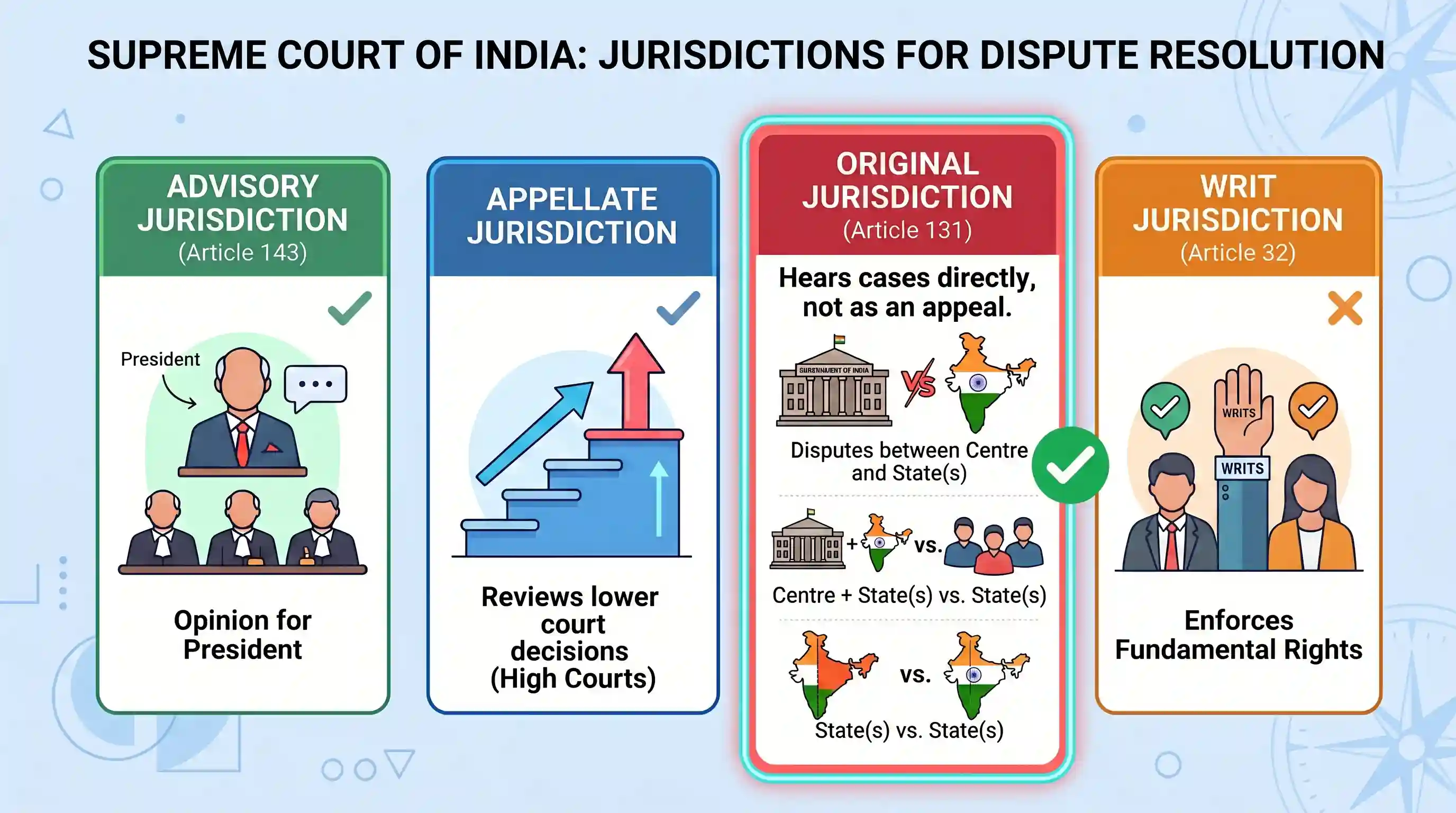
Original Jurisdiction: This refers to the power of a court to hear a case for the first time, not by way of appeal. Article 131 of the Indian Constitution grants the Supreme Court exclusive original jurisdiction in disputes:between the Government of India and one or more States; or between the Government of India and any State or States on one side and one or more other States on the other; or between two or more States. Therefore, disputes between the Centre (Government of India) and the States fall directly under the Supreme Court's original jurisdiction.
Advisory Jurisdiction: Under Article 143, the President can seek the opinion of the Supreme Court on a question of law or fact. This is an advisory role, not for resolving disputes between states or between the center and states. Appellate Jurisdiction: This involves the power of a higher court to review decisions made by lower courts. The Supreme Court hears appeals against judgments of High Courts and other tribunals. Writ Jurisdiction: Under Article 32, the Supreme Court has the power to issue various writs (Habeas Corpus, Mandamus, Prohibition, Certiorari, and Quo Warranto) for the enforcement of Fundamental Rights.
Related questions
More UPSC Prelims practice from the same subject and topic.
- Prelims 2014GS1polity-and-governance
With reference to a grouping of countries known as BRICS, consider the following statements: 1. The First Summit of BRICS was held in Rio de Janeiro in 2009. 2. South Africa was the last to join the B…
- Prelims 2014GS1polity-and-governance
Which one of the following is the largest Committee of the Parliament?
- Prelims 2014GS1polity-and-governance
Recently, a series of uprisings of people referred to as 'Arab Spring' originally started from
- Prelims 2014GS1polity-and-governance
Which one of the following Schedules of the Constitution of India contains provisions regarding anti-defection?
- Prelims 2014GS1polity-and-governance
In the Constitution of India, promotion of international peace and security is included in the
- Prelims 2014GS1polity-and-governance
Which of the following is/are the function/functions of the Cabinet Secretariat? 1. Preparation of agenda for Cabinet Meetings 2. Secretarial assistance to Cabinet Committees 3. Allocation of financia…