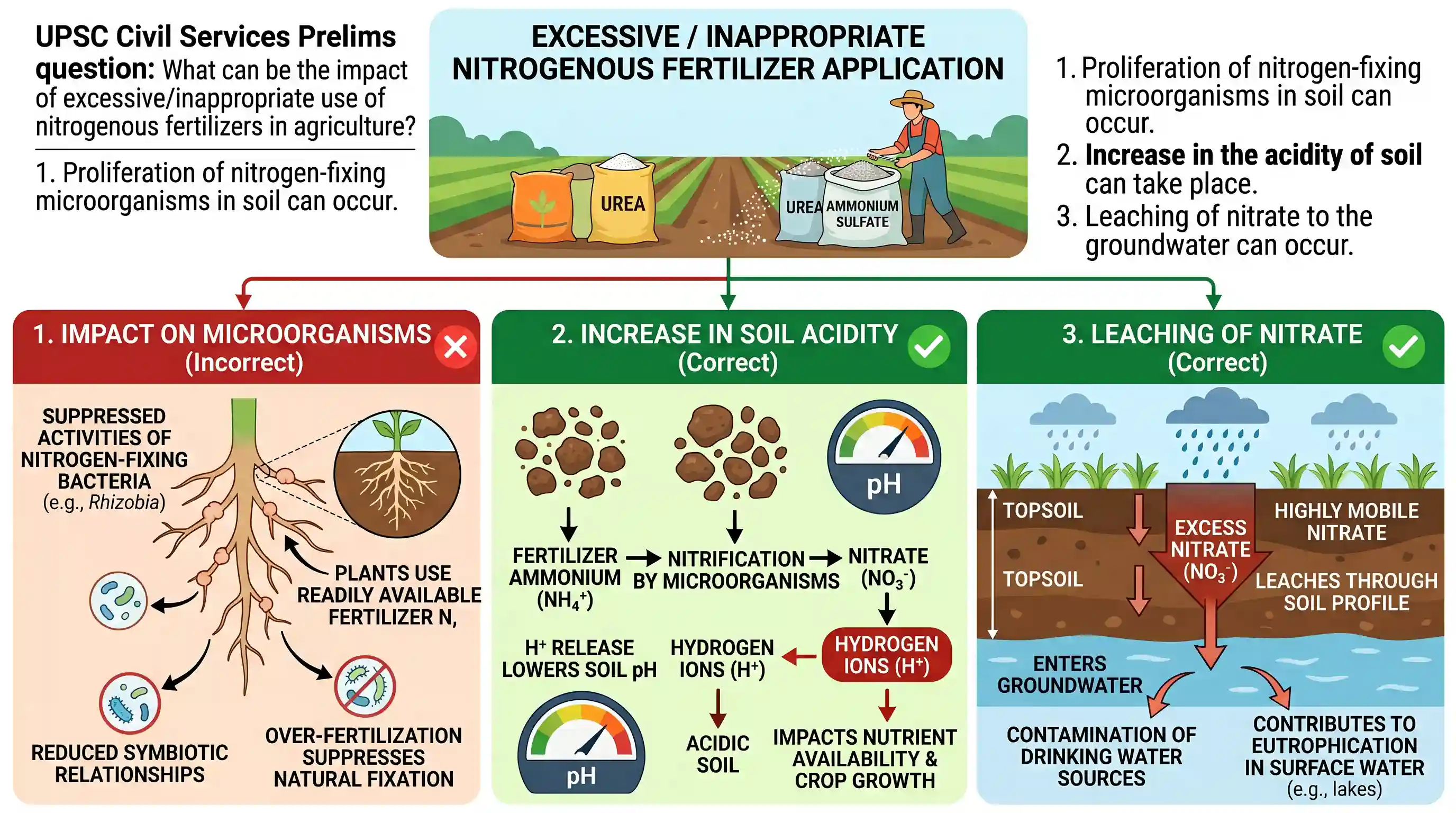
What can be the impact of excessive/inappropriate use of nitrogenous fertilizers in agriculture? 1. Proliferation of nitrogen-fixing microorganisms in soil can occur. 2. Increase in the acidity of soil can take place. 3. Leaching of nitrate to the groundwater can occur. Select the correct answer using the code given below.

- A1 and 3 only
- B2 only
- C2 and 3 onlyCorrect
- D1, 2 and 3
Explanation
-
Proliferation of nitrogen-fixing microorganisms in soil can occur: This is incorrect. Excessive application of nitrogenous fertilizers can actually suppress the activity of natural nitrogen-fixing microorganisms (like rhizobia in legumes) because the plants have an ample supply of readily available nitrogen, reducing their need to form symbiotic relationships for nitrogen fixation. Over-fertilization can reduce microbial diversity and activity.
-
Increase in the acidity of soil can take place: This is correct. Many nitrogenous fertilizers, particularly ammonium-based ones (e.g., urea, ammonium sulfate), undergo nitrification in the soil, a process where ammonium (NH4+) is converted to nitrate (NO3-). This process releases hydrogen ions (H+), which increases soil acidity. Prolonged use can lead to soil acidification, impacting nutrient availability and crop growth.
-
Leaching of nitrate to the groundwater can occur: This is correct. Nitrate (NO3-), a highly mobile form of nitrogen, is not readily bound by soil particles. When applied in excess or during heavy rainfall, nitrate can easily leach through the soil profile and enter groundwater, leading to contamination of drinking water sources and contributing to eutrophication in surface water bodies.
Related questions
More UPSC Prelims practice from the same subject and topic.
- Prelims 2015GS1geography
Which of the following National Parks is unique in being a swamp with floating vegetation that supports a rich biodiversity?
- Prelims 2015GS1geography
With reference to the International Union for Conservation of Nature and Natural Resources (IUCN) and the Convention on International Trade in Endangered Species of Wild Fauna and Flora (CITES), which…
- Prelims 2015GS1geography
Among the following, which were frequently mentioned in the news for the outbreak of Ebola virus recently?
- Prelims 2015GS1geography
With reference to 'fly ash' produced by the power plants using coal as fuel, which of the following statements is/are correct? 1. Fly ash can be used in the production of bricks for building construct…
- Prelims 2015GS1geography
With reference to 'dugong', a mammal found in India, which of the following statements is/are correct? 1. It is a herbivorous marine animal. 2. It is found along the entire coast of India. 3. It is gi…
- Prelims 2015GS1geography
Which one of the following regions of India has a combination of mangrove forest, evergreen forest and deciduous forest?