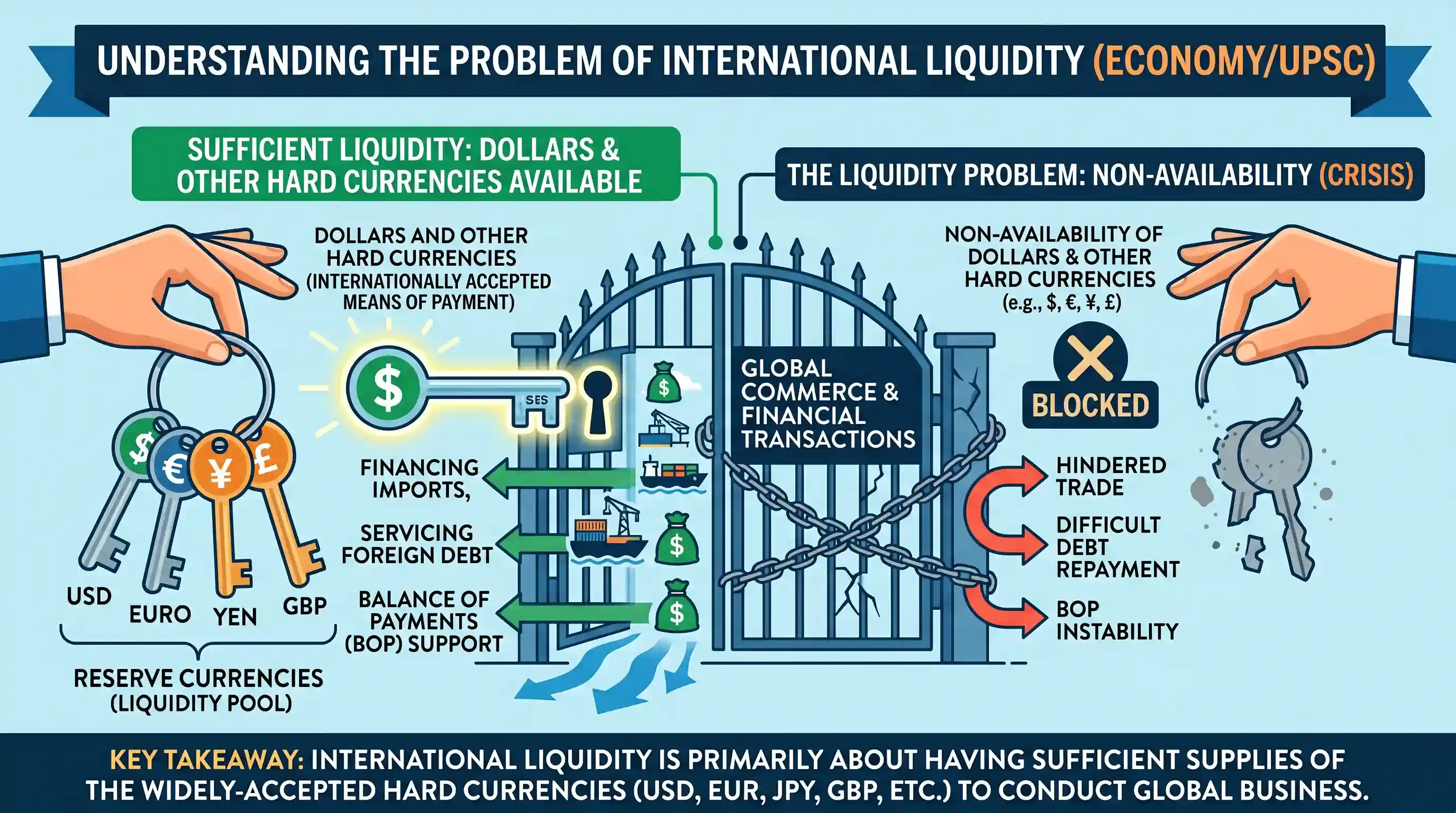
The problem of international liquidity is related to the non-availability of

- Agoods and services
- Bgold and silver
- Cdollars and other hard currenciesCorrect
- Dexportable surplus
Explanation
The problem of international liquidity refers to the non-availability or insufficient supply of internationally accepted means of payment required to finance international trade and financial transactions. In the modern global economy, this primarily involves widely accepted and convertible currencies, often referred to as 'hard currencies'. The US Dollar is the most prominent international reserve currency, but other major currencies like the Euro, Japanese Yen, and Pound Sterling also play significant roles.
When there's a shortage of these 'dollars and other hard currencies' that are widely accepted for cross-border payments, it creates a problem of international liquidity, hindering global trade and investment flows.
Related questions
More UPSC Prelims practice from the same subject and topic.
- Prelims 2015GS1economy
The terms 'Agreement on Agriculture', 'Agreement on the Application of Sanitary and Phytosanitary Measures' and 'Peace Clause' appear in the news frequently in the context of the affairs of the
- Prelims 2015GS1economy
'Pradhan Mantri Jan-Dhan Yojana' has been launched for
- Prelims 2015GS1economy
A decrease in tax to GDP ratio of a country indicates which of the following? 1. Slowing economic growth rate 2. Less equitable distribution of national income Select the correct answer using the code…
- Prelims 2015GS1economy
In the 'Index of Eight Core Industries', which one of the following is given the highest weight?
- Prelims 2015GS1economy
The Fair and Remunerative Price (FRP) of sugarcane is approved by the
- Prelims 2015GS1economy
Who of the following was/were economic critic/critics of colonialism in India? 1. Dadabhai Naoroji 2. G. Subramania Iyer 3. R. C. Dutt Select the correct answer using the code given below.