In the context of which of the following do you sometimes find the terms 'amber box, blue box and green box' in the news?

- AWTO affairsCorrect
- BSAARC affairs
- CUNFCCC affairs
- DIndia-EU negotiations on FTA
Explanation
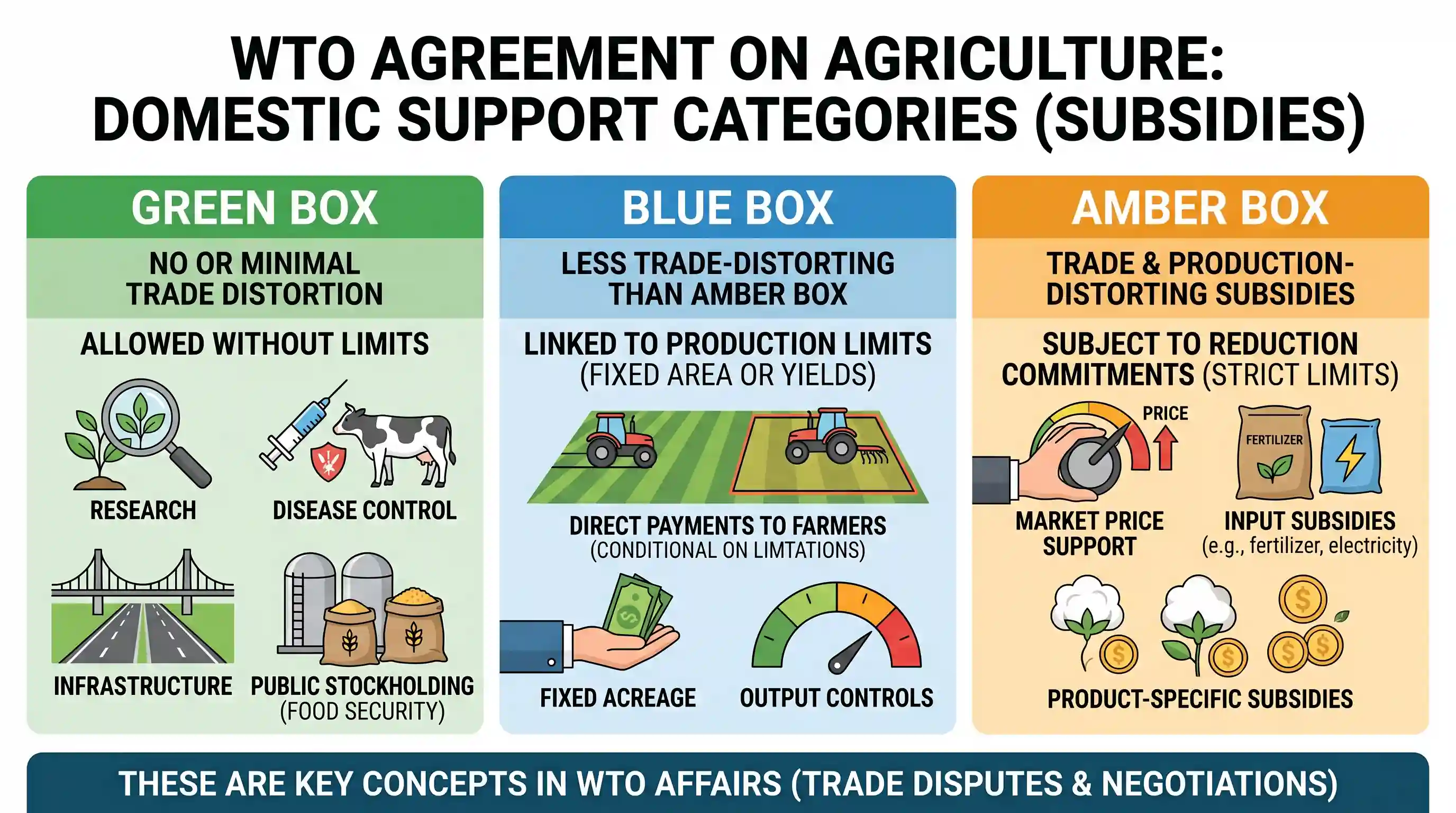
The terms 'amber box,' 'blue box,' and 'green box' are central to the World Trade Organization (WTO) agreements, particularly the Agreement on Agriculture. They refer to different categories of domestic support (subsidies) that countries provide to their agricultural sectors:
Amber Box: Refers to domestic support measures that are considered to distort trade and production. These are subject to reduction commitments. Blue Box: Covers subsidies that are linked to production-limiting programmes, but which are applied to fixed areas or yields. These are less distorting than amber box measures and are therefore subject to less stringent reduction commitments. Green Box: Includes domestic support measures that are considered to be non-trade-distorting or minimally trade-distorting. These are allowed without limits as they include support for services such as research, disease control, infrastructure, and food security programmes. These terms are crucial in discussions and negotiations related to agricultural trade policies within the WTO framework.
Related questions
More UPSC Prelims practice from the same subject and topic.
- Prelims 2016GS1economy
With reference to the International Monetary and Financial Committee (IMFC), consider the following statements: 1. IMFC discusses matters of concern affecting the global economy, and advises the Inter…
- Prelims 2016GS1economy
Which of the following best describes the term 'import cover', sometimes seen in the news?
- Prelims 2016GS1economy
'Global Financial Stability Report' is prepared by the
- Prelims 2016GS1economy
Which of the following is/are the indicator/indicators used by IFPRI to compute the Global Hunger Index Report? 1. Undernourishment 2. Child stunting 3. Child mortality Select the correct answer using…
- Prelims 2016GS1economy
There has been a persistent deficit budget year after year. Which action/actions of the following can-be-taken by the Government to reduce the deficit? 1. Reducing revenue expenditure 2. Introducing n…
- Prelims 2016GS1economy
The establishment of 'Payment Banks' is being allowed in India to promote financial inclusion. Which of the following statements is/are correct in this context? 1. Mobile telephone companies and super…