India is an important member of the 'International Thermonuclear Experimental Reactor'. If this experiment succeeds, what is the immediate advantage for India?

- AIt can use thorium in place of uranium for power generation
- BIt can attain a global role in satellite navigation
- CIt can drastically improve the efficiency of its fission reactors in power generation
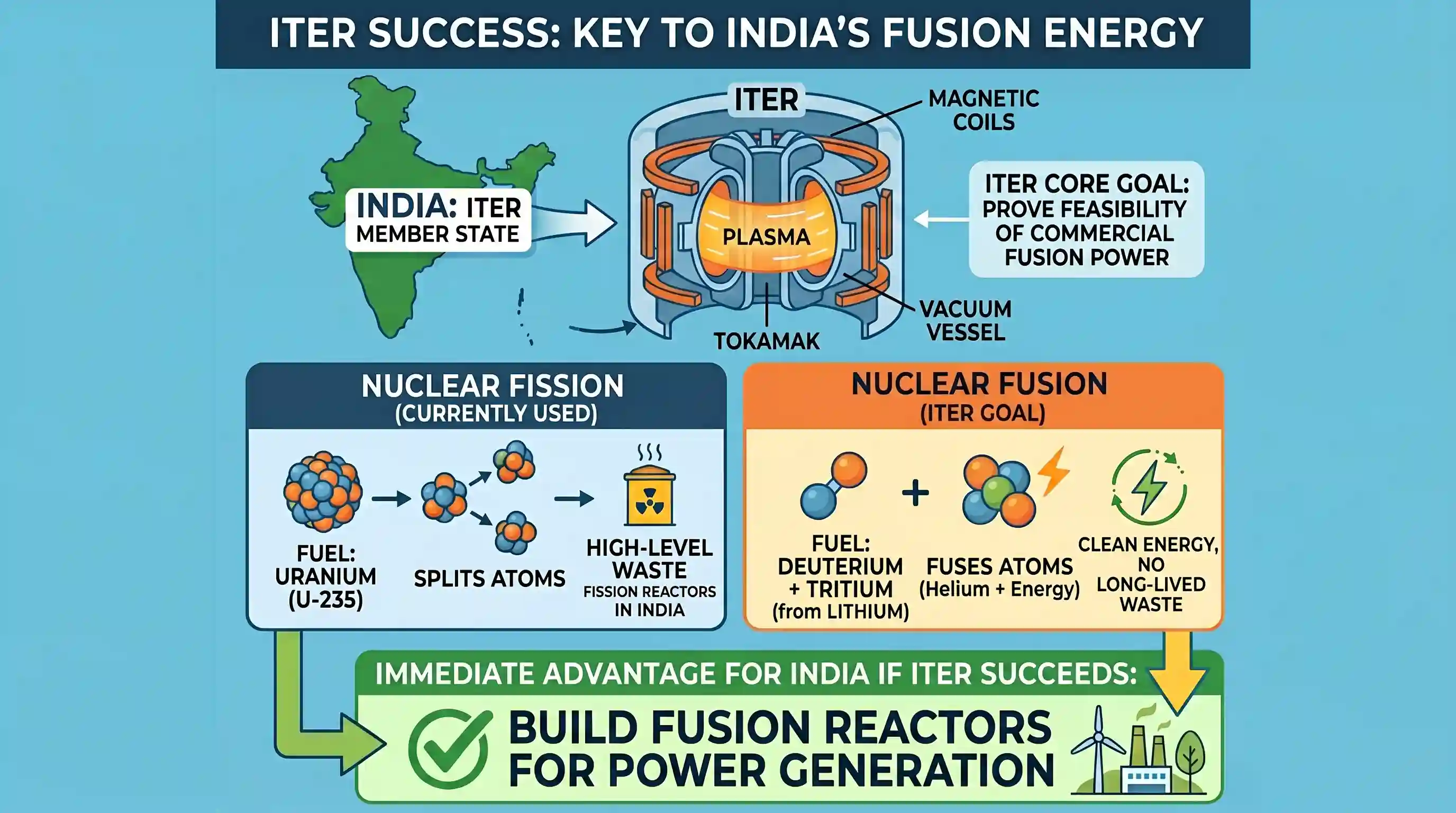
- DIt can build fusion reactors for power generationCorrect
Explanation
The International Thermonuclear Experimental Reactor (ITER) is a large-scale scientific experiment designed to prove the feasibility of fusion as a large-scale, carbon-free source of energy. Fusion is the process that powers the sun and stars. If the ITER experiment succeeds in demonstrating sustainable fusion reactions, the immediate and most significant advantage for India, as a member, would be the ability to develop and build its own commercial fusion reactors for power generation. This would offer a new, potentially cleaner and abundant energy source, addressing India's growing energy demands.
Options A, B, and C are not the direct or immediate advantages: thorium use (A) is related to fission technology; satellite navigation (B) is unrelated to nuclear energy; and improving fission reactor efficiency (C) is also not the primary goal of a fusion project.
Related questions
More UPSC Prelims practice from the same subject and topic.
- Prelims 2016GS1science-and-technology
With reference to 'LiFi', recently in the news, which of the following statements is/are correct? 1. It uses light as the medium for high-speed data transmission. 2. It is a wireless technology and is…
- Prelims 2016GS1science-and-technology
In the context of the developments in Bioinformatics, the term 'transcriptome', sometimes seen in the news, refers to
- Prelims 2016GS1science-and-technology
'Project Loon', sometimes seen in the news, is related to
- Prelims 2016GS1science-and-technology
Which one of the following is the best description of 'INS Astradharini', that was in the news recently?
- Prelims 2016GS1science-and-technology
What is 'Greased Lightning-10 (GL-10)', recently in the news?
- Prelims 2016GS1science-and-technology
Which of the following statements is/are correct? Viruses can infect 1. bacteria 2. fungi 3. plants Select the correct answer using the code given below.