A bag contains 15 red balls and 20 black balls. Each ball is numbered either 1 or 2 or 3. 20% of the red balls are numbered 1 and 40% of them are numbered 3. Similarly, among the black balls, 45% are numbered 2 and 30% are numbered 3. A boy picks a ball at random. He wins if the ball is red and numbered 3 or if it is black and numbered 1 or 2. What are the chances of his winning?

- A(1)/(2)
- B(4)/(7)Correct
- C(5)/(9)
- D(12)/(13)
Explanation
To solve this, we first determine the number of balls for each category and then calculate the winning chances.
-
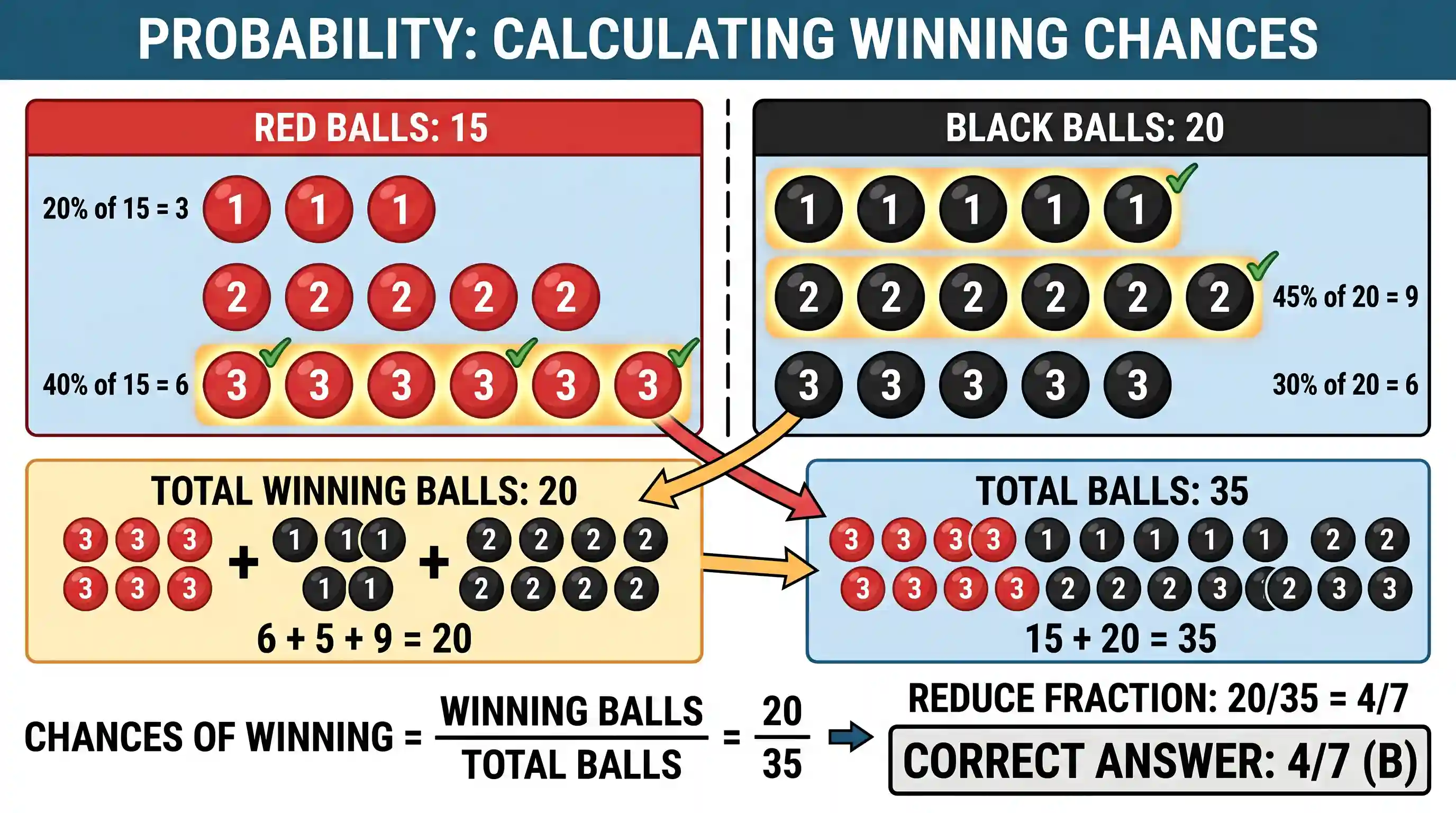
Total Red Balls = 15 Red balls numbered 1: 20% of 15 = 0.20 * 15 = 3 balls Red balls numbered 3: 40% of 15 = 0.40 * 15 = 6 balls Red balls numbered 2: 15 - (3 + 6) = 15 - 9 = 6 balls
-
Total Black Balls = 20 Black balls numbered 2: 45% of 20 = 0.45 * 20 = 9 balls Black balls numbered 3: 30% of 20 = 0.30 * 20 = 6 balls Black balls numbered 1: 20 - (9 + 6) = 20 - 15 = 5 balls
-
Winning Conditions: a) Ball is red and numbered 3: There are 6 such balls. b) Ball is black and numbered 1: There are 5 such balls. c) Ball is black and numbered 2: There are 9 such balls.
-
Total number of winning balls = 6 (red & 3) + 5 (black & 1) + 9 (black & 2) = 20 balls.
-
Total number of balls = 15 (red) + 20 (black) = 35 balls.
-
Chances of winning = (Total winning balls) / (Total balls) = 20 / 35.
-
Simplify the fraction: 20/35 = (5 * 4) / (5 * 7) = 4/7.
Therefore, the chances of his winning are 4/7.
The final answer is B.
Related questions
More UPSC Prelims practice from the same subject and topic.
- Prelims 2018CSATQuantitative Aptitude
19 boys turn out for playing hockey. Of these, 11 are wearing hockey shirts and 14 are wearing hockey pants. There are no boys without shirts and/or pants. What is the number of boys wearing full unif…
- Prelims 2018CSATQuantitative Aptitude
There are 24 equally spaced points lying on the circumference of a circle. What is the maximum number of equilateral triangles that can be drawn by taking sets of three points as the vertices?
- Prelims 2018CSATQuantitative Aptitude
Consider the following sum: • +1• +2• +• 3 + • 1 = 21• In the above sum, • stands for
- Prelims 2018CSATQuantitative Aptitude
How many diagonals can be drawn by joining the vertices of an octagon?
- Prelims 2018CSATQuantitative Aptitude
A train 200 metres long is moving at the rate of 40 kmph. In how many seconds will it cross a man standing near the railway line?
- Prelims 2018CSATQuantitative Aptitude
If X is between -3 and -1, and Y is between -1 and 1, then X ² - Y² is in between which of the following?