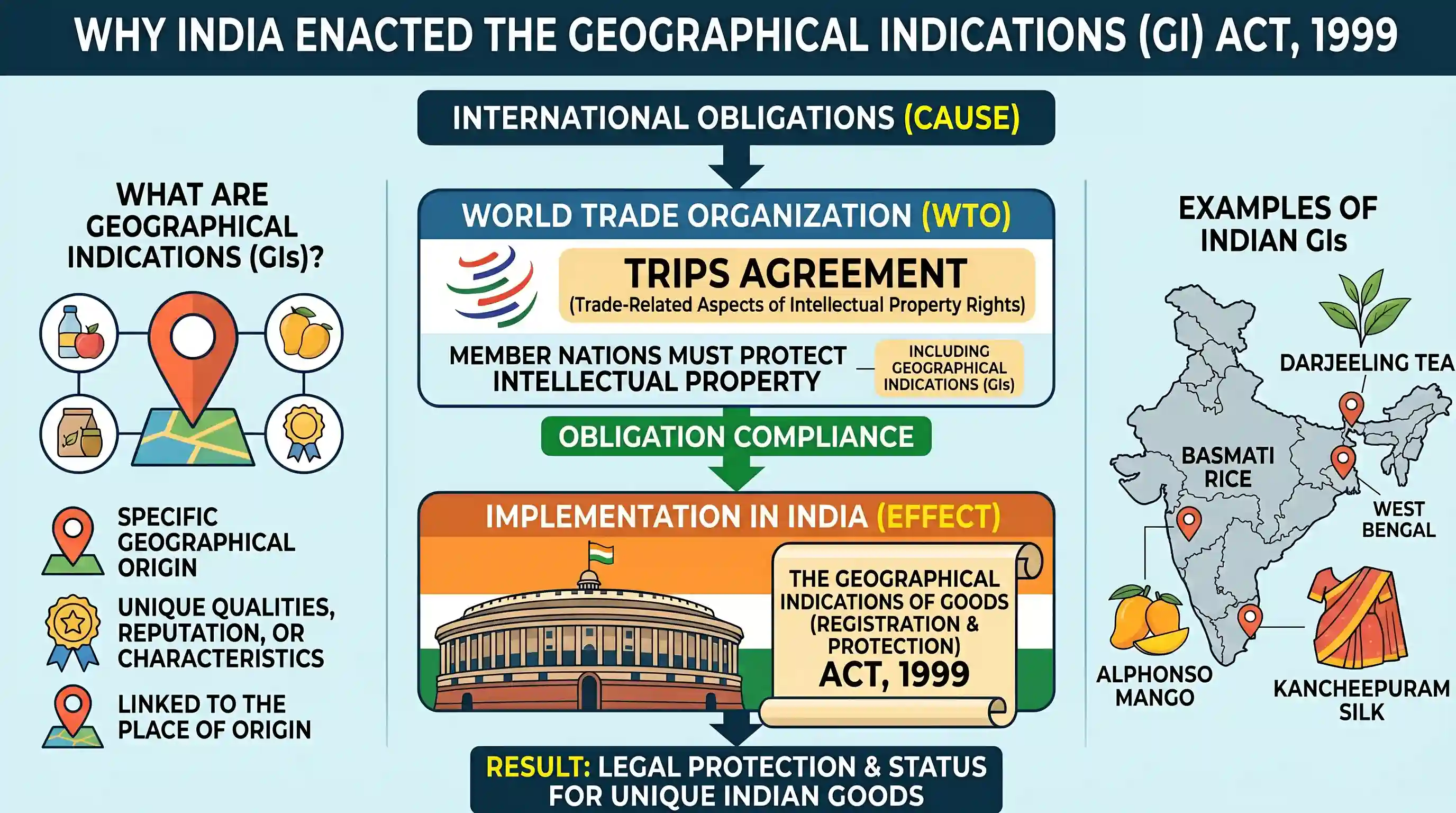
India enacted The Geographical Indications of Goods (Registration and Protection) Act, 1999 in order to comply with the obligations to

- AILO
- BIMF
- CUNCTAD
- DWTOCorrect
Explanation
India's Geographical Indications of Goods (Registration and Protection) Act, 1999, was enacted to align with its international obligations. Specifically, this legislation was a direct response to the requirements set forth by the Agreement on Trade-Related Aspects of Intellectual Property Rights (TRIPS Agreement). The TRIPS Agreement is one of the core agreements administered by the World Trade Organization (WTO). It mandates that WTO member countries provide protection for various forms of intellectual property, including Geographical Indications (GIs). Therefore, to be compliant with its commitments under the WTO, India passed this Act to allow for the registration and legal protection of goods that possess unique qualities or a reputation due to their geographical origin.
Related questions
More UPSC Prelims practice from the same subject and topic.
- Prelims 2018GS1polity-and-governance
"Rule of Law Index" is released by which of the following?
- Prelims 2018GS1polity-and-governance
Very recently, in which of the following countries have lakhs of people either suffered from severe famine/acute malnutrition or died due to starvation caused by war/ethnic conflicts?
- Prelims 2018GS1polity-and-governance
The term "two-state solution" is sometimes mentioned in the news in the context of the affairs of
- Prelims 2018GS1polity-and-governance
International Labour Organization's Conventions 138 and 182 are related to
- Prelims 2018GS1polity-and-governance
Consider the following countries: 1. Australia 2. Canada 3. China 4. India 5. Japan 6. USA Which of the above are among the 'free-trade partners' of ASEAN?
- Prelims 2018GS1polity-and-governance
Consider the following statements: 1. In the first Lok Sabha, the single largest party in the opposition was the Swatantra Party. 2. In the Lok Sabha, a "Leader of the Opposition" was recognised for t…