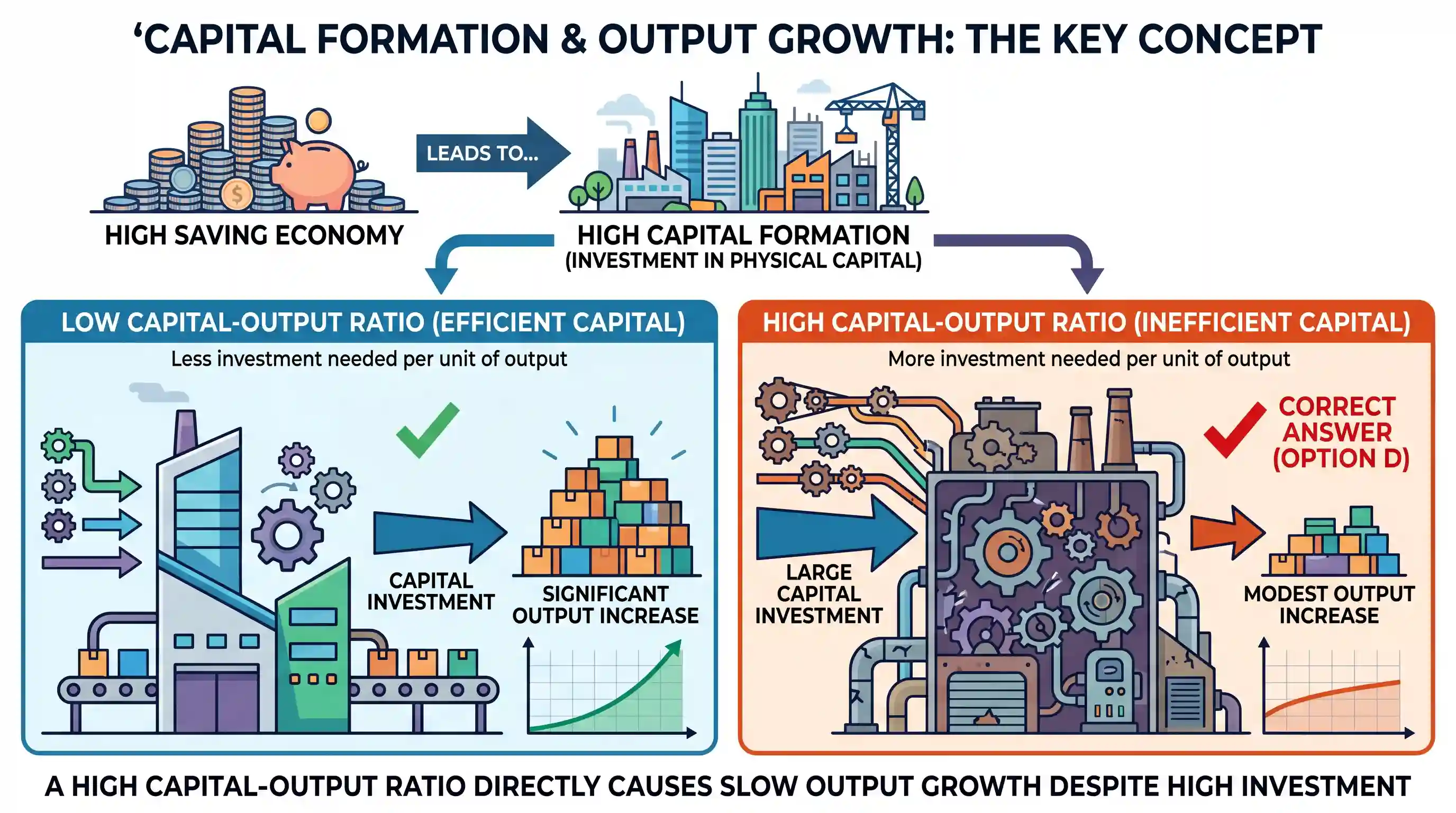
Despite being a high saving economy, capital formation may not result in significant increase in output due to

- Aweak administrative machinery
- Billiteracy
- Chigh population density
- Dhigh capital-output ratioCorrect
Explanation
A high saving economy implies that a significant portion of national income is being saved and potentially invested, leading to capital formation. However, if this capital formation does not result in a significant increase in output, it suggests an inefficiency in the utilization of capital. This inefficiency is directly captured by a high capital-output ratio. A high capital-output ratio means that a large amount of capital investment is required to produce a relatively small increase in output. In other words, the productivity of capital is low. If this ratio is high, even with substantial capital formation (due to high savings), the resulting increase in output will be modest.
While weak administrative machinery, illiteracy, and high population density are indeed developmental challenges that can hinder overall productivity, the most direct economic reason for capital formation failing to generate proportional output increase is the inefficiency of capital, as reflected in a high capital-output ratio.
Related questions
More UPSC Prelims practice from the same subject and topic.
- Prelims 2018GS1economy
If a commodity is provided free to the public by the Government, then
- Prelims 2018GS1economy
Increase in absolute and per capita real GNP do not connote a higher level of economic development, if
- Prelims 2018GS1economy
Human capital formation as a concept is better explained in terms of a process which enables 1. individuals of a country to accumulate more capital. 2. increasing the knowledge, skill levels and capac…
- Prelims 2018GS1economy
Consider the following items : 1. Cereal grains hulled 2. Chicken eggs cooked 3. Fish processed and canned 4. Newspapers containing advertising material Which of the above items is/are exempted under …
- Prelims 2018GS1economy
As per the NSSO 70th Round "Situation Assessment Survey of Agricultural Households", consider the following statements: 1. Rajasthan has the highest percentage share of agricultural households among i…
- Prelims 2018GS1economy
Which one of the following best describes the term "Merchant Discount Rate" sometimes seen in news?