How many five-digit prime numbers can be obtained by using all the digits 1, 2, 3, 4 and 5 without repetition of digits?

- A0Correct
- B1
- C9
- D10
Explanation
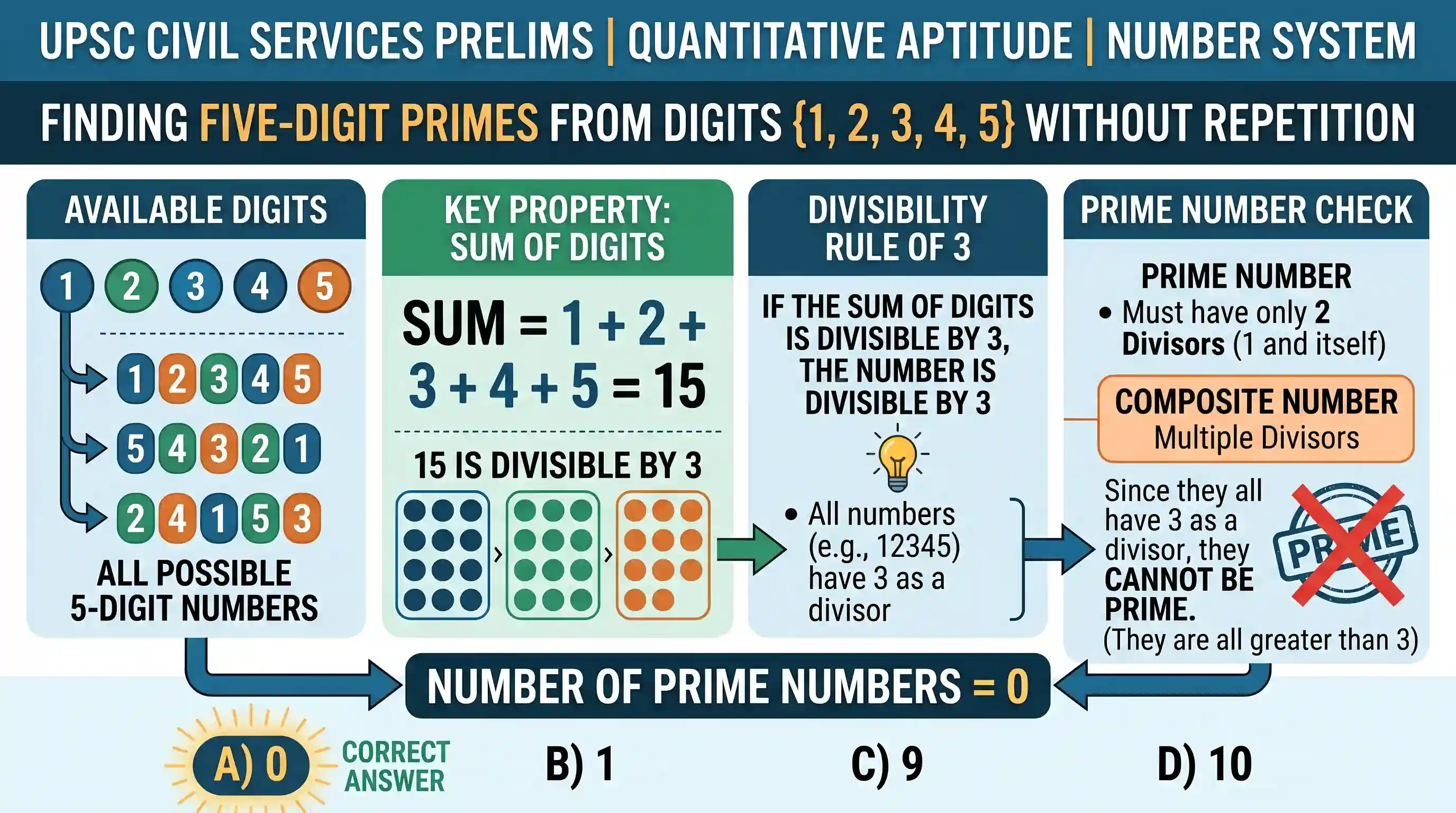
The sum of the digits 1, 2, 3, 4, and 5 is 1 + 2 + 3 + 4 + 5 = 15.
A fundamental divisibility rule states that a number is divisible by 3 if the sum of its digits is divisible by 3. Since the sum of the digits (15) is divisible by 3, any five-digit number formed by using these digits without repetition will also be divisible by 3.
For a number to be prime, it must be a natural number greater than 1 that has no positive divisors other than 1 and itself. Any number formed using these digits (e.g., 12345, 54321, etc.) will be a five-digit number, which is clearly greater than 3. Since all such numbers are divisible by 3 and are greater than 3, they have 3 as a divisor in addition to 1 and themselves. Therefore, none of these numbers can be prime.
Thus, the number of five-digit prime numbers that can be obtained using these digits is 0.
Analyzing the options: A) 0: This is correct because no such prime number can be formed. B) 1: Incorrect, as explained above. C) 9: Incorrect. D) 10: Incorrect.
The final answer is A.
Related questions
More UPSC Prelims practice from the same subject and topic.
- Prelims 2020CSATQuantitative Aptitude
How many zeroes are there at the end of the following product? 1 × 5 × 10 × 15 × 20 × 25 × 30 × 35 × 40 × 45 × 50 × 55 × 60
- Prelims 2020CSATQuantitative Aptitude
Let XYZ be a three-digit number, where (x + y + z) is not a multiple of 3. Then (XYZ + YZX + ZXY) is not divisible by
- Prelims 2020CSATQuantitative Aptitude
In the sum A + 1A + 5A + AA + A1 = 1AA for which digit does the symbol A stand?
- Prelims 2020CSATQuantitative Aptitude
One page is torn from a booklet whose pages are numbered in the usual manner starting from the first page as 1. The sum of the numbers on the remaining pages is 195. The torn page contains which of th…
- Prelims 2020CSATQuantitative Aptitude
Let A3BC and DE2F be four-digit numbers where each letter represents a different digit greater than 3. If the sum of the numbers is 15902, then what is the difference between the values of A and D?
- Prelims 2020CSATQuantitative Aptitude
Two Statements Si and S2 are given below followed by a Question: S1: n is a prime number. S2: n leaves a remainder of 1 when divided by 4. If n is a unique natural number between 10 and 20, then what …