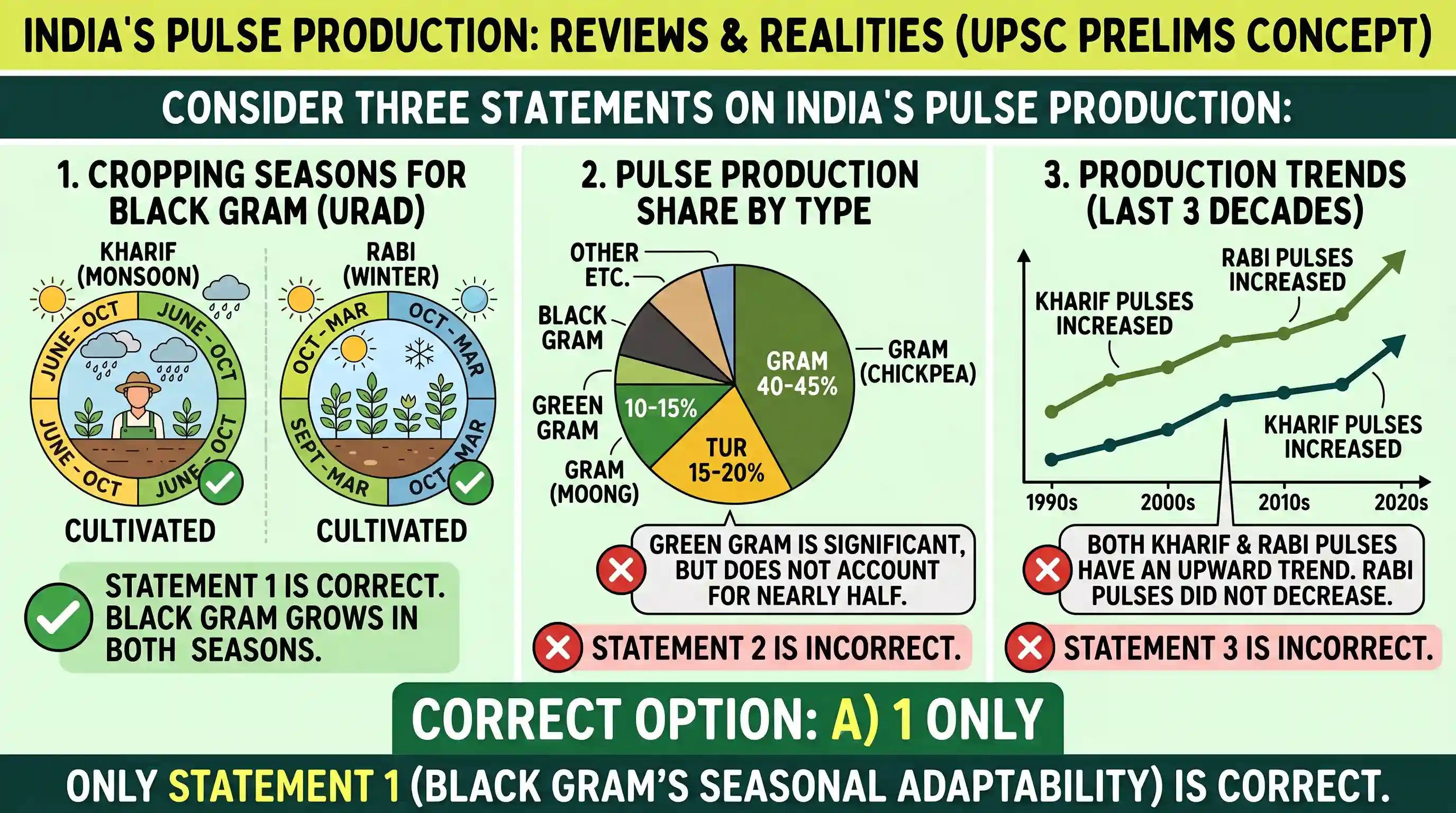
With reference to pulse production in India, consider the following statements: 1. Black gram can be cultivated as both kharif and rabi crop. 2. Green-gram alone accounts for nearly half of pulse production. 3. In the last three decades, while the production of kharif pulses has increased, the production of rabi pulses has decreased. Which of the statements given above is/are correct?

- A1 onlyCorrect
- B2 and 3 only
- C2 only
- D1, 2 and 3
Explanation
Let's analyze each statement regarding pulse production in India:
-
Black gram can be cultivated as both kharif and rabi crop: This statement is correct. Black gram (Urad dal) is known for its adaptability and can indeed be grown in both the kharif (monsoon season, typically June-October) and rabi (winter season, typically October-March) seasons, depending on the specific agro-climatic conditions and varieties. It is often grown as an intercrop or catch crop due to its short duration.
-
Green-gram alone accounts for nearly half of pulse production: This statement is incorrect. While green gram (Moong dal) is an important pulse crop in India, it does not account for nearly half of the total pulse production. Gram (chickpea) is typically the largest pulse produced in India, followed by Tur (pigeon pea) and then other pulses like green gram and black gram. Green gram's share is significant but far from half of the total production.
-
In the last three decades, while the production of kharif pulses has increased, the production of rabi pulses has decreased: This statement is incorrect. India has made significant efforts to increase overall pulse production to achieve self-sufficiency. Over the last three decades, there have been fluctuations, but the general trend has seen an increase in the production of both kharif and rabi pulses, driven by factors like increased area under cultivation, improved varieties, and government support. While kharif pulse production has seen a boost, rabi pulse production has also generally shown an increasing trend, not a decrease.
Therefore, only statement 1 is correct.
Related questions
More UPSC Prelims practice from the same subject and topic.
- Prelims 2020GS1geography
Which of the following Protected Areas are located in Cauvery basin ? 1. Nagarhole National Park 2. Papikonda National Park 3. Sathyamangalam Tiger Reserve 4. Wayanad Wildlife Sanctuary Select the cor…
- Prelims 2020GS1geography
"The crop is subtropical in nature. A hard frost is injurious to it. It requires at least 210 frost-free days and 50 to 100 centimeters of rainfall for its growth. A light well-drained soil capable of…
- Prelims 2020GS1geography
With reference to the current trends in the cultivation of sugarcane in India, consider the following statements: 1. A substantial saving in seed material is made when 'bud chip settlings' are raised …
- Prelims 2020GS1geography
Siachen Glacier is situated to the
- Prelims 2020GS1geography
Which of the following are the reasons/factors for exposure to benzene pollution? 1. Automobile exhaust 2. Tobacco smoke 3. Wood burning 4. Using varnished wooden furniture 5. Using products made of p…
- Prelims 2020GS1geography
Consider the following pairs: River Flows into 1. Mekong : Andaman Sea 2. Thames : Irish Sea 3. Volga : Caspian Sea 4. Zambezi : Indian Ocean Which of the pairs given above is/are correctly matched?