With reference to Urban Cooperative Banks' in India, consider the following statements : 1. They are supervised and regulated by local boards set up by the State Governments. 2. They can issue equity shares and preference shares. 3. They were brought under the purview of the Banking Regulation Act, 1949 through an Amendment in 1966. Which of the statements given above is/are correct?

- A1 only
- B2 and 3 onlyCorrect
- C1 and 3 only
- D1, 2 and 3
Explanation
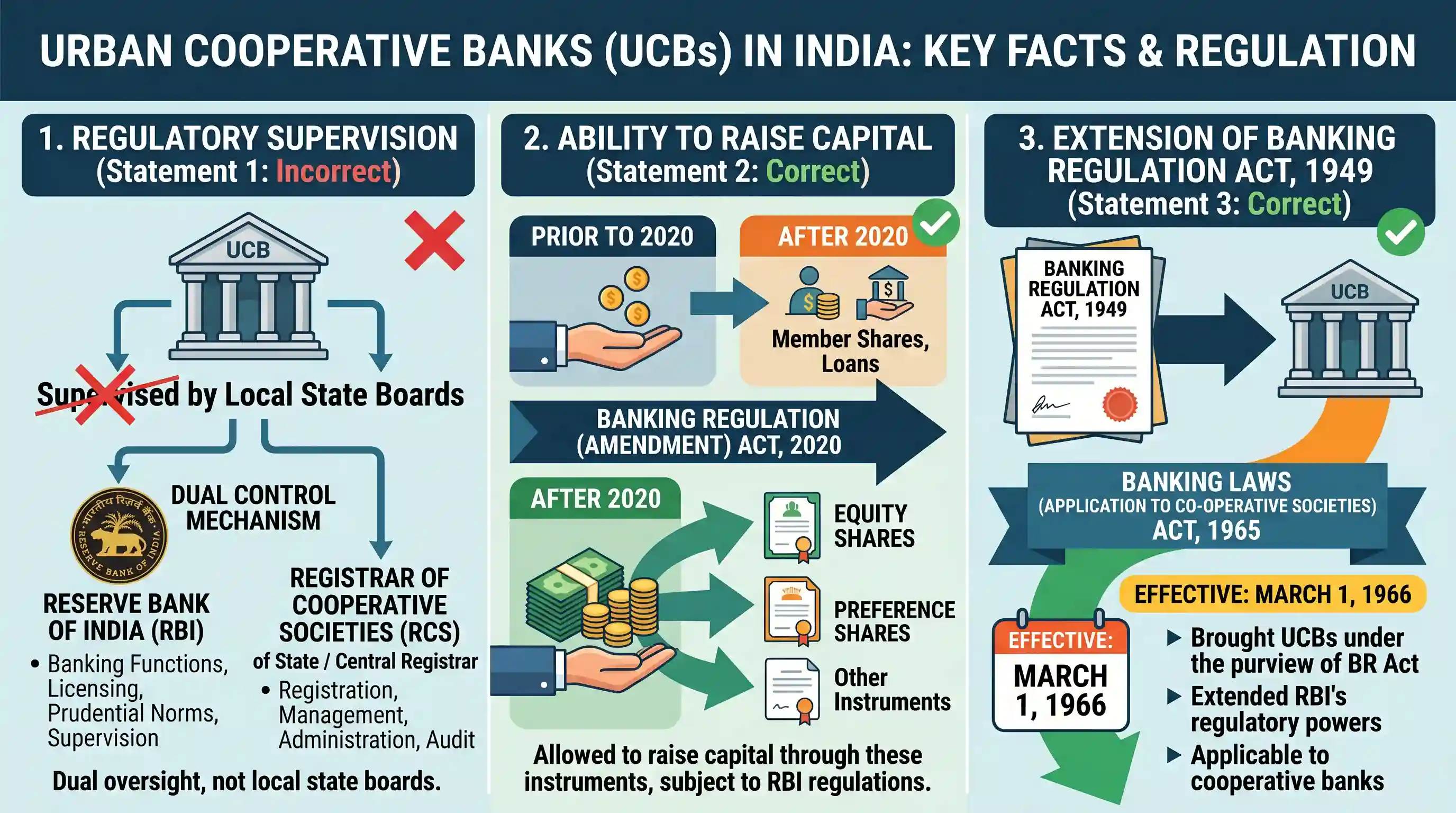
Statement 1: Urban Cooperative Banks (UCBs) are regulated by a dual control mechanism. They are supervised and regulated by the Reserve Bank of India (RBI) concerning banking functions (like licensing, capital adequacy, lending, etc.) and by the Registrar of Cooperative Societies (RCS) of the respective state (or Central RCS for multi-state UCBs) regarding their registration, management, and administration as cooperative societies. They are not supervised by 'local boards set up by the State Governments' in the manner implied. This statement is incorrect.
Statement 2: Previously, UCBs faced limitations in raising capital. However, the Banking Regulation (Amendment) Act, 2020, brought UCBs under the direct supervision of the RBI and allowed them to raise capital through the issue of equity shares, preference shares, and other specified instruments, subject to RBI regulations. This was a significant reform aimed at strengthening their financial position. This statement is correct.
Statement 3: Urban Cooperative Banks were indeed brought under the regulatory purview of the Banking Regulation Act, 1949, through the Banking Laws (Application to Co-operative Societies) Act, 1965, which came into effect from March 1, 1966. This amendment extended significant regulatory powers of the RBI over UCBs. This statement is correct.
Therefore, statements 2 and 3 are correct.
Related questions
More UPSC Prelims practice from the same subject and topic.
- Prelims 2021GS1economy
Indian Government Bond Yields are influenced by which of the following? 1. Actions of the United States Federal Reserve 2. Actions of the Reserve Bank of India 3. Inflation and short-term interest rat…
- Prelims 2021GS1economy
The money multiplier in an economy increases with which one of the following?
- Prelims 2021GS1economy
With reference to India, consider the following statements : 1. Retail investors through demat account can invest in 'Treasury Bills' and 'Government of India Debt Bonds' in primary market. 2. The 'Ne…
- Prelims 2021GS1economy
In India, the central bank's function as the 'lender of last resort' usually refers to which of the following? 1. Lending to trade and industry bodies when they fail to borrow from other sources 2. Pr…
- Prelims 2021GS1economy
Which among the following steps is most likely to be taken at the time of an economic recession?
- Prelims 2021GS1economy
Consider the following statements: Other things remaining unchanged, market demand for a good might increase if 1. price of its substitute increases 2. price of its complement increases 3. the good is…