With reference to street-lighting, how do sodium lamps differ from LED lamps? 1. Sodium lamps produce light in 360 degrees but it is not so in the case of LED lamps. 2. As street-lights, sodium lamps have longer life span than LED lamps. 3. The spectrum of visible light from sodium lamps is almost monochromatic while LED lamps offer significant colour advantages in street-lighting. Select the correct answer using the code given below.

- A3 only
- B2 only
- C1 and 3 onlyCorrect
- D1, 2 and 3
Explanation
Statements 1 and 3 are correct; statement 2 is not.
-
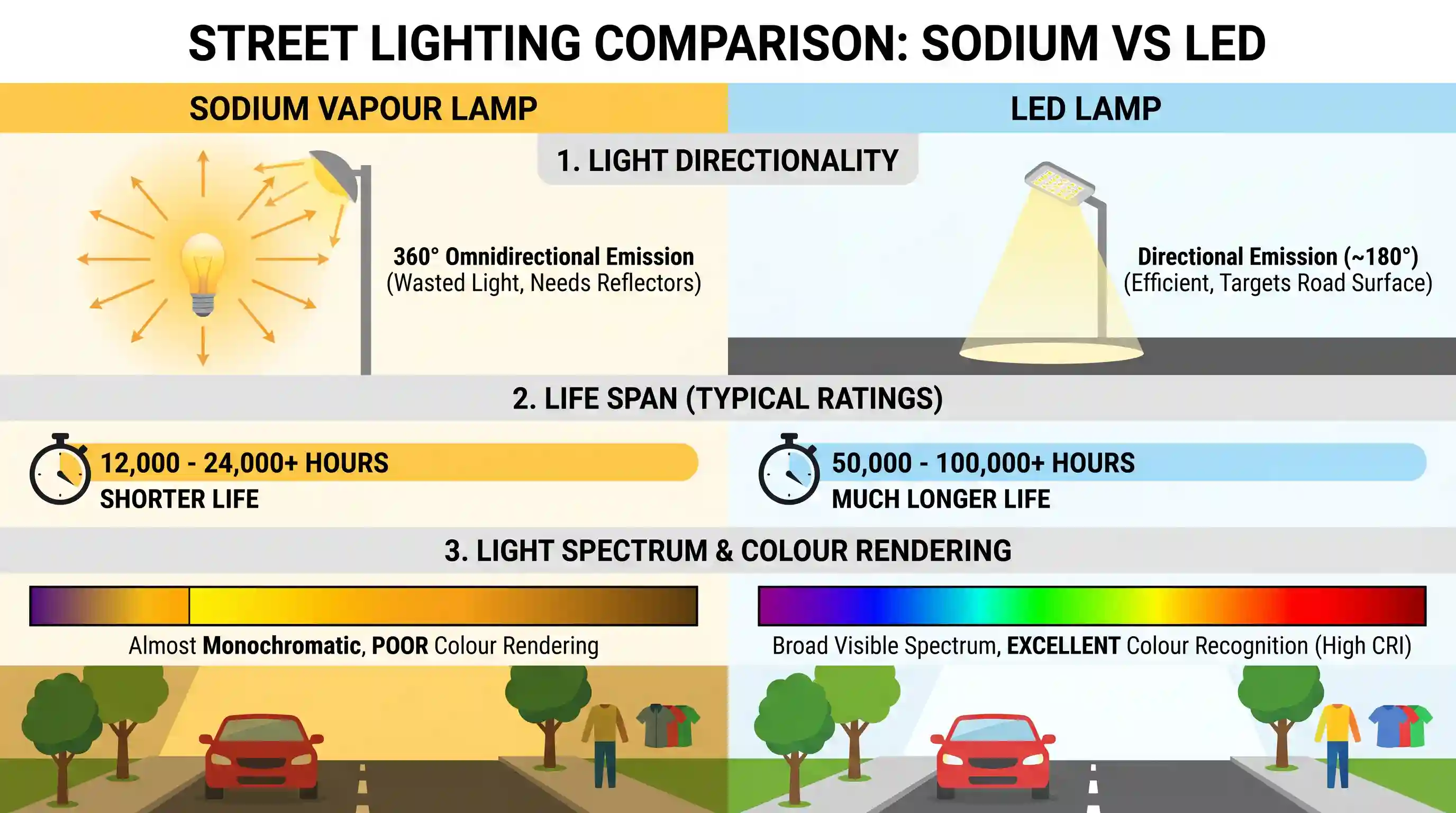
Correct. Sodium-vapour lamps emit light omnidirectionally (≈360°), so a large fraction of the light is wasted upwards or sideways and has to be redirected with reflectors. LEDs are inherently directional sources (typically a forward beam of ≈180° or less), which makes them more efficient for street lighting where light is needed only on the road surface.
-
Incorrect. LED street lights have a much longer rated life — typically 50,000–100,000 hours — than high-pressure sodium lamps, which last roughly 12,000–24,000 hours. Sodium lamps therefore have a shorter life span than LEDs, not longer.
-
Correct. Low/high-pressure sodium lamps emit an almost monochromatic yellow-orange light (very poor colour rendering, CRI close to zero or low double digits). White LEDs offer a much broader, tunable spectrum and high colour rendering, giving significant colour-recognition advantages in street lighting.
Hence only 1 and 3 are correct, and the answer is C.
Related questions
More UPSC Prelims practice from the same subject and topic.
- Prelims 2021GS1science-and-technology
Which one of the following is used in preparing a natural mosquito repellent?
- Prelims 2021GS1science-and-technology
In a pressure cooker, the temperature at which the food is cooked depends mainly upon which of the following? 1. Area of the hole in the lid 2. Temperature of the flame 3. Weight of the lid Select the…
- Prelims 2021GS1science-and-technology
Consider the following : 1. Bacteria 2. Fungi 3. Virus Which of the above can be cultured in artificial/synthetic medium?
- Prelims 2021GS1science-and-technology
Water can dissolve more substances than any other liquid because
- Prelims 2021GS1science-and-technology
The term 'ACE2' is talked about in the context of
- Prelims 2021GS1science-and-technology
'Triclosan', considered harmful when exposed to high levels for a long time, is most likely present in which of the following?