A 3-digit number ABC, on multiplication with D gives 37DD where A, B, C and D are different non-zero digits. What is the value of A + B + C ?

- A18Correct
- B16
- C15
- DCannot be determined due to insufficient data
Explanation
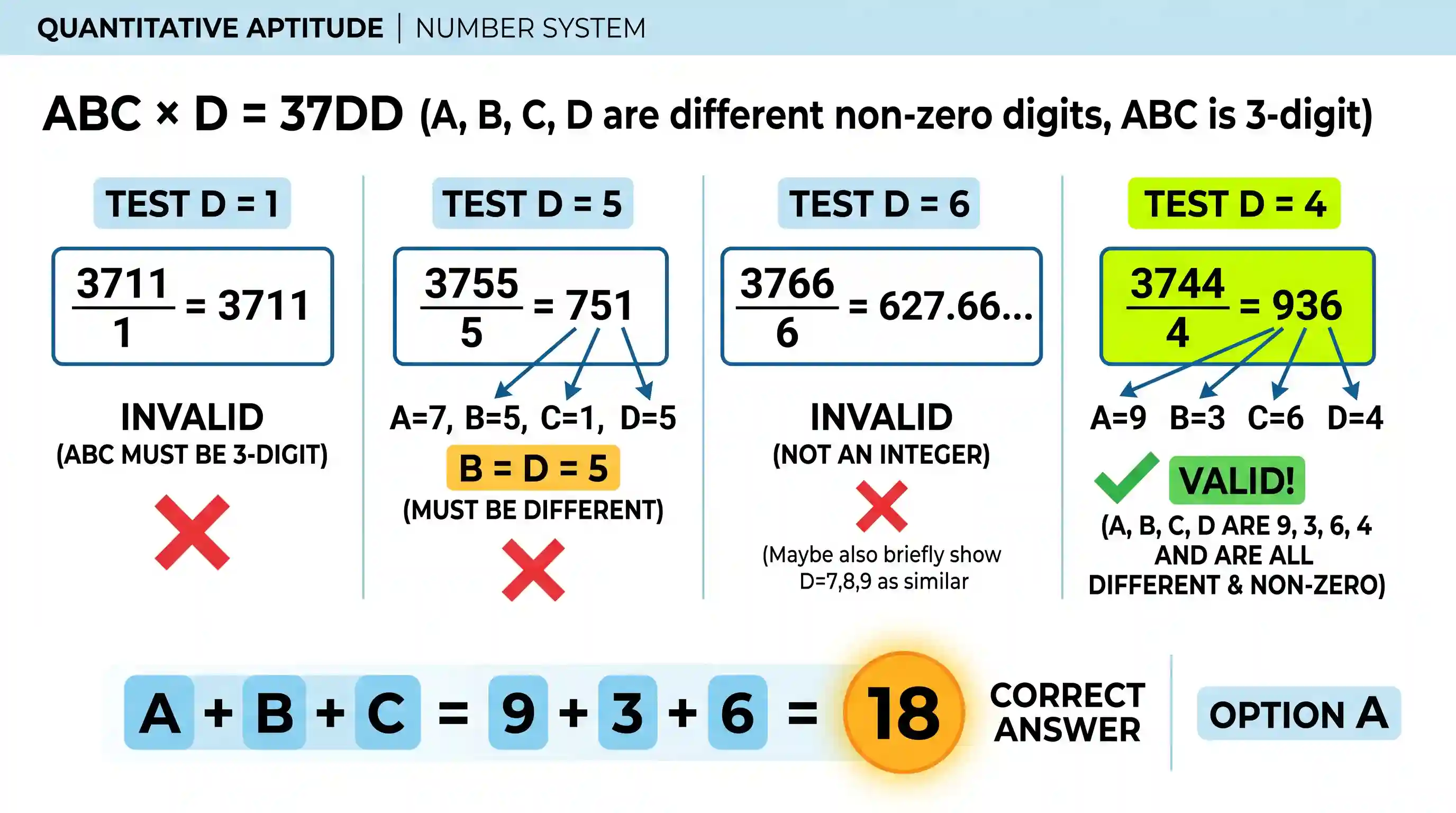
To solve this, we have the equation ABC multiplied by D equals 37DD. Since A, B, C, and D are non-zero digits, we can test values for D.
If D is 1, ABC would be 3711, which is a 4-digit number. This is impossible as ABC is a 3-digit number.
If D is 5, 3755 divided by 5 equals 751. Here, A is 7, B is 5, and C is 1. However, the problem states that A, B, C, and D must be different digits. Since B and D are both 5, this value is rejected.
If D is 6, 3766 divided by 6 does not result in a whole number.
If D is 7, 3777 divided by 7 equals 539.57, which is not an integer.
If D is 8, 3788 divided by 8 equals 473.5, which is not an integer.
If D is 9, 3799 divided by 9 equals 422.11, which is not an integer.
Now, let us try a smaller value for D. If D is 4, 3744 divided by 4 equals 936. Here, A is 9, B is 3, C is 6, and D is 4. All digits 9, 3, 6, and 4 are different and non-zero, satisfying all conditions of the problem.
The value of A + B + C is 9 + 3 + 6 which equals 18. Therefore, option A is correct.
Related questions
More UPSC Prelims practice from the same subject and topic.
- Prelims 2023CSATQuantitative Aptitude
What is the remainder when 85 × 87 × 89 × 91 × 95 × 96 is divided by 100?
- Prelims 2023CSATQuantitative Aptitude
What is the unit digit in the expansion of (57242)^(9×7×5×3×1)?
- Prelims 2023CSATQuantitative Aptitude
If ABC and DEF are both 3-digit numbers such that A, B, C, D, E and F are distinct non-zero digits such that ABC + DEF = 1111 , then what is the value of A + B + C + D + E + F ?
- Prelims 2023CSATQuantitative Aptitude
D is a 3-digit number such that the ratio of the number to the sum of its digits is least. What is the difference between the digit at the hundred's place and the digit at the unit's place of D?
- Prelims 2023CSATQuantitative Aptitude
Three of the five positive integers p, q, r, s, t are even and two of them are odd (not necessarily in order). Consider the following: 1. p + q + r - s - t is definitely even. 2. 2p + q + 2r - 2s + t …
- Prelims 2023CSATQuantitative Aptitude
Consider the following in respect of prime number p and composite number c. 1. p + c{p - c} can be even. 2. 2p + c can be odd. 3. pc can be odd. Which of the statements given above are correct?