A number N is formed by writing 9 for 99 times. What is the remainder if N is divided by 13?

- A11Correct
- B9
- C7
- D1
Explanation
To solve this, we first look for a pattern in the remainders when a sequence of 9s is divided by 13.
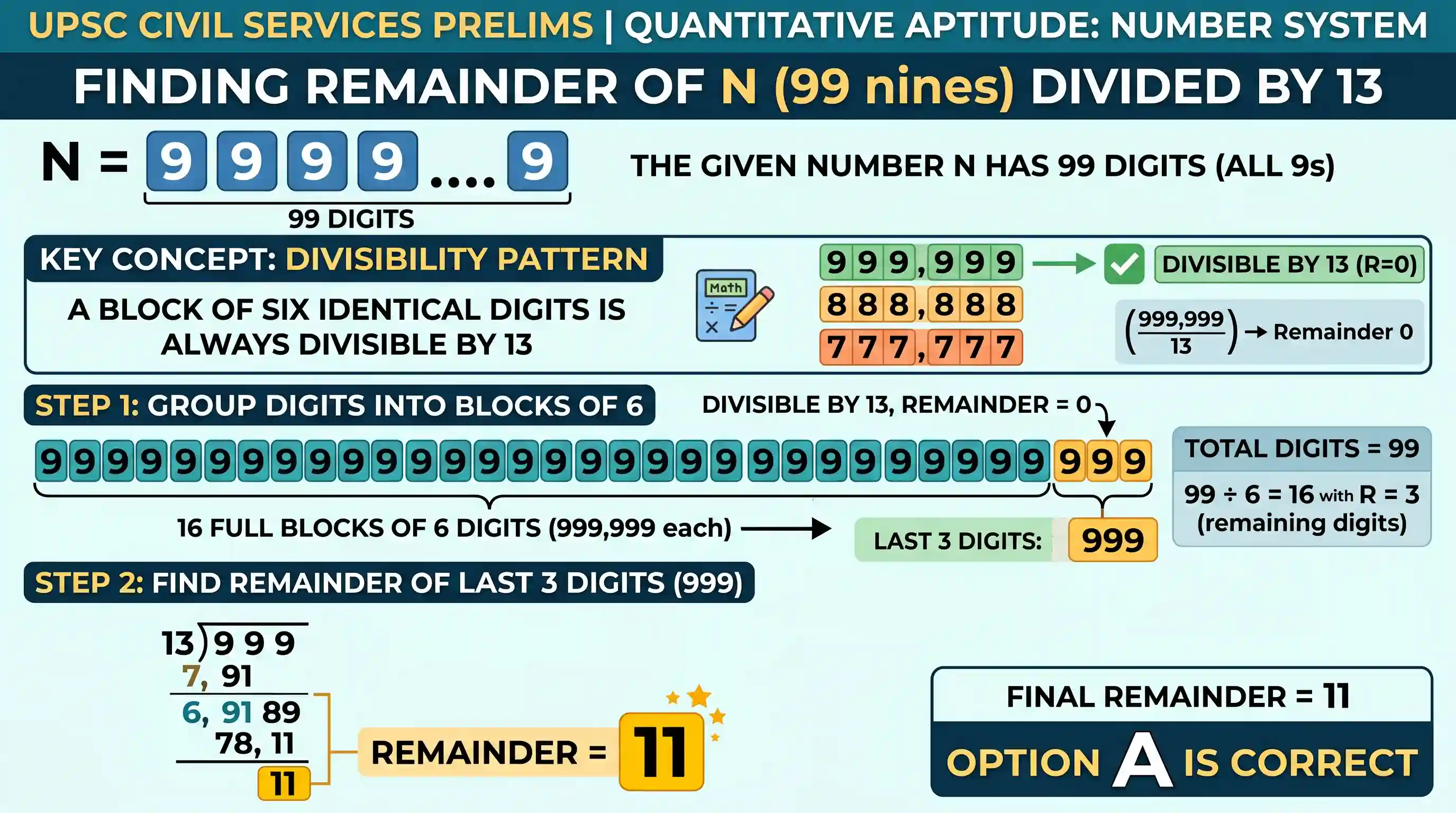
When we divide 999,999 by 13, the remainder is 0. This is because 1,001 is divisible by 13, and any six digit number with identical digits is always divisible by 7, 11, and 13.
Since a block of six 9s is exactly divisible by 13, we can group the 99 digits into sets of six. Dividing 99 by 6 gives 16 full blocks with a remainder of 3.
This means that the first 96 digits form a number that is perfectly divisible by 13, leaving a remainder of 0. We only need to find the remainder of the last three digits, which are 999.
Dividing 999 by 13: 13 times 70 is 910. 999 minus 910 is 89. 13 times 6 is 78. 89 minus 78 is 11.
The remainder is 11. Therefore, option A is correct.
Related questions
More UPSC Prelims practice from the same subject and topic.
- Prelims 2023CSATQuantitative Aptitude
What is the remainder when 85 × 87 × 89 × 91 × 95 × 96 is divided by 100?
- Prelims 2023CSATQuantitative Aptitude
What is the unit digit in the expansion of (57242)^(9×7×5×3×1)?
- Prelims 2023CSATQuantitative Aptitude
If ABC and DEF are both 3-digit numbers such that A, B, C, D, E and F are distinct non-zero digits such that ABC + DEF = 1111 , then what is the value of A + B + C + D + E + F ?
- Prelims 2023CSATQuantitative Aptitude
D is a 3-digit number such that the ratio of the number to the sum of its digits is least. What is the difference between the digit at the hundred's place and the digit at the unit's place of D?
- Prelims 2023CSATQuantitative Aptitude
Three of the five positive integers p, q, r, s, t are even and two of them are odd (not necessarily in order). Consider the following: 1. p + q + r - s - t is definitely even. 2. 2p + q + 2r - 2s + t …
- Prelims 2023CSATQuantitative Aptitude
Consider the following in respect of prime number p and composite number c. 1. p + c{p - c} can be even. 2. 2p + c can be odd. 3. pc can be odd. Which of the statements given above are correct?