Let pp, qq and rr be 2-digit numbers where p< q< r . If pp + qq + rr = tt0 , where tt0 is a 3-digit number ending with zero, consider the following statements: 1. The number of possible values of p is 5. 2. The number of possible values of q is 6. Which of the above statements is/are correct?

- A1 only
- B2 only
- CBoth 1 and 2Correct
- DNeither 1 nor 2
Explanation
The problem involves interpreting the notation 'pp', 'qq', 'rr', and 'tt0'.
- 'tt0' is a 3-digit number ending with zero. This implies it's a multiple of 10.
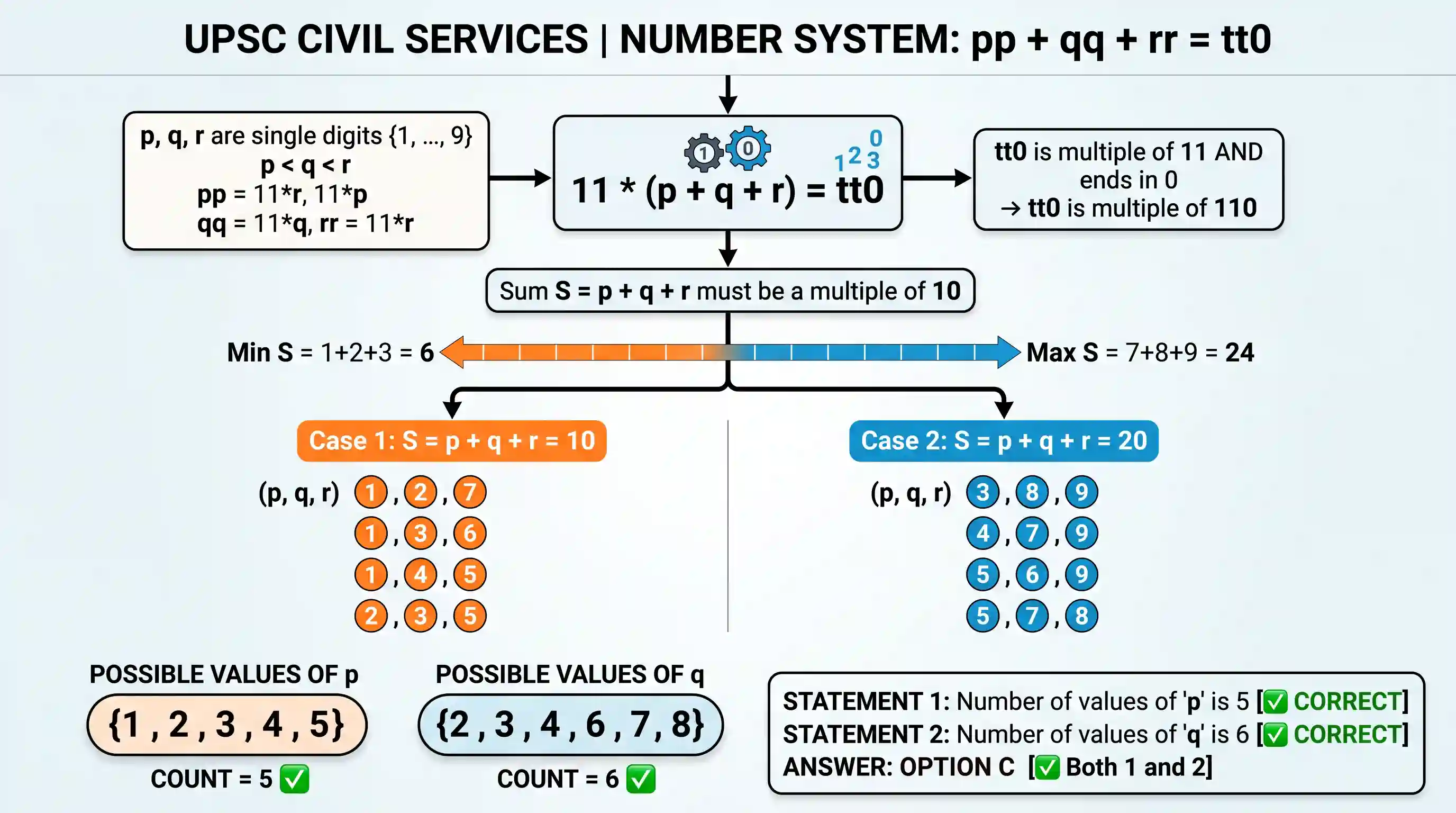
- The sum is pp + qq + rr = tt0. If 'p' were a 2-digit number (e.g., p=12), then 'pp' would typically mean 1212 (a 4-digit number). In this case, the sum of three 4-digit numbers would be a 4-digit or 5-digit number, not a 3-digit number 'tt0'. Therefore, the only way for the equation to hold and 'tt0' to be a 3-digit number is if 'p', 'q', 'r' are single-digit numbers, and 'pp' means 11*p (e.g., if p=1, pp=11; if p=5, pp=55). The phrase "p, q, r be 2-digit numbers" is a contradiction in the question, and we must proceed with 'p', 'q', 'r' being single digits for a consistent solution.
Let p, q, r be single-digit numbers (1-9). Given p = 3: Smallest q is p+1, smallest r is q+1. So p+q+r >= 3+4+5 = 12 > 10. No solutions.
Case 2: S = p + q + r = 20 We need p = 6: Smallest sum is 6+7+8 = 21 > 20. No solutions.
Now let's evaluate the statements:
Statement 1: The number of possible values of p is 5. From Case 1 (S=10), possible values for p are {1, 2}. From Case 2 (S=20), possible values for p are {3, 4, 5}. Combining these, the set of possible values for p is {1, 2, 3, 4, 5}. The number of possible values of p is 5. Statement 1 is CORRECT.
Statement 2: The number of possible values of q is 6. From Case 1 (S=10): (1, 2, 7) -> q=2 (1, 3, 6) -> q=3 (1, 4, 5) -> q=4 (2, 3, 5) -> q=3 The possible values for q are {2, 3, 4}.
From Case 2 (S=20): (3, 8, 9) -> q=8 (4, 7, 9) -> q=7 (5, 6, 9) -> q=6 (5, 7, 8) -> q=7 The possible values for q are {6, 7, 8}.
Combining these, the set of possible values for q is {2, 3, 4, 6, 7, 8}. The number of possible values of q is 6. Statement 2 is CORRECT.
Since both statements are correct, the answer is C.
The final answer is C) Both 1 and 2
Related questions
More UPSC Prelims practice from the same subject and topic.
- Prelims 2023CSATQuantitative Aptitude
What is the remainder when 85 × 87 × 89 × 91 × 95 × 96 is divided by 100?
- Prelims 2023CSATQuantitative Aptitude
What is the unit digit in the expansion of (57242)^(9×7×5×3×1)?
- Prelims 2023CSATQuantitative Aptitude
If ABC and DEF are both 3-digit numbers such that A, B, C, D, E and F are distinct non-zero digits such that ABC + DEF = 1111 , then what is the value of A + B + C + D + E + F ?
- Prelims 2023CSATQuantitative Aptitude
D is a 3-digit number such that the ratio of the number to the sum of its digits is least. What is the difference between the digit at the hundred's place and the digit at the unit's place of D?
- Prelims 2023CSATQuantitative Aptitude
Three of the five positive integers p, q, r, s, t are even and two of them are odd (not necessarily in order). Consider the following: 1. p + q + r - s - t is definitely even. 2. 2p + q + 2r - 2s + t …
- Prelims 2023CSATQuantitative Aptitude
Consider the following in respect of prime number p and composite number c. 1. p + c{p - c} can be even. 2. 2p + c can be odd. 3. pc can be odd. Which of the statements given above are correct?