AB and CD are 2-digit numbers. Multiplying AB with CD results in a 3-digit number DEF. Adding DEF to another 3-digit number GHI results in 975. Further A, B, C, D, E, F, G, H, I are distinct digits. If E = 0, F = 8, then what is A + B + C equal to?

- A6Correct
- B7
- C8
- D9
Explanation
The problem provides two equations and a set of constraints:
- AB * CD = DEF
- DEF + GHI = 975
- A, B, C, D, E, F, G, H, I are distinct digits.
- E = 0, F = 8.
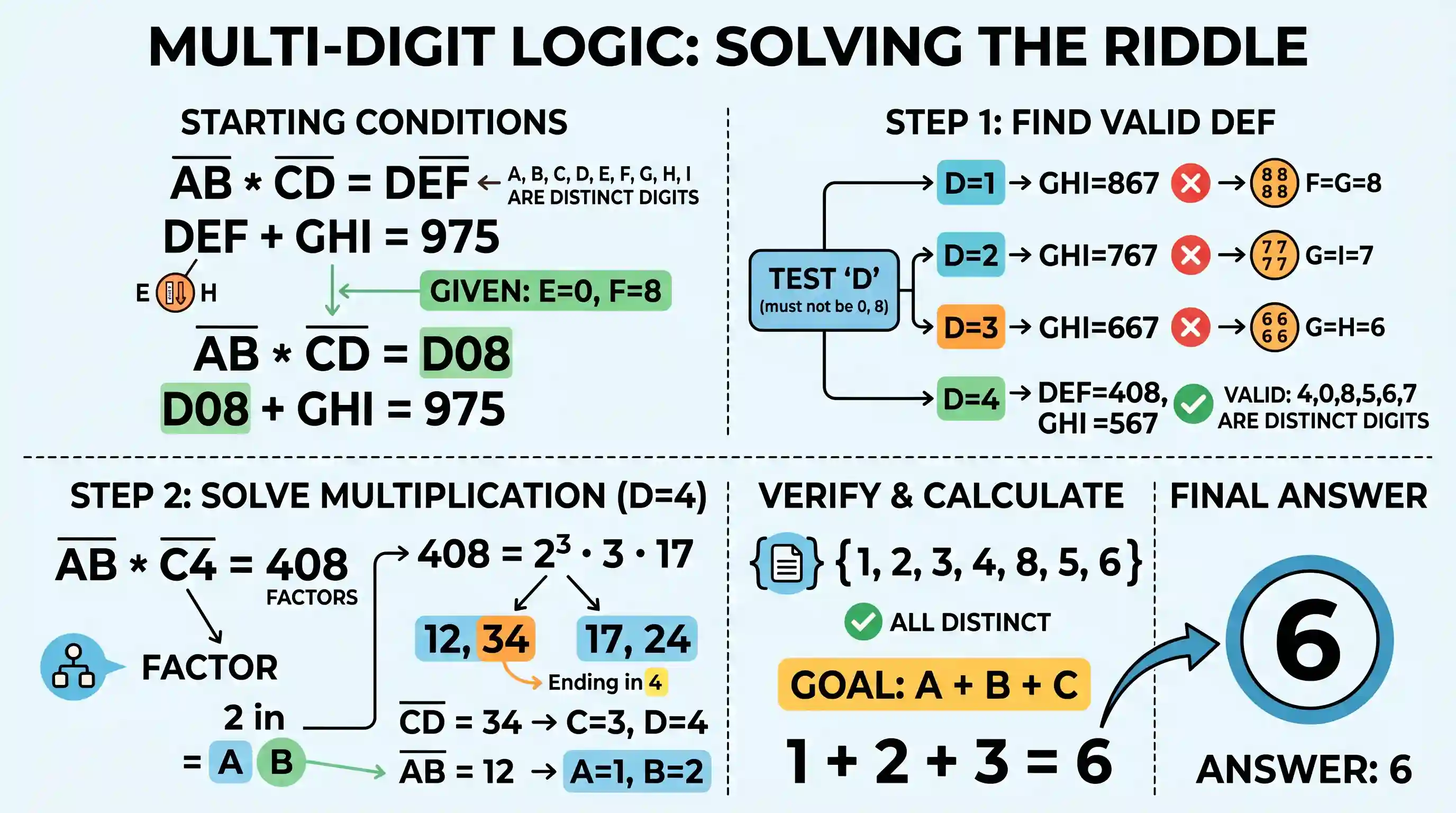
Step 1: Use the known values E=0, F=8 to determine DEF. DEF = D08.
Step 2: Substitute DEF into the second equation. D08 + GHI = 975
Step 3: Determine possible values for D. D must be a digit (0-9) and distinct from E=0 and F=8. Since DEF is a 3-digit number, D cannot be 0. So D can be 1, 2, 3, 4, 5, 6, 7, 9. Let's test these values for D, keeping the distinct digit constraint in mind:
-
If D = 1, DEF = 108. GHI = 975 - 108 = 867. Digits used: D=1, E=0, F=8, G=8, H=6, I=7. Here, F=8 and G=8. This violates the distinct digit constraint (F and G must be distinct). So D cannot be 1.
-
If D = 2, DEF = 208. GHI = 975 - 208 = 767. Digits used: D=2, E=0, F=8, G=7, H=6, I=7. Here, G=7 and I=7. This violates the distinct digit constraint. So D cannot be 2.
-
If D = 3, DEF = 308. GHI = 975 - 308 = 667. Digits used: D=3, E=0, F=8, G=6, H=6, I=7. Here, G=6 and H=6. This violates the distinct digit constraint. So D cannot be 3.
-
If D = 4, DEF = 408. GHI = 975 - 408 = 567. Digits used: D=4, E=0, F=8, G=5, H=6, I=7. These digits {0, 4, 5, 6, 7, 8} are all distinct. This is a valid set. So, D=4, E=0, F=8, G=5, H=6, I=7. Digits remaining for A, B, C are from {1, 2, 3, 9}.
Step 4: Use the first equation AB * CD = DEF with D=4 and DEF=408. AB * C4 = 408. We need to find two 2-digit numbers, one ending in 4, whose product is 408. Let's find the factors of 408: 408 = 2^3 * 3 * 17. Factors include: 1, 2, 3, 4, 6, 8, 12, 17, 24, 34, 51, 68, 102, etc. We are looking for two 2-digit factors. Possible pairs: (12, 34) (17, 24)
Since CD must end in 4 (C4), the only possibility is CD = 34. If CD = 34, then C=3 and D=4. Consequently, AB = 12, so A=1 and B=2.
Step 5: Verify all distinct digit constraints. A=1, B=2, C=3, D=4, E=0, F=8, G=5, H=6, I=7. The set of all digits is {1, 2, 3, 4, 0, 8, 5, 6, 7}. All 9 digits are distinct. This solution is consistent with all conditions.
Step 6: Calculate A + B + C. A + B + C = 1 + 2 + 3 = 6.
(Brief check for other D values, if D=5, DEF=508. GHI=467. Digits 0,8,5,4,6,7 are distinct. AB*C5=508. Factors of 508 are 1,2,4,127,254,508. No two 2-digit factors. So D cannot be 5. Similarly, other D values will lead to contradictions.)
The final answer is 6.
The final answer is A) 6
Related questions
More UPSC Prelims practice from the same subject and topic.
- Prelims 2023CSATQuantitative Aptitude
What is the remainder when 85 × 87 × 89 × 91 × 95 × 96 is divided by 100?
- Prelims 2023CSATQuantitative Aptitude
What is the unit digit in the expansion of (57242)^(9×7×5×3×1)?
- Prelims 2023CSATQuantitative Aptitude
If ABC and DEF are both 3-digit numbers such that A, B, C, D, E and F are distinct non-zero digits such that ABC + DEF = 1111 , then what is the value of A + B + C + D + E + F ?
- Prelims 2023CSATQuantitative Aptitude
D is a 3-digit number such that the ratio of the number to the sum of its digits is least. What is the difference between the digit at the hundred's place and the digit at the unit's place of D?
- Prelims 2023CSATQuantitative Aptitude
Three of the five positive integers p, q, r, s, t are even and two of them are odd (not necessarily in order). Consider the following: 1. p + q + r - s - t is definitely even. 2. 2p + q + 2r - 2s + t …
- Prelims 2023CSATQuantitative Aptitude
Consider the following in respect of prime number p and composite number c. 1. p + c{p - c} can be even. 2. 2p + c can be odd. 3. pc can be odd. Which of the statements given above are correct?