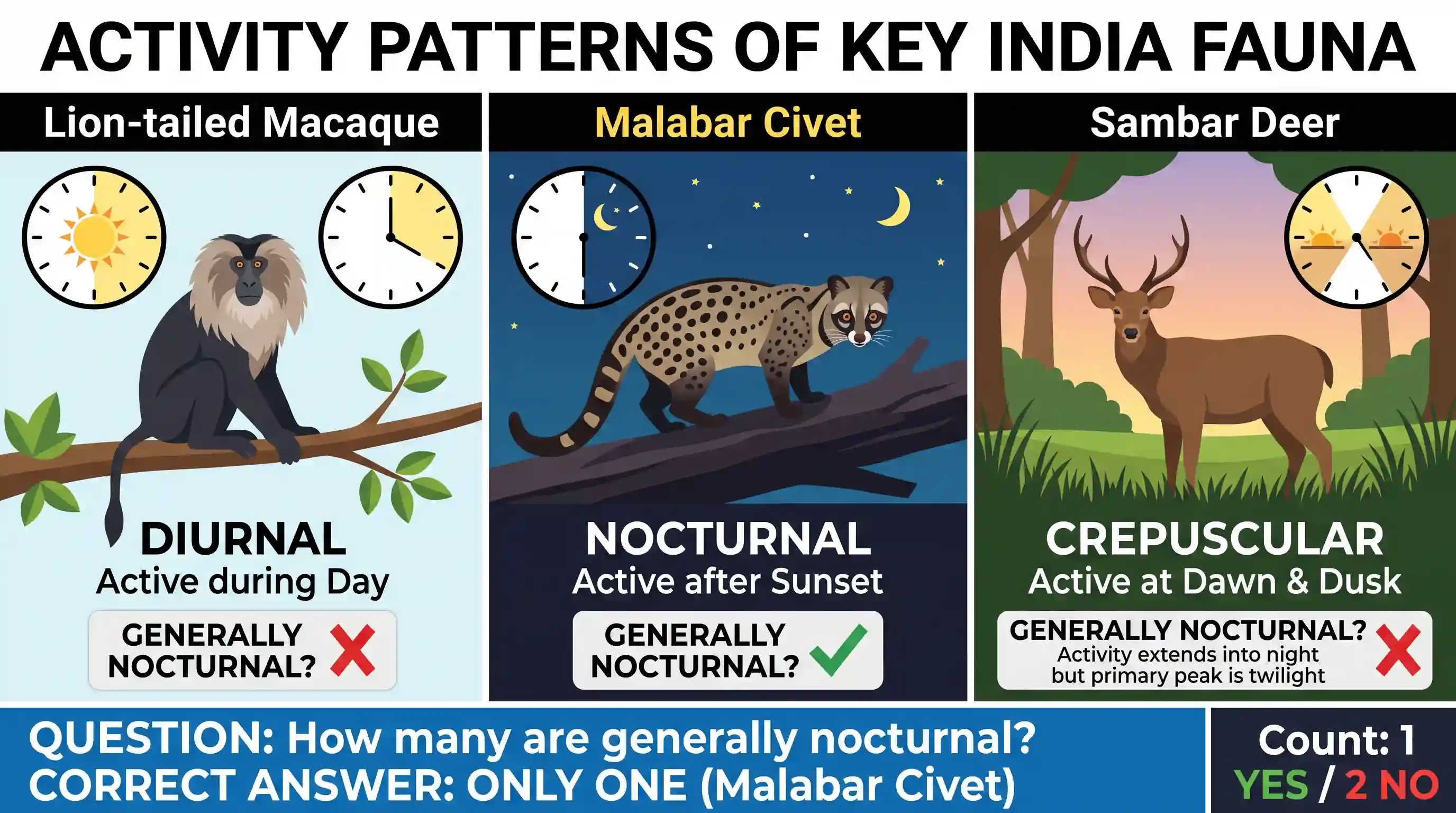
Consider the following fauna: 1. Lion-tailed Macaque 2. Malabar Civet 3. Sambar Deer How many of the above are generally nocturnal or most active after sunset?

- AOnly oneCorrect
- BOnly two
- CAll three
- DNone
Explanation
Let's examine the activity patterns of the given fauna:
-
Lion-tailed Macaque: These primates are diurnal, meaning they are primarily active during the day. They forage for food and engage in social activities during daylight hours.
-
Malabar Civet: The Malabar Civet (Viverra civettina) is a critically endangered species native to the Western Ghats of India. It is primarily nocturnal, meaning it is most active after sunset and during the night for foraging and other activities.
-
Sambar Deer: Sambar deer are largely crepuscular, meaning they are most active during twilight hours (dawn and dusk). While their activity often extends into the night for foraging, they are not strictly nocturnal in the same way as many other animals that are exclusively active after dark. However, given the option asks 'generally nocturnal or most active after sunset', they do fit this description to some extent alongside their crepuscular nature.
Considering the strict interpretation of 'generally nocturnal or most active after sunset' implying a primary nocturnal habit, the Malabar Civet is the clearest fit. While Sambar deer do have nocturnal activity, their primary activity peak is crepuscular. Therefore, only one of the given animals is primarily or generally nocturnal.
Related questions
More UPSC Prelims practice from the same subject and topic.
- Prelims 2023GS1geography
Consider the following trees: 1. Jackfruit (Artocarpus heterophyllus) 2. Mahua (Madhuca indica) 3. Teak (Tectona grandis) How many of the above are deciduous trees?
- Prelims 2023GS1geography
Consider the following statements: Statement-I: Marsupials are not naturally found in India. Statement-II: Marsupials can thrive only in montane grasslands with no predators. Which one of the followin…
- Prelims 2023GS1geography
'Invasive Species Specialist Group' (that develops Global Invasive Species Database) belongs to which one of the following organizations?
- Prelims 2023GS1geography
Which of the following organisms perform waggle dance for others of their kin to indicate the direction and the distance to a source of their food?
- Prelims 2023GS1geography
Consider the following statements regarding the Indian squirrels: 1. They build nests by making burrows in the ground. 2. They store their food materials like nuts and seeds in the ground. 3. They are…
- Prelims 2023GS1geography
Which one of the following makes a tool with a stick to scrape insects from a hole in a tree or a log of wood?