Consider the following statements: 1. Some microorganisms can grow in environments with temperature above the boiling point of water. 2. Some microorganisms can grow in environments with temperature below the freezing point of water. 3. Some microorganisms can grow in highly acidic environment with a pH below 3. How many of the above statements are correct?

- AOnly one
- BOnly two
- CAll threeCorrect
- DNone
Explanation
Let's evaluate each statement about microorganisms:
-
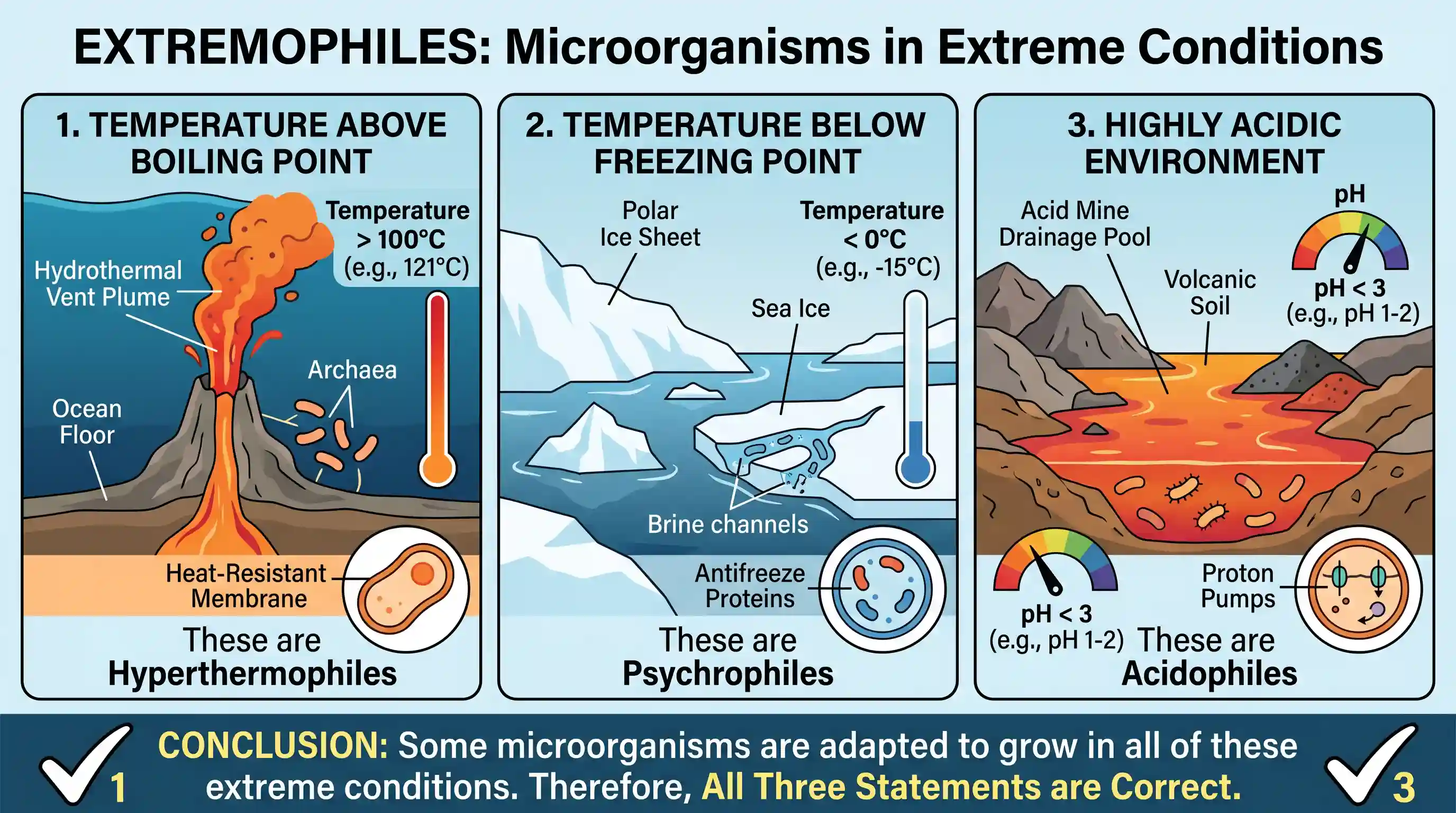
Some microorganisms can grow in environments with temperature above the boiling point of water: This statement is correct. These are known as hyperthermophiles, a type of extremophile. They thrive in extremely hot environments, such as hydrothermal vents in the deep sea or hot springs, with optimal growth temperatures often exceeding 80°C and some capable of growing above 100°C (e.g., certain Archaea species).
-
Some microorganisms can grow in environments with temperature below the freezing point of water: This statement is correct. These are called psychrophiles or psychrotrophs. They are adapted to cold environments like polar regions, glaciers, and deep-sea waters, and can grow optimally at low temperatures, including below 0°C.
-
Some microorganisms can grow in highly acidic environment with a pH below 3: This statement is correct. These are known as acidophiles. They thrive in extremely acidic conditions, such as acid mine drainage, volcanic soils, or the stomach of animals. Their enzymes and cellular structures are adapted to function at very low pH levels (e.g., some Archaea and bacteria can grow at pH 1 or 2).
Since all three statements are correct, the answer is 'All three'.
Related questions
More UPSC Prelims practice from the same subject and topic.
- Prelims 2023GS1science-and-technology
Consider the following statements: 1. Some mushrooms have medicinal properties. 2. Some mushrooms have psycho-active properties. 3. Some mushrooms have insecticidal properties. 4. Some mushrooms have …
- Prelims 2023GS1science-and-technology
Consider the following actions: 1. Detection of car crash/collision which results in the deployment of airbags almost instantaneously 2. Detection of accidental free fall of a laptop towards the groun…
- Prelims 2023GS1science-and-technology
With reference to green hydrogen, consider the following statements: 1. It can be used directly as a fuel for internal combustion. 2. It can be blended with natural gas and used as fuel for heat or po…
- Prelims 2023GS1science-and-technology
'Wolbachia method' is sometimes talked about with reference to which one of the following?
- Prelims 2023GS1science-and-technology
'Aerial metagenomics' best refers to which one of the following situations?
- Prelims 2023GS1science-and-technology
Consider the following statements: Statement-I: India, despite having uranium deposits, depends on coal for most of its electricity production. Statement-II: Uranium, enriched to the extent of at leas…