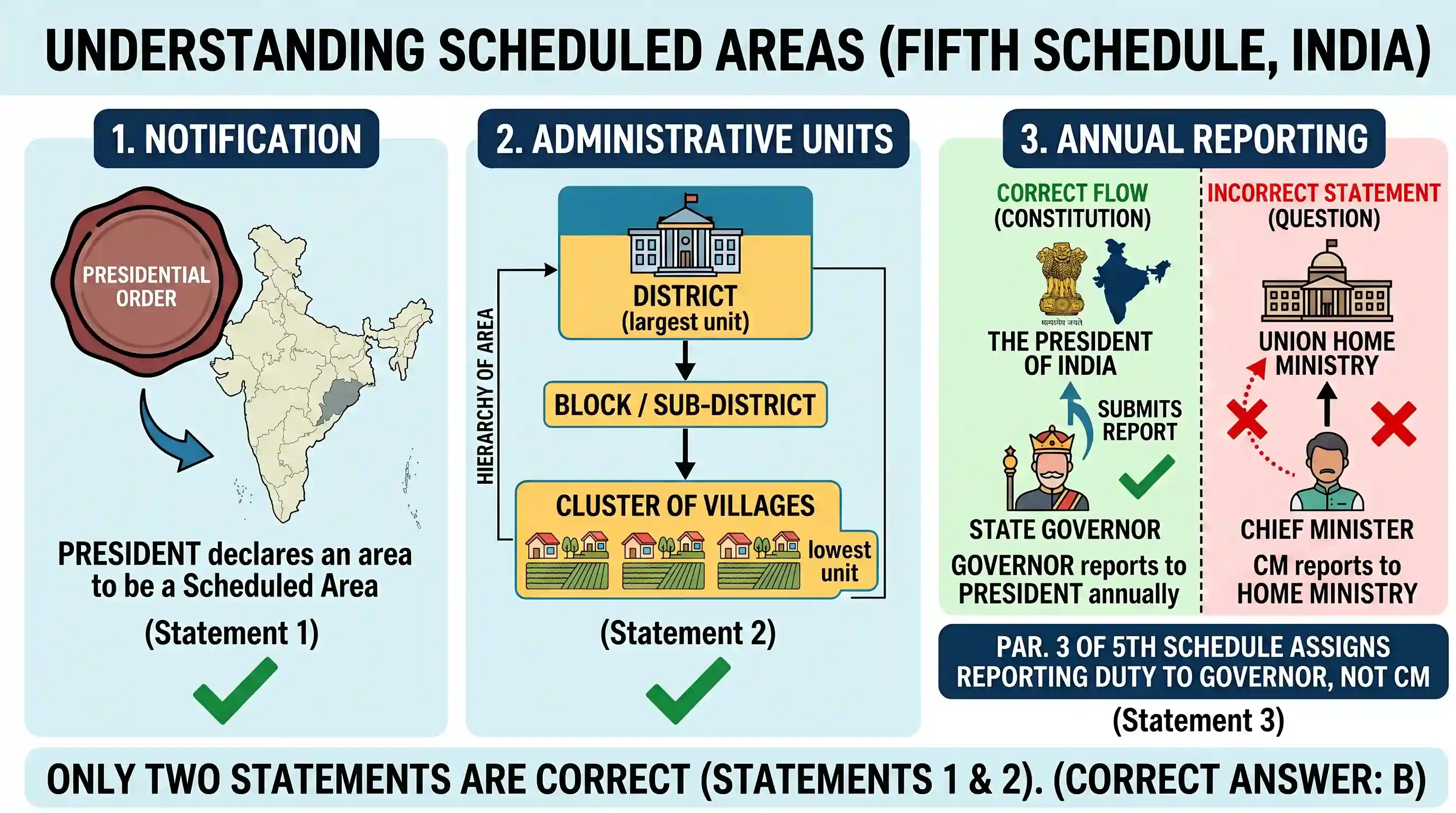
With reference to 'Scheduled Areas' in India, consider the following statements: 1. Within a State, the notification of an area as Scheduled Area takes place through an Order of the President. 2. The largest administrative unit forming the Scheduled Area is the District and the lowest is the cluster of villages in the Block. 3. The Chief Ministers of the concerned States are required to submit annual reports to the Union Home Ministry on the administration of Scheduled Areas in the States. How many of the above statements are correct?

- AOnly one
- BOnly twoCorrect
- CAll three
- DNone
Explanation
Let's analyze the statements regarding 'Scheduled Areas' in India:
-
Within a State, the notification of an area as Scheduled Area takes place through an Order of the President. This statement is correct. The Fifth Schedule of the Constitution empowers the President to declare any area to be a Scheduled Area. Changes to such areas (increasing, decreasing, rescheduling) also require a Presidential Order.
-
The largest administrative unit forming the Scheduled Area is the District and the lowest is the cluster of villages in the Block. This statement is correct. Scheduled Areas are typically notified at the district, sub-district, or block level, and their boundaries can extend down to clusters of villages, recognizing indigenous populations within these administrative units. So, district is the largest, and clusters of villages (or even individual villages in some cases) can be the lowest demarcation.
-
The Chief Ministers of the concerned States are required to submit annual reports to the Union Home Ministry on the administration of Scheduled Areas in the States. This statement is incorrect. According to the Fifth Schedule (Para 3), the Governor of each state having Scheduled Areas is required to submit a report to the President annually (or whenever required) regarding the administration of such areas in their state, not the Chief Minister to the Union Home Ministry.
Therefore, only two statements (1 and 2) are correct.
Related questions
More UPSC Prelims practice from the same subject and topic.
- Prelims 2023GS1polity-and-governance
Consider the following: 1. Demographic performance 2. Forest and ecology 3. Governance reforms 4. Stable government 5. Tax and fiscal efforts For the horizontal tax devolution, the Fifteenth Finance C…
- Prelims 2023GS1polity-and-governance
Consider the following statements: Statement-I: In India, prisons are managed by State Governments with their own rules and regulations for the day-to-day administration of prisons. Statement-II: In I…
- Prelims 2023GS1polity-and-governance
Consider the following organizations/bodies in India: 1. The National Commission for Backward Classes 2. The National Human Rights Commission 3. The National Law Commission 4. The National Consumer Di…
- Prelims 2023GS1polity-and-governance
Consider the following statements: Once the Central Government notifies an area as a 'Community Reserve' 1. the Chief Wildlife Warden of the State becomes the governing authority of such forest 2. hun…
- Prelims 2023GS1polity-and-governance
Consider the following statements: Statement-I: The Supreme Court of India has held in some judgements that the reservation policies made under Article 16(4) of the Constitution of India would be limi…
- Prelims 2023GS1polity-and-governance
Consider the following statements in relation to Janani Suraksha Yojana: 1. It is a safe motherhood intervention of the State Health Departments. 2. Its objective is to reduce maternal and neonatal mo…