Consider the Question Statements given below in respect of and two three cities P, Q and R in a State: \ Question: How far is city P from city Q ? Statement- 1: City Q is 18 km from city R. Statement- 2: City P is 43 km from city R. Which one of the following is correct in respect of the Question and the Statements?

- AStatement-1 alone is sufficient to answer the Question
- BStatement-2 alone is sufficient to answer the Question
- CBoth Statement-1 and Statement-2 are sufficient to answer the Question
- DBoth Statement-1 and Statement-2 are not sufficient to answer the QuestionCorrect
Explanation
The question asks for the distance between city P and city Q.
Statement 1: City Q is 18 km from city R. This statement gives us the distance QR = 18 km. It provides no information about city P. Therefore, Statement 1 alone is not sufficient to determine the distance PQ.
Statement 2: City P is 43 km from city R. This statement gives us the distance PR = 43 km. It provides no information about city Q's position relative to P or R's position relative to Q. Therefore, Statement 2 alone is not sufficient to determine the distance PQ.
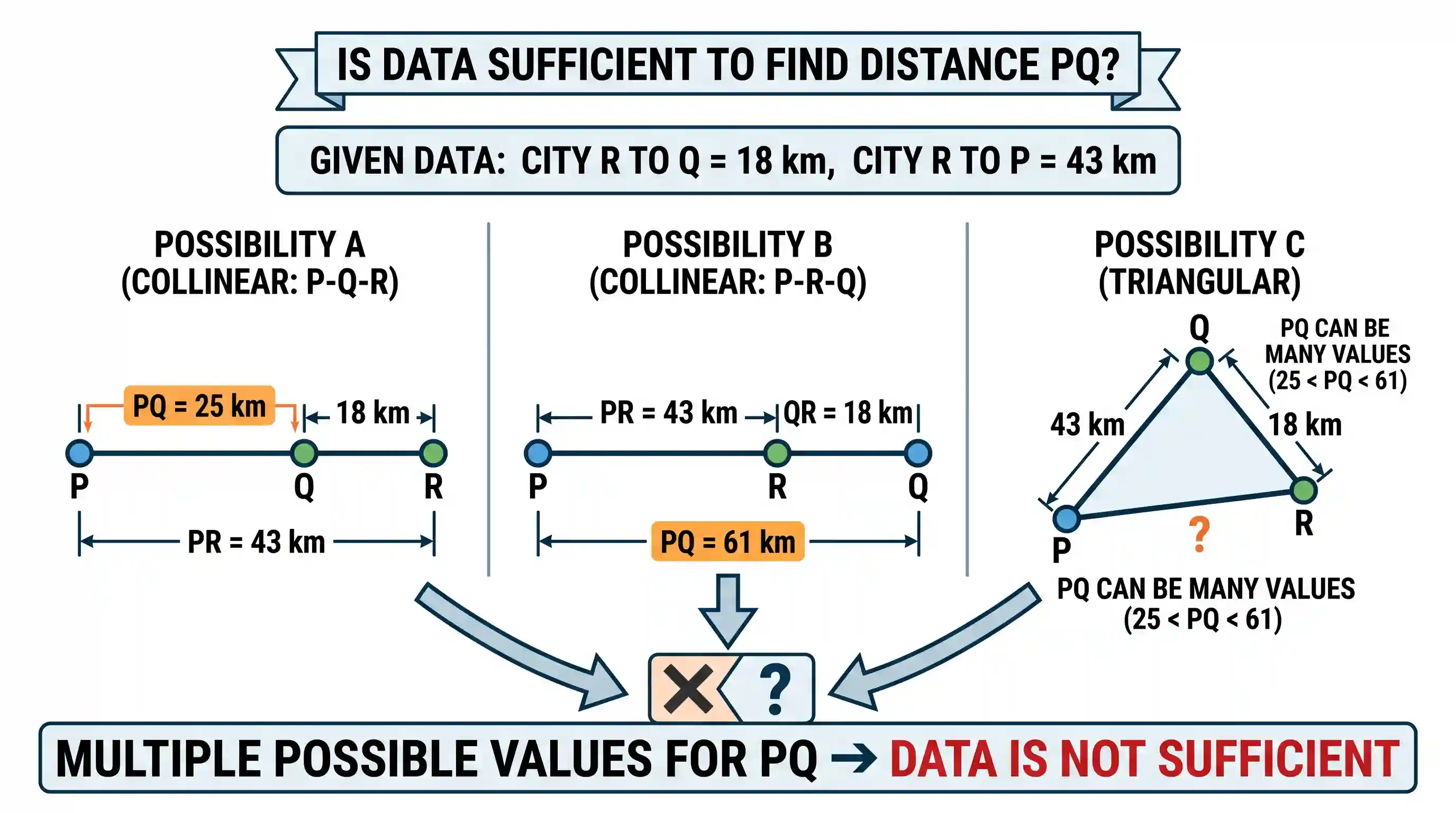
Combining both Statement 1 and Statement 2: We know QR = 18 km and PR = 43 km. We need to find PQ. There are multiple possible arrangements for the three cities P, Q, and R:
- If Q is located between P and R (P-Q-R): Then PQ + QR = PR. So, PQ + 18 = 43, which means PQ = 43 - 18 = 25 km.
- If R is located between P and Q (P-R-Q): Then PR + RQ = PQ. So, 43 + 18 = PQ, which means PQ = 61 km.
- If the three cities form a triangle (not collinear): In this case, the distance PQ would be a side of a triangle with other sides 18 km and 43 km. According to the triangle inequality theorem, the third side (PQ) must be greater than the absolute difference of the other two sides and less than their sum. So, |43 - 18| < PQ < (43 + 18), which means 25 km < PQ < 61 km.
Since we can get different possible distances for PQ (25 km, 61 km, or any value between 25 km and 61 km if they form a triangle), the information provided by both statements together is not sufficient to determine a unique distance between city P and city Q.
Therefore, both Statement-1 and Statement-2 are not sufficient to answer the Question.
The final answer is D
Related questions
More UPSC Prelims practice from the same subject and topic.
- Prelims 2024CSATLogical Reasoning
Three Statements followed by three Conclusions are given below. You have to take the Statements to be true even if they seem to be at variance from the commonly known facts. Read all the Conclusions a…
- Prelims 2024CSATLogical Reasoning
Two Statements followed by four Conclusions are given below. You have to take the Statements to be true even if they seem to be at variance from the commonly known facts. Read all the Conclusions and …
- Prelims 2024CSATLogical Reasoning
Consider the following statements : 1. A is older than B. 2. C and D are of the same age. 3. E is the youngest. 4. F is younger than D. 5. F is older than A. How many statements given above are requir…
- Prelims 2024CSATLogical Reasoning
Consider the sequence: ABC _ _ ABC _ DABBCD _ ABCD Which one of the following completes the sequence?
- Prelims 2024CSATLogical Reasoning
What is the value of X in the sequence 2, 12, 36, 80, 150, X?
- Prelims 2024CSATLogical Reasoning
Consider the following statements: 1. Between 3:16 p.m. and 3:17 p.m., both hour hand and minute hand coincide. 2. Between 4:58 p.m. and 4:59 p.m., both minute hand and second hand coincide. Which of …