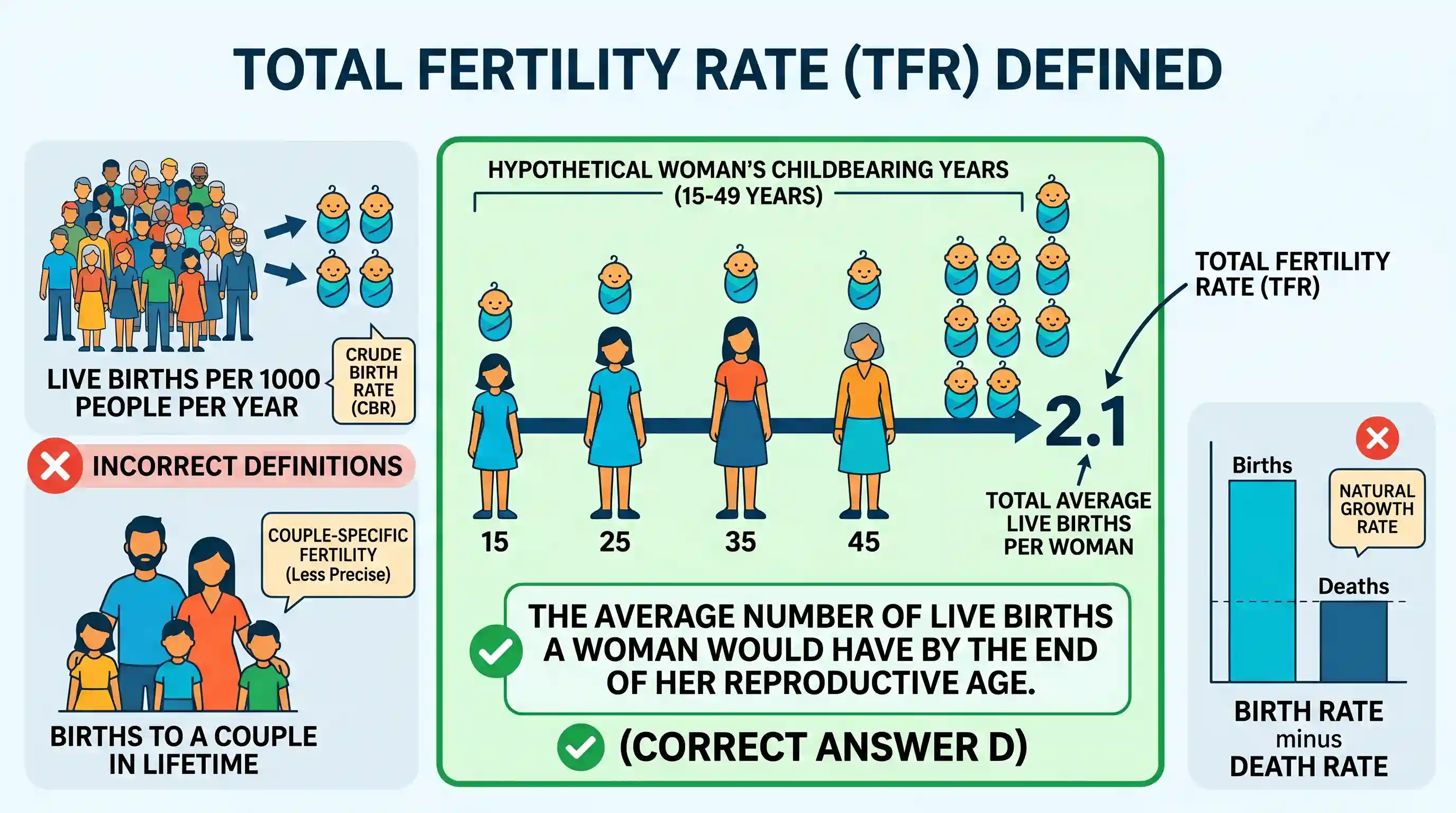
The total fertility rate in an economy is defined as:

- Athe number of children born per 1000 people in the population in a year.
- Bthe number of children born to a couple in their lifetime in a given population.
- Cthe birth rate minus death rate.
- Dthe average number of live births a woman would have by the end of her child-bearing age.Correct
Explanation
The correct definition of the Total Fertility Rate (TFR) is D) the average number of live births a woman would have by the end of her child-bearing age.
Let's look at the other options:
- A) The number of children born per 1000 people in the population in a year: This describes the Crude Birth Rate (CBR).
- B) The number of children born to a couple in their lifetime in a given population: This is a less precise definition and can be confused with TFR, but TFR specifically aggregates across all women in a population, assuming current age-specific fertility rates persist, and refers to a woman's lifetime.
- C) The birth rate minus death rate: This calculates the natural growth rate of a population.
TFR is a hypothetical measure that represents the average number of children that would be born to a woman over her lifetime if she were to experience the exact current age-specific fertility rates through her childbearing years, and she were to survive throughout her childbearing years. It's a standard demographic indicator used to assess fertility levels and future population trends.
Related questions
More UPSC Prelims practice from the same subject and topic.
- Prelims 2024GS1economy
Consider the following: 1. Exchange-Traded Funds (ETF) 2. Motor vehicles 3. Currency swap Which of the above is/are considered financial instruments?
- Prelims 2024GS1economy
With reference to the sectors of the Indian economy, consider the following pairs: Economic activity | Sector 1. Storage of agricultural produce | Secondary 2. Dairy farm | Primary 3. Mineral explorat…
- Prelims 2024GS1economy
With reference to physical capital in Indian economy, consider the following pairs: Items | Category 1. Farmer's plough | Working capital 2. Computer | Fixed capital 3. Yarn used by the weaver | Fixed…
- Prelims 2024GS1economy
Which one of the following is the correct description of “100 Million Farmers”?
- Prelims 2024GS1economy
Recently, the term "pumped-storage hydropower" is actually and appropriately discussed in the context of which one of the following?
- Prelims 2024GS1economy
With reference to the Indian economy, "Collateral Borrowing and Lending Obligations" are the instruments of: