In India, which of the following can trade in Corporate Bonds and Government Securities? 1. Insurance Companies 2. Pension Funds 3. Retail Investors Select the correct answer using the code given below:

- A1 and 2 only
- B2 and 3 only
- C1 and 3 only
- D1, 2 and 3Correct
Explanation
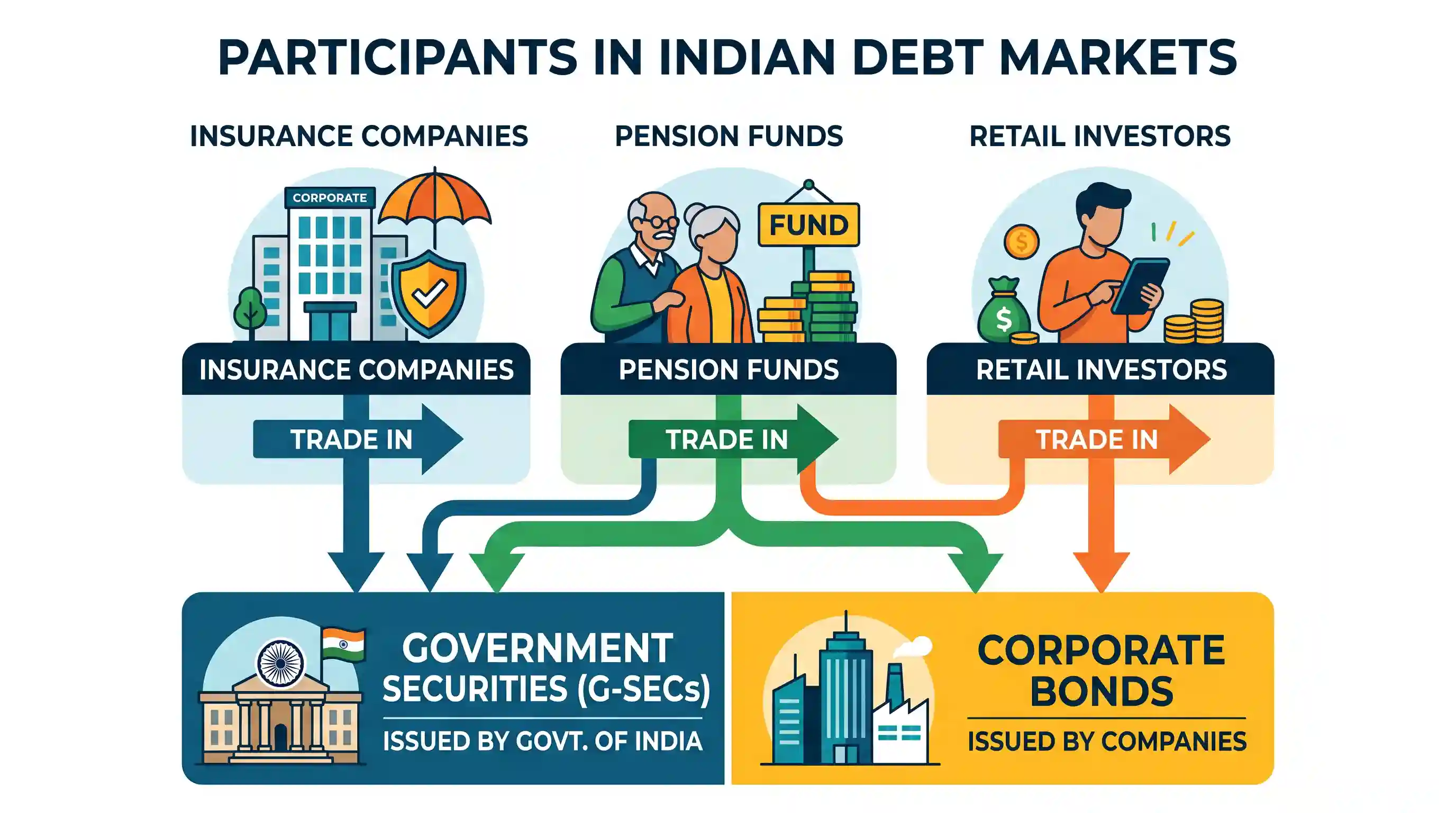
All three categories of entities can trade in Corporate Bonds and Government Securities in India.
-
Insurance Companies: Insurance companies are significant institutional investors in India's debt markets. They invest a large portion of their policyholders' funds in stable, long-term instruments like corporate bonds and government securities to meet their long-term liabilities and regulatory requirements. They are major players in both primary and secondary debt markets.
-
Pension Funds: Pension funds (including the Employees' Provident Fund Organisation - EPFO, and those managed by the Pension Fund Regulatory and Development Authority - PFRDA) are also major institutional investors. Their mandate is to generate long-term returns for pensioners, and they heavily invest in debt instruments, including G-Secs and corporate bonds, which offer stability and regular income.
-
Retail Investors: While institutional investors dominate the debt markets, retail investors can also trade in both government securities and corporate bonds. For G-Secs, the RBI has introduced initiatives like the 'RBI Retail Direct' scheme to allow individual investors direct access to buy and sell G-Secs. For corporate bonds, retail investors can invest through specific platforms on stock exchanges or through bond funds/ETFs. It's important to note that direct participation might be lower due to minimum investment sizes or complexity, but the option to trade exists.
Therefore, all 1, 2, and 3 can trade in Corporate Bonds and Government Securities.
Related questions
More UPSC Prelims practice from the same subject and topic.
- Prelims 2024GS1economy
With reference to the Indian economy, "Collateral Borrowing and Lending Obligations" are the instruments of:
- Prelims 2024GS1economy
Consider the following statements : 1. In India, Non-Banking Financial Companies can access the Liquidity Adjustment Facility window of the Reserve Bank of India. 2. In India, Foreign Institutional In…
- Prelims 2024GS1economy
With reference to the rule/rules imposed by the Reserve Bank of India while treating foreign banks, consider the following statements: 1. There is no minimum capital requirement for wholly owned banki…
- Prelims 2024GS1economy
Consider the following statements : Statement-I : If the United States of America (USA) were to default on its debt, holders of US Treasury Bonds will not be able to exercise their claims to receive p…
- Prelims 2024GS1economy
Consider the following statements : Statement-I : Syndicated lending spreads the risk of borrower default across multiple lenders. Statement-II : The syndicated loan can be a fixed amount/lump sum of …
- Prelims 2024GS1economy
Consider the following statements in respect of the digital rupee : 1. It is a sovereign currency issued by the Reserve Bank of India (RBI) in alignment with its monetary policy. 2. It appears as a li…