As per Article 368 of the Constitution of India, the Parliament may amend any provision of the Constitution by way of : 1. Addition 2. Variation 3. Repeal Select the correct answer using the code given below:

- A1 and 2 only
- B2 and 3 only
- C1 and 3 only
- D1, 2 and 3Correct
Explanation
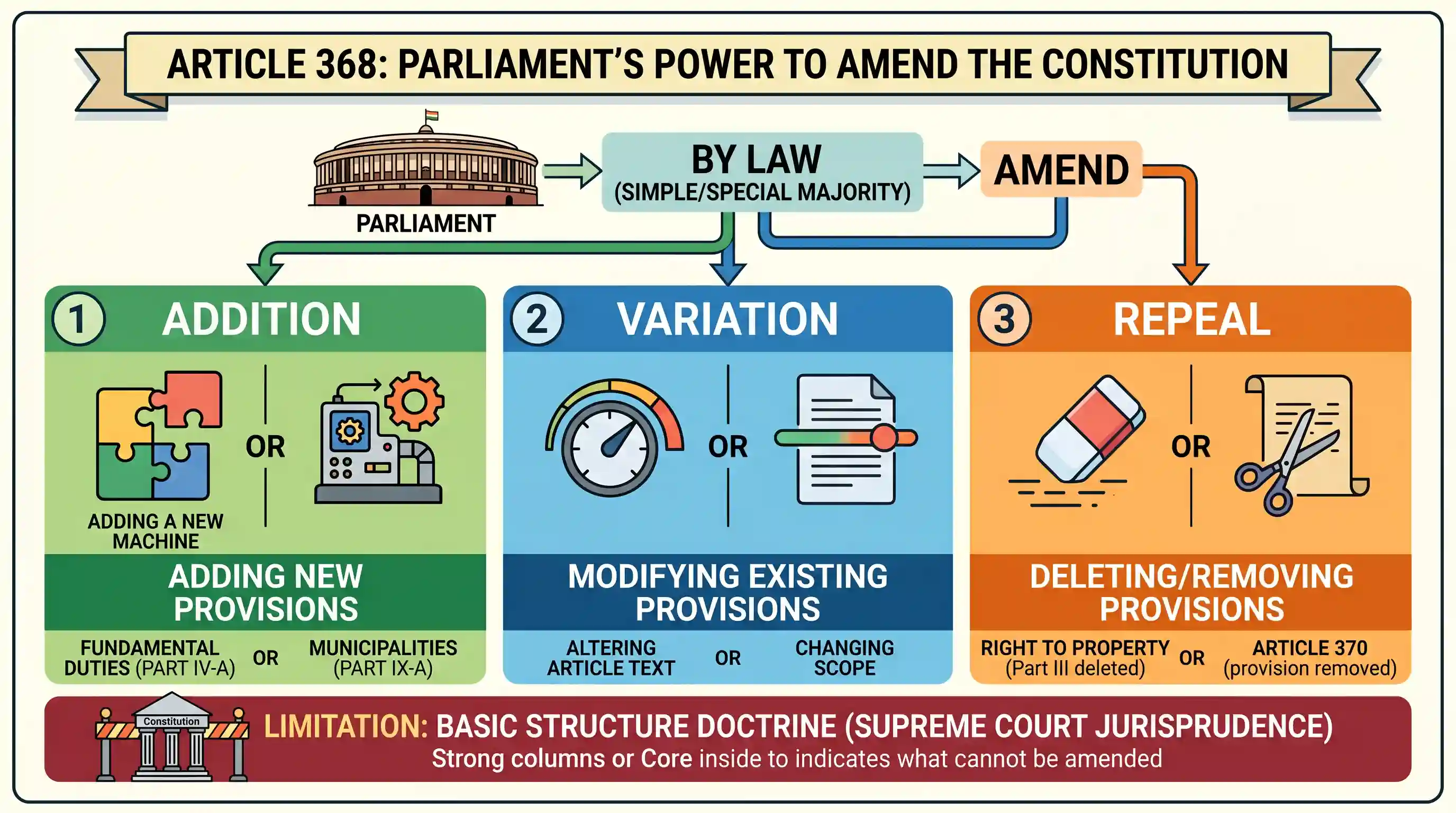
Article 368 of the Constitution of India deals with the power of Parliament to amend the Constitution and the procedure for doing so. An amendment implies changing the existing provisions, which can involve:
-
Addition: Correct. Parliament can add new provisions to the Constitution. For example, the addition of Fundamental Duties (Article 51A) or Part IXA (Municipalities).
-
Variation: Correct. Parliament can modify or change existing provisions of the Constitution. This involves altering the language, scope, or impact of an existing article or part.
-
Repeal: Correct. Parliament can repeal or delete existing provisions of the Constitution. For example, the right to property was removed as a Fundamental Right and made a legal right. This effectively repeals its status as a fundamental right from that part of the Constitution.
The term 'amendment' itself, in constitutional law, encompasses all these forms of change. The Supreme Court, in various judgments, has affirmed Parliament's power to amend the Constitution through addition, variation, or repeal, subject to the Basic Structure Doctrine.
Therefore, all three are correct.
Related questions
More UPSC Prelims practice from the same subject and topic.
- Prelims 2024GS1polity-and-governance
Who was the Provisional President of the Constituent Assembly before Dr. Rajendra Prasad took over?
- Prelims 2024GS1polity-and-governance
Which of the following statements are correct in respect of a Money Bill in the Parliament? 1. Article 109 mentions special procedure in respect of Money Bills. 2. A Money Bill shall not be introduced…
- Prelims 2024GS1polity-and-governance
The Constitution (71st Amendment) Act, 1992 amends the Eighth Schedule to the Constitution to include which of the following languages? 1. Konkani 2. Manipuri 3. Nepali 4. Maithili Select the correct …
- Prelims 2024GS1polity-and-governance
Which of the following statements are correct about the Constitution of India? 1. Powers of the Municipalities are given in Part IX A of the Constitution. 2. Emergency provisions are given in Part XVI…
- Prelims 2024GS1polity-and-governance
Under which of the following Articles of the Constitution of India, has the Supreme Court of India placed the Right to Privacy ?
- Prelims 2024GS1polity-and-governance
Consider the following statements regarding World Toilet Organization : 1. It is one of the agencies of the United Nations. 2. World Toilet Summit, World Toilet Day and World Toilet College are the in…