Subsequent to which one of the following events, Gandhiji, who consistently opposed untouchability and appealed for its eradication from all spheres, decided to include the upliftment of 'Harijans' in his political and social programme?

- AThe Poona PactCorrect
- BThe Gandhi-Irwin Agreement (Delhi Pact)
- CArrest of Congress leadership at the time of the Quit India Movement
- DPromulgation of the Government of India Act, 1935
Explanation
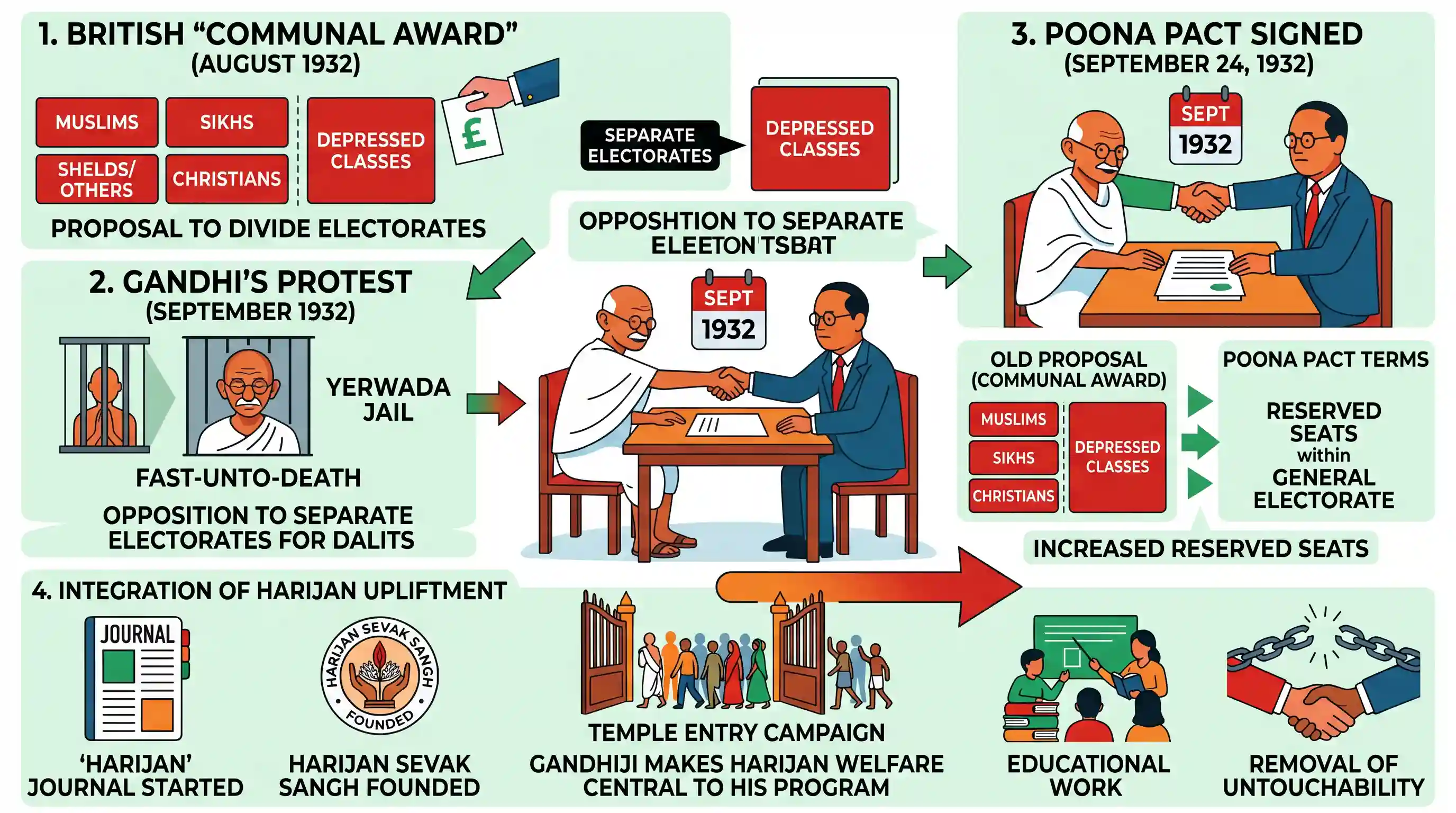
After the Poona Pact (1932), Gandhi decided to include the upliftment of 'Harijans' (Dalits) in his political and social program.
The Poona Pact was signed between Gandhi and Dr. B.R. Ambedkar following Gandhi's fast-unto-death in protest against the British Communal Award that provided separate electorates for Dalits. The Pact replaced separate electorates with reserved seats for Dalits within the general electorate.
This event marked a turning point in Gandhi's approach to the caste question. Following the Pact, Gandhi intensified his efforts for Dalit welfare, started the weekly journal 'Harijan', undertook extensive tours to promote Dalit rights, and made temple entry and removal of untouchability central to his constructive program. The experience of negotiating with Ambedkar and the moral challenge posed by the separate electorate issue compelled Gandhi to make Harijan upliftment a priority.
Related questions
More UPSC Prelims practice from the same subject and topic.
- Prelims 2025GS1history
Consider the following statements about Raja Ram Mohan Roy : I. He possessed great love and respect for the traditional philosophical systems of the East. II. He desired his countrymen to accept the r…
- Prelims 2025GS1history
Consider the following subjects with regard to Non-Cooperation Programme : I. Boycott of law-courts and foreign cloth II. Observance of strict non-violence III. Retention of titles and honours without…
- Prelims 2025GS1history
Consider the following statements in respect of the Non-Cooperation Movement : I. The Congress declared the attainment of 'Swaraj' by all legitimate and peaceful means to be its objective. II. It was …
- Prelims 2025GS1history
"Sedition has become my religion" was the famous statement given by Gandhiji at the time of
- Prelims 2025GS1history
Who provided legal defence to the people arrested in the aftermath of Chauri Chaura incident?
- Prelims 2025GS1history
Who among the following was the founder of the 'Self-Respect Movement?