
Question 60
1. Sending a report to the President of India for imposing the President's rule
2. Appointing the Ministers
3. Reserving certain bills passed by the State Legislature for consideration of the President of India
4. Making the rules to conduct the business of the State Government
Select the correct answer using the code given below.
AOptions
BSolution
The Governor of a State acts mostly on the 'aid and advice' of the Council of Ministers, but the Constitution also grants them certain discretionary powers where they can act on their own judgment. Let's analyze the given options:
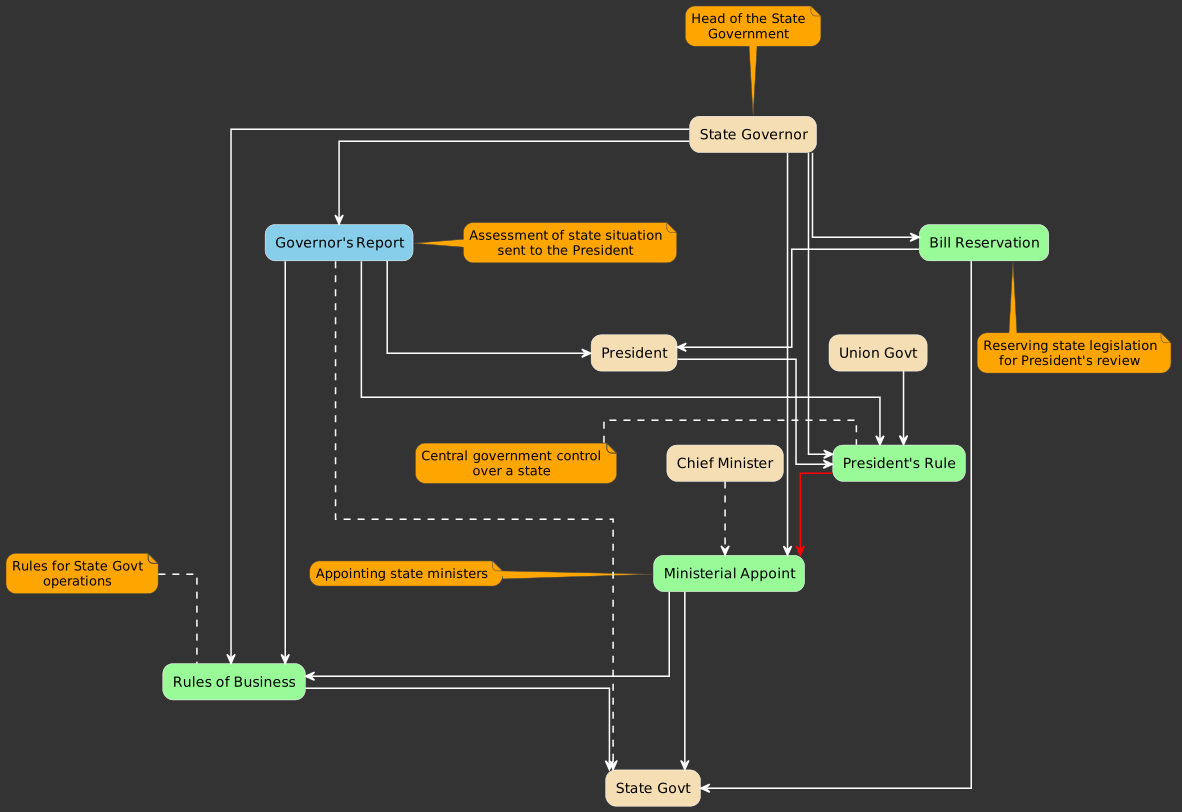
- Sending a report to the President of India for imposing the President's rule: Under Article 356, if the Governor is satisfied that a situation has arisen in which the government of the state cannot be carried on in accordance with the provisions of the Constitution, they can send a report to the President. This power is explicitly a discretionary one, as the Governor acts on their assessment of the constitutional machinery's breakdown.
- Appointing the Ministers: The Governor appoints the Chief Minister and, on the advice of the Chief Minister, appoints other ministers. While the Governor has discretion in choosing a Chief Minister in a hung assembly where no party has a clear majority, the general appointment of ministers once a Chief Minister is designated is not a discretionary power; it is based on the Chief Minister's advice.
- Reserving certain bills passed by the State Legislature for consideration of the President of India: The Governor can reserve certain types of bills passed by the state legislature for the President's assent (e.g., bills that endanger the position of the High Court, are against the Constitution, or are ultra vires). This is a significant discretionary power.
- Making the rules to conduct the business of the State Government: While the Governor makes rules for the more convenient transaction of the business of the state government (under Article 166(3)), these rules are generally framed in consultation with or on the advice of the Council of Ministers, especially the Chief Minister. This is an executive function performed on advice, not a discretionary power in the same vein as the others.
Therefore, statements 1 and 3 correctly identify the discretionary powers of the Governor.
CStrategy
For questions on constitutional functionaries like the Governor, meticulously distinguish between powers exercised on the 'aid and advice' of the Council of Ministers and those that are truly discretionary. Refer to specific articles of the Constitution and landmark judgments for clarity.
DSyllabus Analysis
This question falls under Indian Polity and Governance, specifically the powers and functions of the Governor, with a focus on their discretionary powers as outlined in the Constitution.
EQuestion Analysis
Medium to Difficult. Requires precise knowledge of the Governor's constitutional powers and the specific situations where discretion is applicable.