
Question 80
AOptions
BSolution
A food chain describes the feeding relationships between organisms, illustrating the flow of energy from producers to consumers. It typically starts with producers, followed by primary consumers, then secondary consumers, and so on.
- Producers: Organisms that produce their own food, usually through photosynthesis. In aquatic environments, this includes phytoplankton.
- Primary Consumers (Herbivores): Organisms that feed on producers.
- Secondary Consumers (Carnivores/Omnivores): Organisms that feed on primary consumers.
Let's analyze the given options:
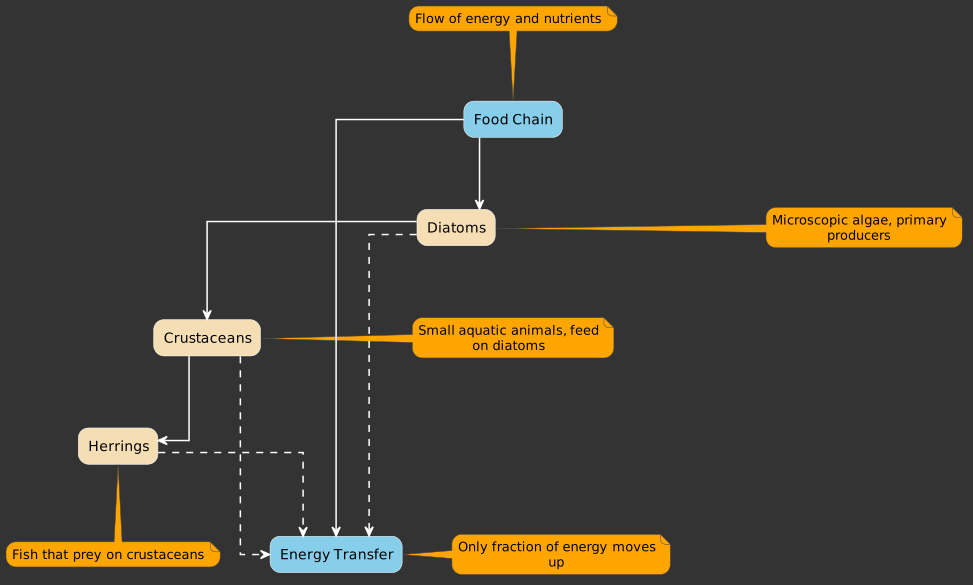
- Diatoms: These are a type of phytoplankton, microscopic algae that perform photosynthesis. They are producers in the marine food chain.
- Crustaceans: These include various marine organisms like copepods and krill, which are types of zooplankton. Zooplankton feed on phytoplankton. Thus, crustaceans are primary consumers that feed on diatoms.
- Herrings: These are small, schooling fish that primarily feed on zooplankton, including crustaceans. Thus, herrings are secondary consumers that feed on crustaceans.
Therefore, the correct sequence representing a food chain is Diatoms (producer) → Crustaceans (primary consumer) → Herrings (secondary consumer).
CStrategy
To solve food chain questions, understand the basic trophic levels: producers, primary consumers (herbivores), secondary consumers (carnivores/omnivores), and tertiary consumers. Identify the primary energy source (producer) and then follow the energy flow sequentially through feeding relationships.
DSyllabus Analysis
This question falls under Environment and Ecology, covering fundamental concepts of Ecology and Ecosystems, specifically Food Chains.
EQuestion Analysis
Easy. This is a basic question on ecological concepts, specifically the understanding of a simple food chain in an aquatic environment.