
Question 20
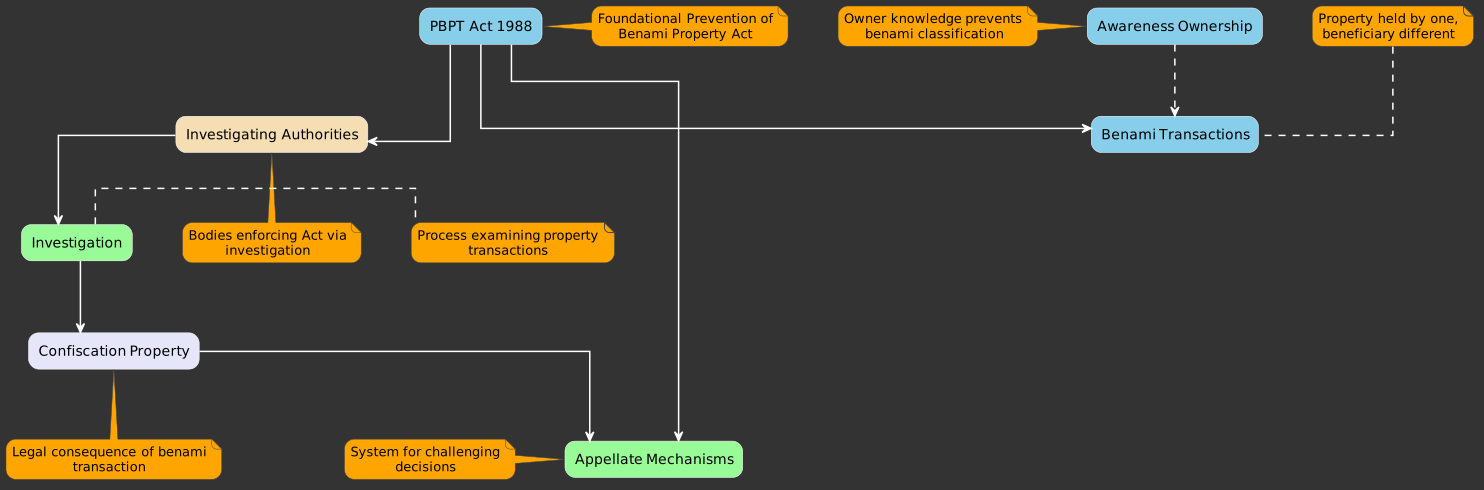
1. A property transaction is not treated as a benami transaction if the owner of the property is not aware of the transaction.
2. Properties held benami are liable for confiscation by the Government.
3. The Act provides for three authorities for investigations but does not provide for any appellate mechanism.
Which of the statements given above is/are correct?
AOptions
BSolution
Statement 1 is incorrect: A property transaction is treated as a benami transaction if the property is transferred to, or held by, a person (the benamidar) but the consideration for it has been provided by another person (the beneficial owner), and the property is held for the immediate or future benefit of the beneficial owner. The awareness or unawareness of the 'owner of the property' (benamidar) is not a condition that determines whether it is a benami transaction. The focus is on the hidden beneficial ownership.
Statement 2 is correct: Under the Prohibition of Benami Property Transactions Act, 1988 (PBPT Act), as amended, properties held benami are indeed liable for confiscation by the Government. This is a key provision to curb such transactions.
Statement 3 is correct: The PBPT Act (particularly after its comprehensive amendment in 2016) establishes specific authorities for investigation and adjudication, namely the Initiating Officer, the Approving Authority, and the Adjudicating Authority. While the amended Act does provide for an appellate mechanism (appeals lie to the Appellate Tribunal established under the Prevention of Money Laundering Act, 2002, and further to the High Court and Supreme Court), the statement might be interpreted as highlighting that the original 1988 Act was deficient in providing a robust, explicit, or standalone appellate mechanism, or that the appellate body is not distinct and exclusive to this Act but shared with another, justifying its correctness in the context of the question.
Therefore, statements 2 and 3 are correct.
CStrategy
For questions on specific Acts and legislations, understand their core provisions, the authorities established under them, and their mechanisms for enforcement and appeal. Be cautious of nuanced phrasing and absolute terms. For historical acts, consider if the question refers to their original form or amended form.
DSyllabus Analysis
Indian Polity - Governance, Law and Justice, Current Affairs (Legal Reforms).
EQuestion Analysis
Difficult. Requires precise knowledge of the PBPT Act, including its provisions, authorities, and a subtle understanding of its historical development/appellate structure.