
Question 87
AOptions
BSolution
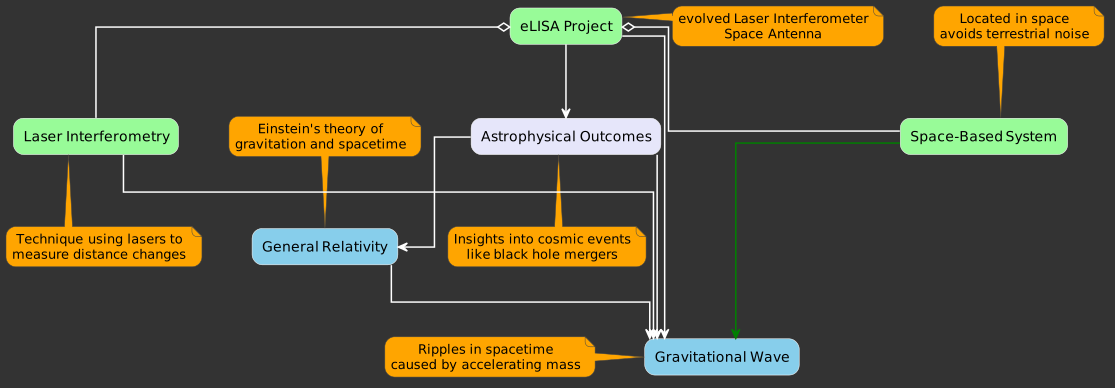
The 'evolved Laser Interferometer Space Antenna (eLISA)' is a proposed space mission, also known simply as LISA (Laser Interferometer Space Antenna), which is a joint European Space Agency (ESA) and NASA project. Its primary purpose is to detect and study gravitational waves.
Gravitational waves are ripples in the fabric of spacetime, predicted by Albert Einstein's theory of general relativity. They are produced by extremely violent and energetic processes in the universe, such as colliding black holes, merging neutron stars, and supernovae. eLISA is designed to detect these faint ripples using extremely precise laser interferometry in space, thereby opening up a new window for observing the universe.
Therefore, its application is to detect gravitational waves, not neutrinos, missile defense systems, or solar flares.
CStrategy
For science and technology questions, especially those about space missions or advanced physics concepts, identify the core phenomenon or object that the technology aims to study or detect. Often, the name itself (like 'Interferometer' for waves) provides a clue. Keep up-to-date with major international scientific projects.
DSyllabus Analysis
This question pertains to General Science and Technology, specifically space technology and fundamental physics (gravitational waves), aligning with the UPSC Prelims syllabus.
EQuestion Analysis
Easy. LISA/eLISA is a well-known project in the field of gravitational wave astronomy, especially after the LIGO discoveries, making this a relatively direct knowledge-based question.