
Question 100
AOptions
BSolution
Indian federalism is often described as 'quasi-federal' or a 'Union of States' because it exhibits characteristics of both a federal and a unitary system. Let's analyze the given options in this context:
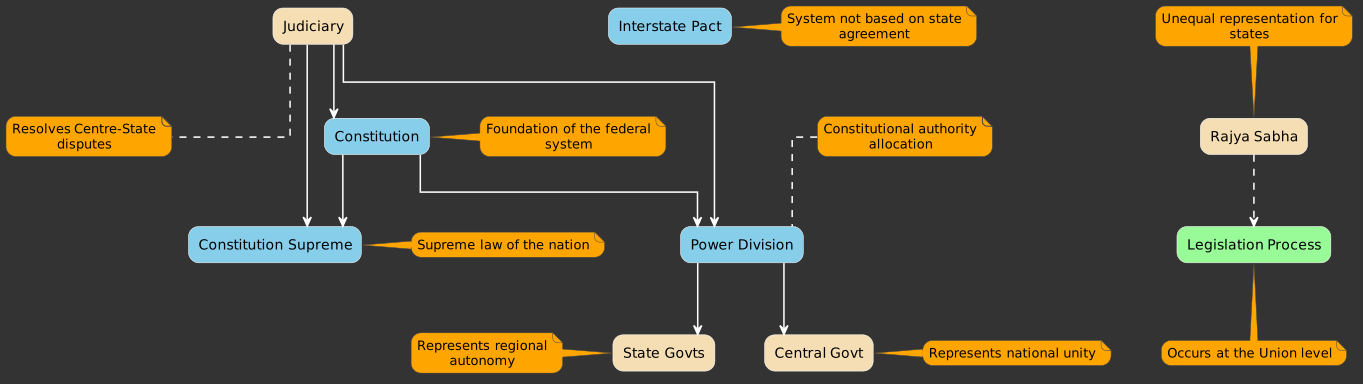
A) There is an independent judiciary in India. This is a feature of Indian federalism. An independent judiciary (Supreme Court and High Courts) is essential to interpret the Constitution, settle disputes between the Centre and States, and uphold the division of powers, which is a hallmark of a federal system.
B) Powers have been clearly divided between the Centre and the States. This is a feature of Indian federalism. The Seventh Schedule of the Constitution explicitly divides legislative powers between the Union (Central), State, and Concurrent Lists, indicating a clear demarcation of responsibilities, typical of a federal structure.
C) The federating units have been given unequal representation in the Rajya Sabha. This is a feature of Indian federalism, though it's a departure from 'classic' federalism (like the USA where all states have equal representation in the Senate). In India, representation in the Rajya Sabha is based on the population of the states, leading to unequal representation among states. This asymmetrical federalism is a characteristic of the Indian system.
D) It is the result of an an agreement among the federating units. This is NOT a feature of Indian federalism. Unlike federal systems such as that of the USA, where independent states came together and signed an agreement to form a federation, the Indian Union was not formed by an agreement among sovereign states. India is described as a 'Union of States' and states have no right to secede from the Union. This indicates a strong unitary bias and distinguishes Indian federalism from true 'coming together' federations.
Therefore, the statement that is not a feature of Indian federalism is that it is the result of an agreement among the federating units.
CStrategy
For questions on federalism, understand the basic characteristics of a federal system and then specifically apply them to the Indian context, noting deviations or unique features. Pay attention to how India's federal structure differs from other major federations. The concept of 'Union of States' and no right to secede is crucial for understanding Indian federalism.
DSyllabus Analysis
This question falls under Indian Polity and Governance, specifically the federal features of the Indian Constitution and the nature of Indian federalism.
EQuestion Analysis
Medium. While basic federal features are known, distinguishing India's unique 'Union of States' model from classic 'agreement-based' federations requires a nuanced understanding of comparative federalism.