
Question 25
1. The families coming under the category of 'below poverty line (BPL)' only are eligible to receive subsidised food grains.
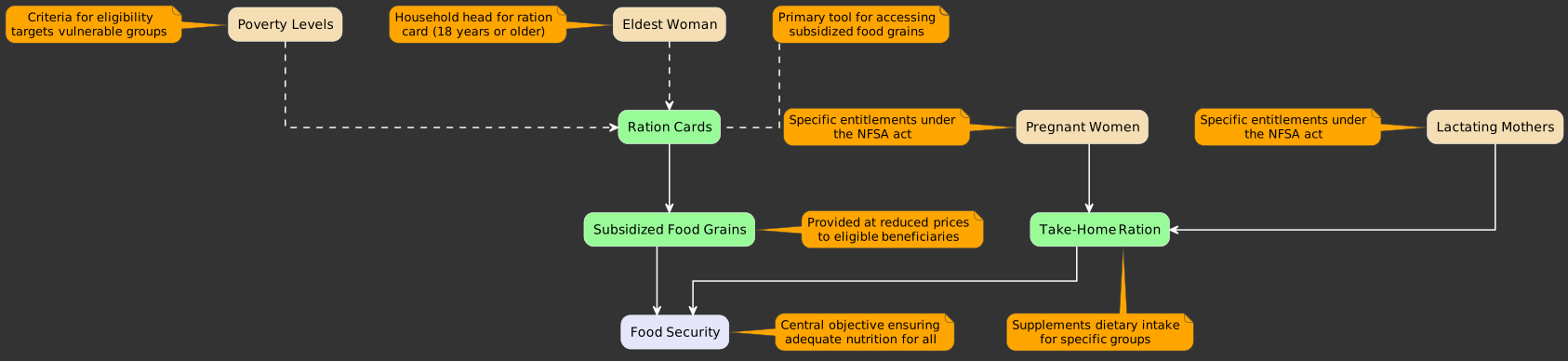
2. The eldest woman in a household, of age 18 years or above, shall be the head of the household for the purpose of issuance of a ration card.
3. Pregnant women and lactating mothers are entitled to a 'take-home ration' of 1600 calories per day during pregnancy and for six months thereafter.
Which of the statements given above is/are correct?
AOptions
BSolution
Statement 1 is incorrect: The National Food Security Act (NFSA), 2013, aims to provide subsidized food grains to up to 75% of the rural population and up to 50% of the urban population, as identified by State/UT Governments. It does not exclusively target families falling under the traditional 'Below Poverty Line (BPL)' category. The Act moved from a BPL/APL (Above Poverty Line) classification to 'priority households' and 'Antyodaya Anna Yojana (AAY)' households, thus broadening the coverage.
Statement 2 is correct: As per Section 13 of the National Food Security Act, 2013, for the purpose of issue of ration cards under the Act, the eldest woman who is 18 years of age or above in the household shall be the head of the household. This provision aims to empower women and ensure their centrality in household food security.
Statement 3 is incorrect: The NFSA, 2013, entitles pregnant women and lactating mothers to free nutritious meals, through the local Anganwadi, during pregnancy and for six months after childbirth, along with maternity benefits of at least Rs. 6,000. While nutrition is provided, the Act does not specify a precise 'take-home ration' of '1600 calories per day'. The focus is on providing a nutritious meal and financial support, with specific calorie/protein norms typically decided at the program implementation level (e.g., ICDS guidelines).
CStrategy
For questions on major social welfare acts, it is crucial to know the precise beneficiaries, benefits, and key provisions. Pay attention to specific percentages, age limits, and the roles of different groups (e.g., eldest woman as head of household). Be cautious of specific numerical values (like calorie counts) unless explicitly stated in the Act itself.
DSyllabus Analysis
This question falls under Indian Polity and Governance, specifically Government Policies and Interventions, and Social Sector Initiatives (Food Security, Welfare Schemes).
EQuestion Analysis
Medium. It requires detailed knowledge of the specific provisions and nuances of a significant social welfare legislation like the NFSA.