
Question 8
1. It is introduced as a part of the Income Tax Act.
2. Non-resident entities that offer advertisement services in India can claim a tax credit in their home country under the "Double Taxation Avoidance Agreements".
Select the correct answer using the code given below:
AOptions
BSolution
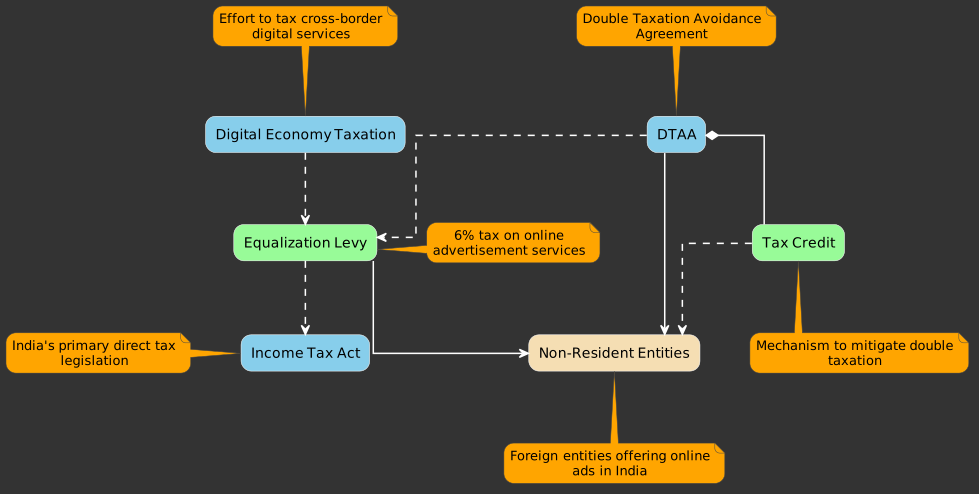
Statement 1 is incorrect: India's equalization levy (often referred to as 'Google Tax') of 6% on online advertisement services offered by non-resident entities was introduced as a new Chapter VIII in the Finance Act, 2016, specifically dealing with the equalization levy. It was not introduced as a part of the Income Tax Act, 1961. This distinction was crucial as it allowed the levy to operate outside the purview of traditional income tax treaties.
Statement 2 is incorrect: The equalization levy is generally not covered under Double Taxation Avoidance Agreements (DTAAs). DTAAs are typically designed to avoid double taxation on income as defined under income tax laws. Since the equalization levy was designed as a separate levy outside the scope of income tax, it does not usually fall under the ambit of existing DTAAs. Therefore, non-resident entities typically cannot claim a tax credit in their home country under DTAAs for this levy.
CStrategy
For questions on recent tax policies, especially those with international implications, it's vital to know the specific legal instrument through which they are introduced (e.g., Finance Act, Income Tax Act) and their implications regarding international tax treaties like DTAAs. Small details about the legal framework can change the correctness of a statement.
DSyllabus Analysis
This question falls under Indian Economy, specifically Taxation, Fiscal Policy, and International Trade & Taxation, often emerging from current affairs related to digital economy taxation.
EQuestion Analysis
Difficult. It requires very specific and up-to-date knowledge of a particular tax policy's legal framework and its interaction with international tax agreements.