
Question 12
1. Aadhaar card can be used as a proof of citizenship or domicile.
2. Once issued, Aadhaar number cannot be deactivated or omitted by the Issuing Authority.
Which of the statements given above is/are correct?
AOptions
BSolution
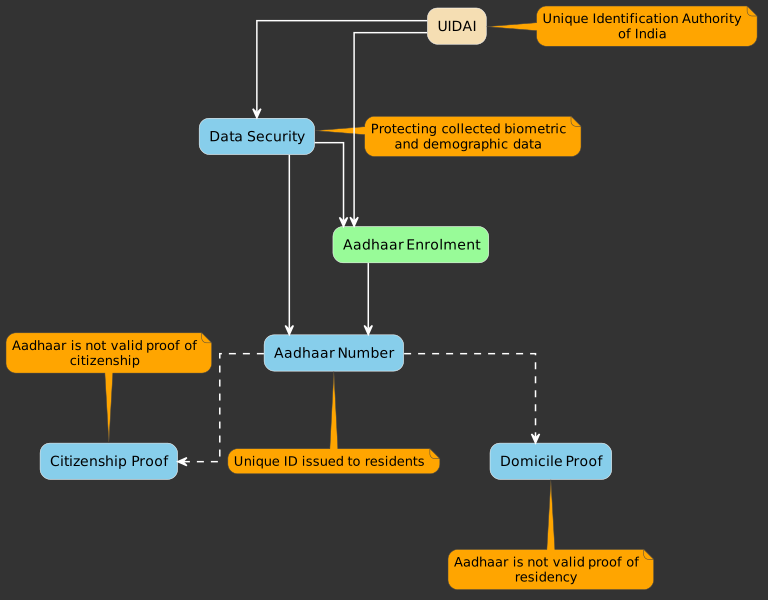
Statement 1 is incorrect: The Unique Identification Authority of India (UIDAI), the issuing body for Aadhaar, explicitly states that Aadhaar is a proof of identity, not a proof of citizenship or domicile. It is issued to residents of India, regardless of their citizenship status, and does not confer any rights of citizenship or domicile. Therefore, it cannot be used as a standalone document for these purposes.
Statement 2 is incorrect: While Aadhaar is designed to be a lifelong identity number, the Aadhaar Act and UIDAI regulations do provide mechanisms for deactivation or omission in certain circumstances. These can include cases where multiple Aadhaar numbers are issued to a single individual (one must be deactivated), or where an Aadhaar number was obtained fraudulently, or if a person explicitly requests deactivation under specific rules (e.g., if they are an NRI who has been away for long). Thus, it is not true that an Aadhaar number cannot be deactivated or omitted by the Issuing Authority.
CStrategy
For questions on government programs like Aadhaar, it's vital to understand their legal basis, intended purpose, and operational guidelines. Be cautious of absolute statements (e.g., 'cannot be deactivated') and clarify what a document *is* versus what it *is not* (e.g., identity vs. citizenship proof).
DSyllabus Analysis
This question falls under Indian Polity and Governance, specifically related to Government Schemes, Digital Governance, and Public Policy.
EQuestion Analysis
Medium. It requires precise knowledge about the characteristics and limitations of the Aadhaar system, which can be easily misunderstood.