
Question 63
1. GM mustard has the genes of a soil bacterium that give the plant the property of pest-resistance to a wide variety of pests.
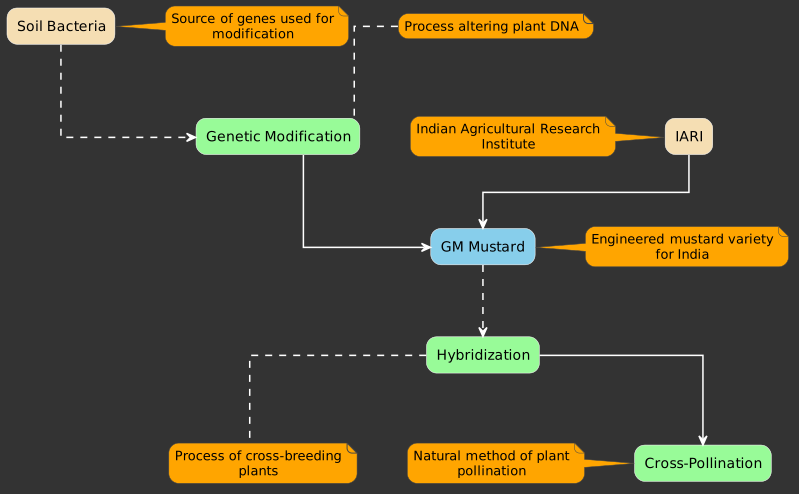
2. GM mustard has the genes that allow the plant cross-pollination and hybridization.
3. GM mustard has been developed jointly by the IARI and Punjab Agricultural University.
Which of the statements given above is/are correct?
AOptions
BSolution
Let's analyze the statements regarding Genetically Modified (GM) mustard, specifically DMH-11 (Dhara Mustard Hybrid-11), developed in India:
1. GM mustard has the genes of a soil bacterium that give the plant the property of pest-resistance to a wide variety of pests. This statement is incorrect. DMH-11 does not primarily have genes for pest resistance. Unlike Bt cotton, which incorporates a gene from the bacterium *Bacillus thuringiensis* (Bt) for pest resistance, GM mustard uses two genes, Barnase and Barstar, derived from the soil bacterium *Bacillus amyloliquefaciens* for creating a male-sterile line and restoring fertility, which is crucial for hybrid seed production. It is not engineered for pest resistance.
2. GM mustard has the genes that allow the plant cross-pollination and hybridization. This statement is correct. The Barnase-Barstar system in DMH-11 is a genetic engineering technique that enables controlled cross-pollination and the efficient production of hybrid mustard varieties. Barnase induces male sterility, and Barstar restores fertility in the hybrid, facilitating cross-pollination for higher yield hybrids.
3. GM mustard has been developed jointly by the IARI and Punjab Agricultural University. This statement is incorrect. DMH-11 was developed by a team of scientists at the Centre for Genetic Manipulation of Crop Plants (CGMCP), University of Delhi South Campus, led by Dr. Deepak Pental. It was not a joint development by IARI (Indian Agricultural Research Institute) and Punjab Agricultural University.
Therefore, only statement 2 is correct.
CStrategy
For questions on controversial or highly specific scientific topics like GM crops, be precise about the details: the specific genetic modification, its intended purpose, and the institutions involved in its development. Avoid generalized assumptions.
DSyllabus Analysis
This question falls under Science & Technology, specifically Biotechnology, Genetically Modified Crops, and their application in agriculture.
EQuestion Analysis
Difficult. Requires very specific and detailed knowledge about a particular GM crop (DMH-11).