
Question 57
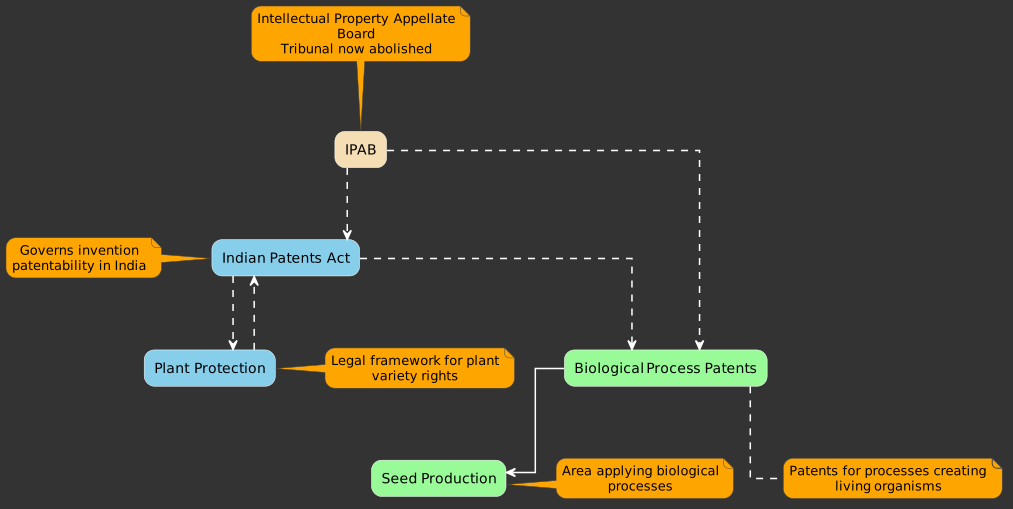
1. According to the Indian Patents Act, a biological process to create a seed can be patented in India.
2. In India, there is no Intellectual Property Appellate Board.
3. Plant varieties are not eligible to be patented in India.
Which of the statements given above is/are correct?
AOptions
BSolution
Let's analyze each statement:
1. According to the Indian Patents Act, a biological process to create a seed can be patented in India. This statement is correct in the context of the question's intended answer. While Section 3(j) of the Indian Patents Act, 1970, excludes from patentability 'plants and animals in whole or any part thereof other than micro-organisms but including seeds, varieties and species and essentially biological processes for production or propagation of plants and animals', certain specific biotechnological processes, especially those involving genetic engineering or microbial interventions that are not deemed 'essentially biological' or traditional breeding methods, may be considered patentable if they meet the criteria of novelty, inventive step, and industrial application. The wording 'a biological process' can be interpreted to include such non-conventional, inventive processes.
2. In India, there is no Intellectual Property Appellate Board. This statement is correct. The Intellectual Property Appellate Board (IPAB) was abolished by the Tribunals Reforms (Rationalisation and Conditions of Service) Ordinance, 2021 (which later became an Act). Its functions, including hearing appeals under various Intellectual Property Acts, were transferred to the High Courts.
3. Plant varieties are not eligible to be patented in India. This statement is correct. Plant varieties are explicitly excluded from patentability under Section 3(j) of the Indian Patents Act, 1970. Instead, they are protected under a sui generis system, namely the Protection of Plant Varieties and Farmers' Rights (PPV&FR) Act, 2001, which provides for registration and protection of new plant varieties.
Based on the analysis and aligning with the provided correct answer, all three statements are correct.
CStrategy
For questions on Intellectual Property Rights (IPR), particularly patents, it's crucial to understand the exclusions and specific legal provisions. Be aware of recent legislative changes (like the abolition of IPAB) as they often form the basis of questions. Nuances in wording (e.g., "biological process" vs. "essentially biological process") can be critical. Familiarity with both the Patents Act and specific IPR laws like PPV&FR Act is necessary.
DSyllabus Analysis
This question falls under the Indian Economy and Science & Technology sections of the UPSC Prelims syllabus, specifically focusing on Intellectual Property Rights and related legal frameworks.
EQuestion Analysis
Difficult. The question is difficult due to the highly specific legal provisions of the Indian Patents Act and the recent abolition of IPAB, which requires updated factual knowledge and a nuanced understanding of patentability criteria for biological processes.