
Question 60
As per the Industrial Employment (Standing Orders) Central (Amendment) Rules, 2018
1. if rules for fixed-term employment are implemented, it becomes easier for the firms/companies to lay off workers
2. no notice of termination of employment shall be necessary in the case of temporary workman
Which of the statements given above is/are correct?
AOptions
BSolution
Let's analyze each statement as per the Industrial Employment (Standing Orders) Central (Amendment) Rules, 2018:
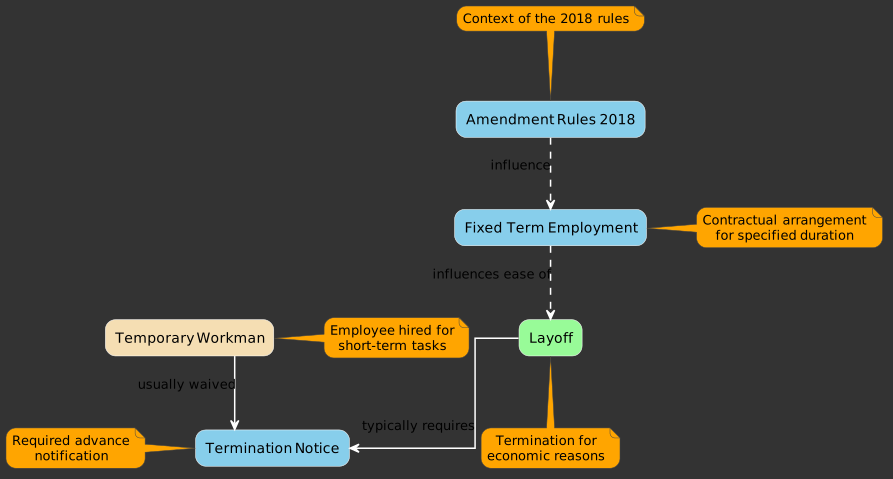
1. if rules for fixed-term employment are implemented, it becomes easier for the firms/companies to lay off workers. This statement is correct. The 2018 amendment introduced the concept of 'fixed-term employment' for all sectors. Under this, a workman can be employed for a fixed period. Crucially, on the expiry of the fixed term, the employment automatically terminates without the requirement of notice or payment of retrenchment compensation, which is normally applicable to regular workmen. This provides firms with greater flexibility in managing their workforce and effectively makes it easier to 'lay off' workers by simply not renewing their contracts upon expiry, without incurring the traditional costs associated with retrenchment.
2. no notice of termination of employment shall be necessary in the case of temporary workman. This statement is incorrect. The Industrial Employment (Standing Orders) Act, 1946, and its associated rules generally require notice of termination or wages in lieu thereof for most categories of workmen, including permanent, probationer, badli, and temporary workmen, unless dismissal is for misconduct. While the 2018 amendment specifically addressed fixed-term employment by removing the need for notice or compensation upon contract expiry, it did not extend this exemption to all 'temporary' workmen generally covered by the existing rules, who may still require notice.
CStrategy
For questions on labor laws and industrial relations, it's crucial to understand the specific impact of amendments. Differentiate between categories of workers (e.g., fixed-term vs. temporary) and the precise legal implications for each. Focus on how new provisions alter existing employment practices.
DSyllabus Analysis
This question falls under the Indian Economy and Social Issues sections of the UPSC Prelims syllabus, specifically focusing on labor laws and employment policies.
EQuestion Analysis
Medium. The question tests specific knowledge about recent amendments to labor laws and their practical implications, requiring a clear understanding of the nuances between different types of employment.