
Question 81
1. No High Court shall have the jurisdiction to declare any central law to be constitutionally invalid.
2. An amendment to the Constitution of India cannot be called into question by the Supreme Court of India.
Which of the statements given above is/are correct?
AOptions
BSolution
Let's analyze each statement regarding the Constitution of India:
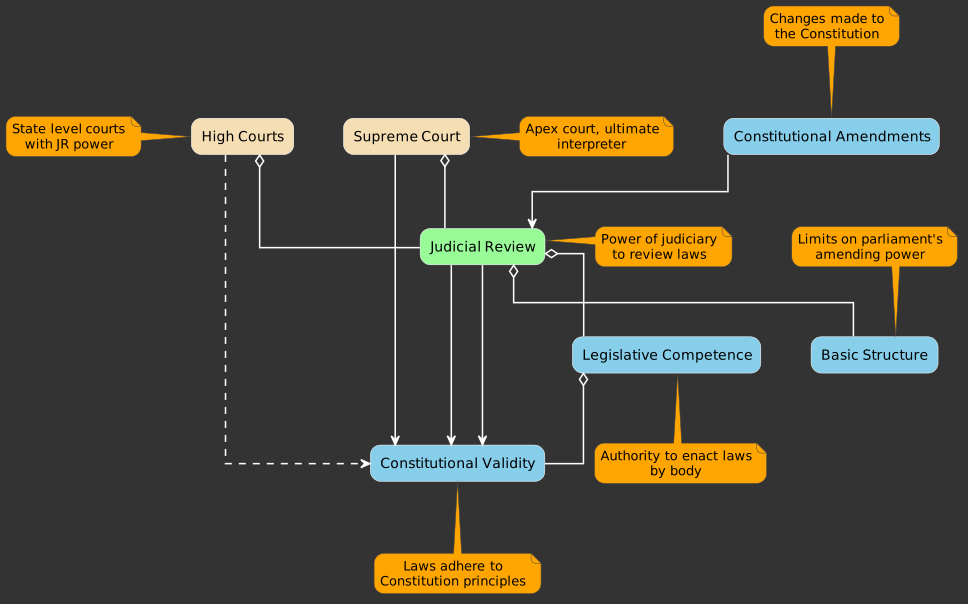
1. No High Court shall have the jurisdiction to declare any central law to be constitutionally invalid. This statement is incorrect. Both the Supreme Court (under Article 32) and the High Courts (under Article 226 and 227) have the power of judicial review to declare any law, be it central or state, constitutionally invalid if it violates the provisions of the Constitution. This power is a fundamental aspect of the Indian judiciary's role as the guardian of the Constitution.
2. An amendment to the Constitution of India cannot be called into question by the Supreme Court of India. This statement is also incorrect. The Supreme Court of India, through its power of judicial review, can indeed examine the constitutional validity of an amendment to the Constitution. The landmark Kesavananda Bharati case (1973) established the 'Basic Structure Doctrine', which allows the Supreme Court to strike down any constitutional amendment that violates the basic structure of the Constitution. Therefore, amendments can be called into question.
Since both statements are incorrect, the correct answer is 'Neither 1 nor 2'.
CStrategy
For questions on the Indian Constitution and judiciary, a thorough understanding of the powers of the Supreme Court and High Courts, especially judicial review and the Basic Structure Doctrine, is essential. Be wary of absolute statements like 'No' or 'cannot' as they are often incorrect in constitutional contexts.
DSyllabus Analysis
This question falls under 'Indian Polity and Governance' and specifically 'Judiciary' within the UPSC Prelims syllabus.
EQuestion Analysis
Medium. Requires a clear understanding of the powers of the judiciary in India, particularly regarding judicial review of laws and constitutional amendments.