
Question 40
1. Under Ramsar Convention, it is mandatory on the part of the Government of India to protect and conserve all the wetlands in the territory of India.
2. The Wetlands (Conservation and Management) Rules, 2010 were framed by the Government of India based on the recommendations of Ramsar Convention.
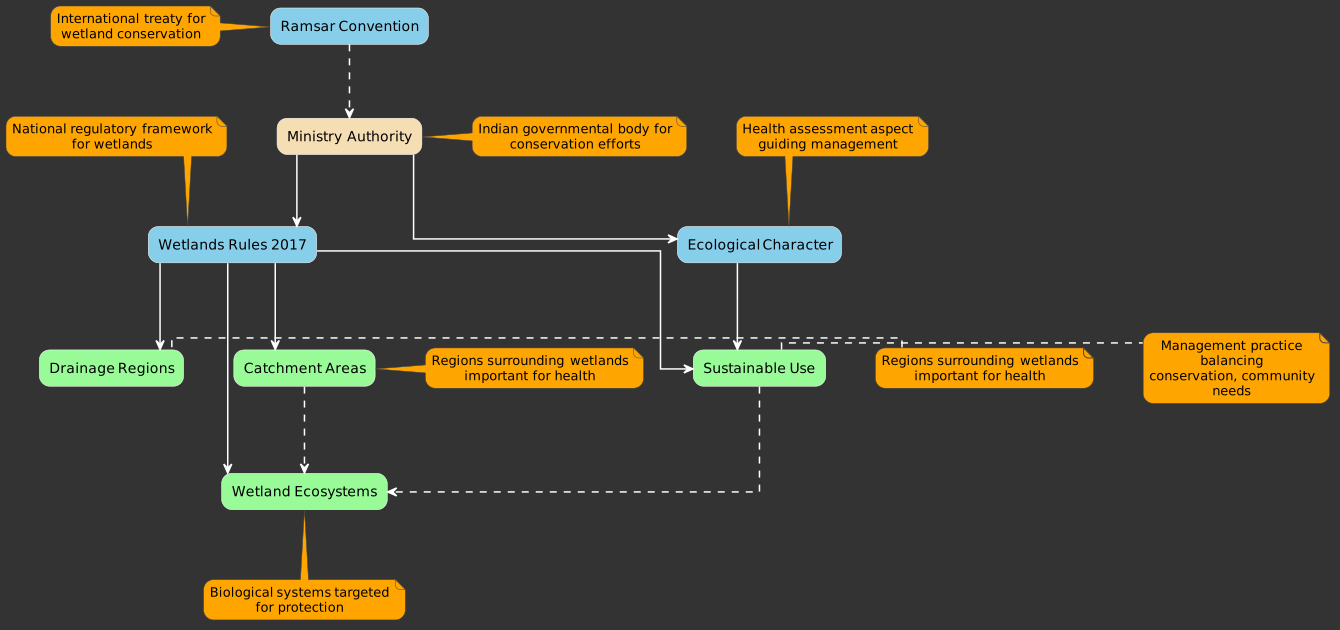
3. The Wetlands (Conservation and Management) Rules, 2010 also encompass the drainage area or catchment regions of the wetlands as determined by the authority.
Which of the statements given above is/are correct?
AOptions
BSolution
Let's analyze each statement regarding the Ramsar Convention and Wetlands Rules:
1. Under Ramsar Convention, it is mandatory on the part of the Government of India to protect and conserve all the wetlands in the territory of India. Incorrect. The Ramsar Convention (Convention on Wetlands of International Importance especially as Waterfowl Habitat) encourages contracting parties to designate suitable wetlands for the List of Wetlands of International Importance (Ramsar Sites) and to promote their wise use. It does not mandate the protection and conservation of *all* wetlands across the entire territory of a country, though it does promote the wise use concept for all wetlands within the territory.
2. The Wetlands (Conservation and Management) Rules, 2010 were framed by the Government of India based on the recommendations of Ramsar Convention. Correct. India, being a signatory to the Ramsar Convention, framed these rules to provide a legal framework for the conservation and wise use of wetlands in the country, aligning with the convention's principles and guidelines.
3. The Wetlands (Conservation and Management) Rules, 2010 also encompass the drainage area or catchment regions of the wetlands as determined by the authority. Correct. The 2010 Rules (and subsequent 2017 Rules) recognized that the ecological health of a wetland is intrinsically linked to its surrounding drainage or catchment area. Therefore, they sought to regulate activities not just within the wetland boundary but also in its catchment, acknowledging the hydrological connectivity and potential impacts from upstream/surrounding activities.
Thus, statements 2 and 3 are correct.
CStrategy
For questions on international conventions and associated national laws, pay close attention to the scope and mandates. Be wary of absolute terms like 'all' or 'mandatory' in convention contexts, as they often promote broader principles rather than strict mandates for every single resource. Understand the evolution and key features of relevant national legislation.
DSyllabus Analysis
This question falls under the Environment & Ecology (Environmental Governance, International Conventions, Wetlands) and Indian Polity (Acts and Rules) sections of the UPSC Prelims syllabus.
EQuestion Analysis
Medium to Difficult. It requires a nuanced understanding of both the Ramsar Convention's principles and the specifics of Indian wetland rules, including their scope.