
Question 13
1. The Constitution of India defines its 'basic structure' in terms of federalism, secularism, fundamental rights and democracy.
2. The Constitution of India provides for 'judicial review' to safeguard the citizens' liberties and to preserve the ideals on which the Constitution is based.
Which of the statements given above is/are correct?
AOptions
BSolution
Let's examine each statement:
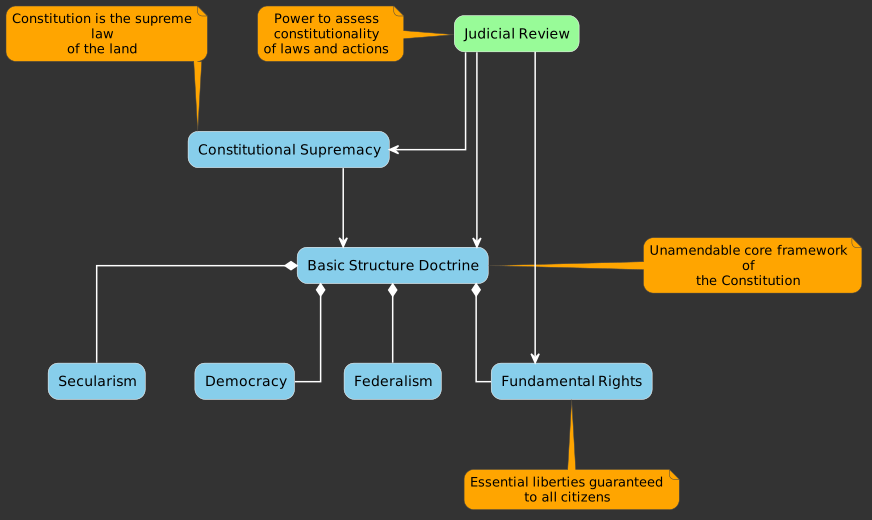
1. The Constitution of India defines its 'basic structure' in terms of federalism, secularism, fundamental rights and democracy. This statement is incorrect. The 'basic structure' doctrine is a judicial innovation that evolved through a series of Supreme Court judgments, most notably the Kesavananda Bharati case (1973). The Constitution of India itself does not explicitly define or list what constitutes its 'basic structure'. It is the judiciary that has, over time, identified various elements like federalism, secularism, democracy, republican nature, judicial review, etc., as part of this basic structure, which cannot be altered by parliamentary amendment.
2. The Constitution of India provides for 'judicial review' to safeguard the citizens' liberties and to preserve the ideals on which the Constitution is based. This statement is correct. The Constitution of India explicitly provides for judicial review in various articles. For example, Article 13 declares that laws inconsistent with or in derogation of Fundamental Rights shall be void. Articles 32 and 226 empower the Supreme Court and High Courts, respectively, to issue writs for the enforcement of Fundamental Rights and for other purposes. This power of judicial review is essential to check the constitutionality of legislative and executive actions, thereby safeguarding citizens' liberties and upholding constitutional ideals.
Therefore, only statement 2 is correct.
CStrategy
When dealing with constitutional concepts like 'basic structure' and 'judicial review', understand their origins. Basic structure is a judicial construct, not a constitutional definition. Judicial review, however, has explicit constitutional backing. Distinguishing between what the Constitution explicitly states and what the judiciary has interpreted or evolved is key.
DSyllabus Analysis
This question falls under the Indian Polity section, specifically focusing on the fundamental features of the Indian Constitution, judicial review, and the doctrine of basic structure.
EQuestion Analysis
Medium. While both concepts are crucial, the nuance regarding whether the Constitution *defines* the basic structure or if it's a judicial interpretation is a common point of confusion.