
Question 98
1. 36% of India's districts are classified as "overexploited" or "critical" by the Central Ground Water Authority (CGWA).
2. CGWA was formed under the Environment (Protection) Act.
3. India has the largest area under groundwater irrigation in the world.
Which of the statements given above is/are correct?
AOptions
BSolution
Let's analyze the statements regarding groundwater management in India:
1. 36% of India's districts are classified as "overexploited" or "critical" by the Central Ground Water Authority (CGWA): This statement is incorrect. While groundwater over-exploitation is a severe issue in India, the figure of 36% often refers to the percentage of 'assessment units' (such as blocks, talukas, or mandals), not entire districts, that are categorized as over-exploited, critical, or semi-critical. According to various reports by the CGWB (Central Ground Water Board, which works under CGWA), the percentage of over-exploited assessment units varies but is typically around 17% (as per 2022 assessment). The cumulative percentage of 'over-exploited,' 'critical,' and 'semi-critical' units is higher, but 36% specifically for 'districts' being overexploited or critical is not accurate in official assessments. Therefore, the statement is inaccurate in terms of the unit of measurement and possibly the precise percentage.
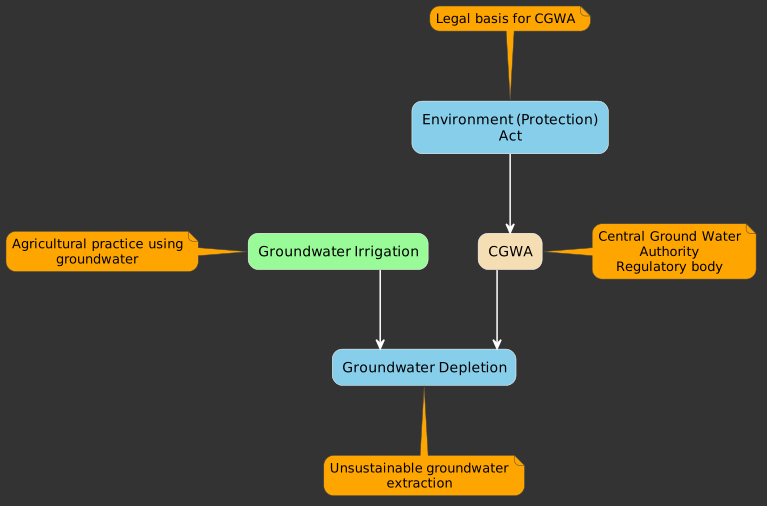
2. CGWA was formed under the Environment (Protection) Act: This statement is correct. The Central Ground Water Authority (CGWA) was constituted under Section 3(3) of the Environment (Protection) Act, 1986, in 1997. Its primary mandate is to regulate and control groundwater development and management throughout the country.
3. India has the largest area under groundwater irrigation in the world: This statement is correct. India is globally recognized as the largest user of groundwater, with groundwater being the primary source of irrigation for a vast agricultural area. This extensive reliance on groundwater for irrigation has significantly contributed to the rapid decline of water tables in many parts of the country.
Therefore, statements 2 and 3 are correct.
CStrategy
For questions on environmental issues and governance, verify the legal basis of institutions and the extent of the problem. Be cautious with precise percentages or numbers unless they are well-established facts from authoritative sources, as these can often be misleading or outdated. Understand India's global standing in terms of resource utilization.
DSyllabus Analysis
This question falls under Environment & Ecology, Indian Geography, and Governance, specifically water resources management, environmental regulation, and agricultural practices in India.
EQuestion Analysis
Medium to Difficult. Statement 1 requires precise factual knowledge about groundwater assessment units and their classification, which can be tricky. Statements 2 and 3 are more commonly known facts related to India's water sector and environmental governance.