
Question 70
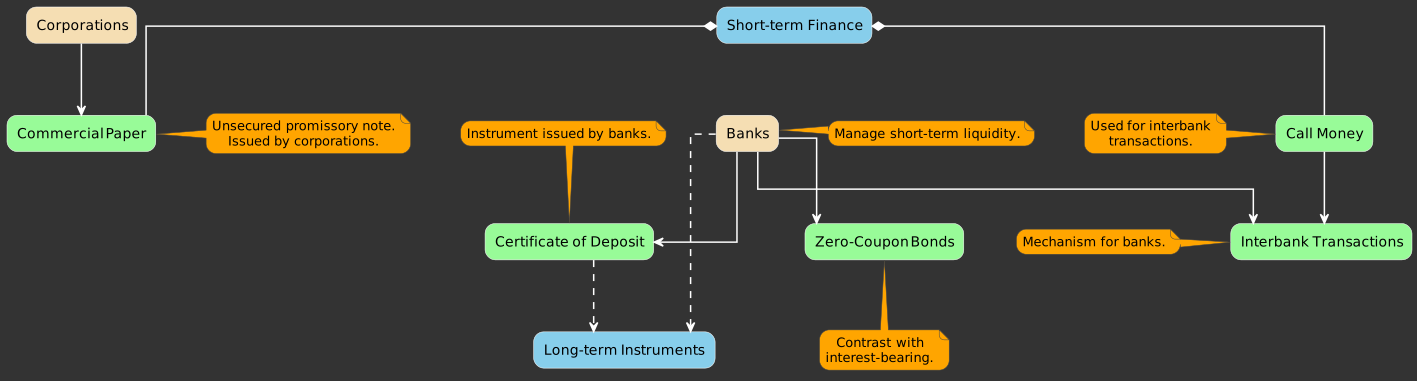
1. 'Commercial Paper' is a short-term unsecured promissory note.
2. 'Certificate of Deposit' is a long-term instrument issued by the Reserve Bank of India to a corporation.
3. 'Call Money' is a short-term finance used for interbank transactions.
4. 'Zero-Coupon Bonds' are the interest bearing short-term bonds issued by the Scheduled Commercial Banks to corporations.
Which of the statements given above is/are correct?
AOptions
BSolution
Let's analyze each statement regarding financial market instruments in India:
1. 'Commercial Paper' is a short-term unsecured promissory note. This statement is correct. Commercial Paper (CP) is indeed a short-term (typically 7 days to 1 year) money market instrument issued by highly-rated corporate borrowers and primary dealers. It is unsecured, meaning it is not backed by collateral, and is issued in the form of a promissory note.
2. 'Certificate of Deposit' is a long-term instrument issued by the Reserve Bank of India to a corporation. This statement is incorrect. A Certificate of Deposit (CD) is a short-term (generally 7 days to 1 year for banks; 3 months to 1 year for financial institutions) money market instrument. It is issued by commercial banks and financial institutions, not typically by the Reserve Bank of India, and can be issued to individuals, corporations, or funds. It is not a long-term instrument.
3. 'Call Money' is a short-term finance used for interbank transactions. This statement is correct. Call money refers to overnight lending and borrowing between banks to manage their day-to-day liquidity positions. It is a very short-term (typically one day) money market instrument primarily used for interbank transactions.
4. 'Zero-Coupon Bonds' are the interest bearing short-term bonds issued by the Scheduled Commercial Banks to corporations. This statement is incorrect. Zero-Coupon Bonds (ZCBs) are bonds that do not pay periodic interest (coupons). Instead, they are issued at a discount to their face value and redeemed at face value upon maturity, with the difference constituting the investor's return. They are not 'interest bearing' in the traditional sense, can be short or long-term, and are issued by various entities (governments, corporations), not exclusively by Scheduled Commercial Banks to corporations.
Therefore, statements 1 and 3 are correct.
CStrategy
For questions on financial market instruments, precision in definitions is key. Understand the characteristics of each instrument: its maturity period (short-term/long-term), whether it's secured or unsecured, its issuer, and how returns are generated (interest-bearing, discount).
DSyllabus Analysis
This question falls under the Indian Economy, specifically focusing on financial markets, money market instruments, and capital market instruments.
EQuestion Analysis
Medium. It requires precise knowledge of the definitions and characteristics of various financial instruments commonly used in the Indian money and capital markets.