
Question 54
1. Housing loans owed by households
2. Amounts outstanding on credit cards
3. Treasury bills
Select the correct answer using the code given below:
AOptions
BSolution
Non-financial debt typically refers to the debt held by entities other than financial corporations, such as households, non-financial corporations, and the government. Let's examine the options:
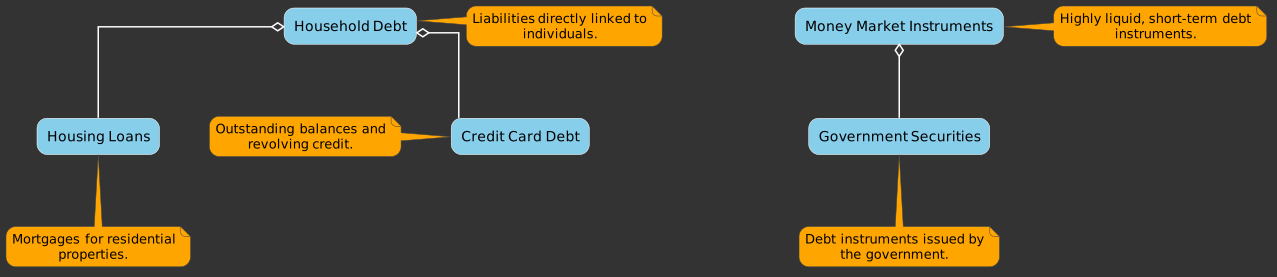
1. Housing loans owed by households: Housing loans are borrowed by individuals (households) for purchasing homes. Households are non-financial entities, and these loans represent a significant part of household debt. Therefore, this is included in non-financial debt.
2. Amounts outstanding on credit cards: Credit card outstanding amounts are also a form of debt incurred by households for consumption or other purposes. Households are non-financial entities. Therefore, this is also included in non-financial debt.
3. Treasury bills: Treasury bills are short-term debt instruments issued by the government. The government is also a non-financial entity. In a broad sense, government debt is considered non-financial debt. However, in many economic discussions, 'non-financial debt' often implicitly refers to private non-financial debt (households and non-financial corporations), with government debt being discussed separately as 'public debt'. Given the provided answer, the question likely refers to private non-financial debt, or the most common understanding of household and corporate non-financial debt, thereby excluding treasury bills in this specific context.
Based on the provided correct answer, only housing loans and credit card outstanding amounts are considered in this context of non-financial debt.
CStrategy
When dealing with economic definitions, understand the precise categories and common classifications used. Be aware that terms like 'non-financial debt' can sometimes have a broader or narrower interpretation depending on the context, often differentiating between private and public sectors.
DSyllabus Analysis
This question falls under the Indian Economy, particularly topics related to financial markets, public debt, and household finance.
EQuestion Analysis
Medium-Difficult. While Treasury bills are technically government (non-financial) debt, the provided answer suggests a narrower interpretation, likely focusing on private non-financial debt, making it tricky.