
Question 99
1. Jet streams occur in the Northern Hemisphere only.
2. Only some cyclones develop an eye.
3. The temperature inside the eye of a cyclone is nearly 10°C lesser than that of the surroundings.
Which of the statements given above is/are correct?
AOptions
BSolution
Let's analyze the statements concerning atmospheric phenomena:
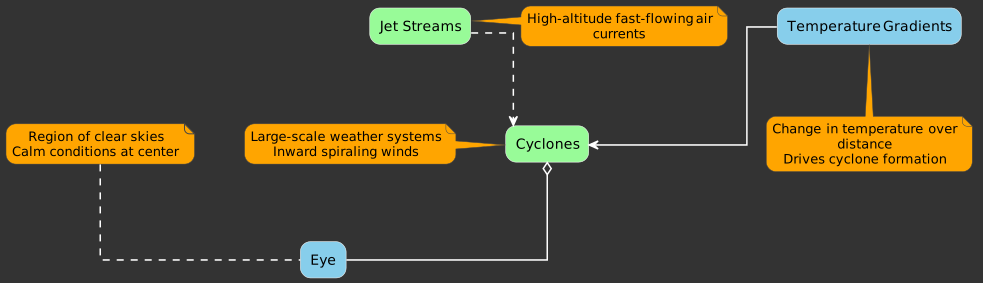
1. Jet streams occur in the Northern Hemisphere only: This statement is incorrect. Jet streams are high-altitude, fast-flowing, narrow air currents that occur in both the Northern and Southern Hemispheres. The two main types are the polar jet streams and the subtropical jet streams, both of which are found in both hemispheres, although their exact positions and strengths may vary seasonally.
2. Only some cyclones develop an eye: This statement is correct. The 'eye' is a distinct feature found primarily in *mature and strong tropical cyclones* (such as hurricanes or typhoons). It is a central region of relatively calm weather, clear skies, and light winds. Weaker tropical cyclones and all extra-tropical cyclones (mid-latitude cyclones, which form due to the collision of warm and cold air masses) typically do not develop a well-defined eye. The eye forms only when the cyclone intensifies sufficiently to create a powerful vortex where air descends in the center.
3. The temperature inside the eye of a cyclone is nearly 10°C lesser than that of the surroundings: This statement is incorrect. The eye of a mature tropical cyclone is characterized by significantly *warmer* temperatures than the surrounding eyewall and spiral rainbands. This warmth is due to the sinking air within the eye, which undergoes adiabatic warming as it descends. This warmer core is a defining characteristic of tropical cyclones and contributes to their sustenance. Therefore, the temperature is higher, not lesser.
Based on the analysis, only statement 2 is correct.
CStrategy
For questions on physical geography and atmospheric phenomena, distinguish between general characteristics and specific conditions. Be highly skeptical of absolute statements ('only,' 'never') unless they describe a fundamental scientific principle. Understand the basic physics and dynamics behind phenomena like the cyclone's eye.
DSyllabus Analysis
This question falls under Physical Geography, specifically climatology, atmospheric circulation, and cyclones.
EQuestion Analysis
Medium. This question requires a good conceptual understanding of atmospheric phenomena. The statements about the eye of a cyclone are common points of confusion, often requiring precise knowledge of their characteristics.