
Question 9
1. Person with an annual income of less than ₹ 1,00,000
2. Transgender with an annual income of less than ₹ 2,00,000
3. Member of Other Backward Classes (OBC) with an annual income of less than ₹ 3,00,000
4. All Senior Citizens
Select the correct answer using the code given below:
AOptions
BSolution
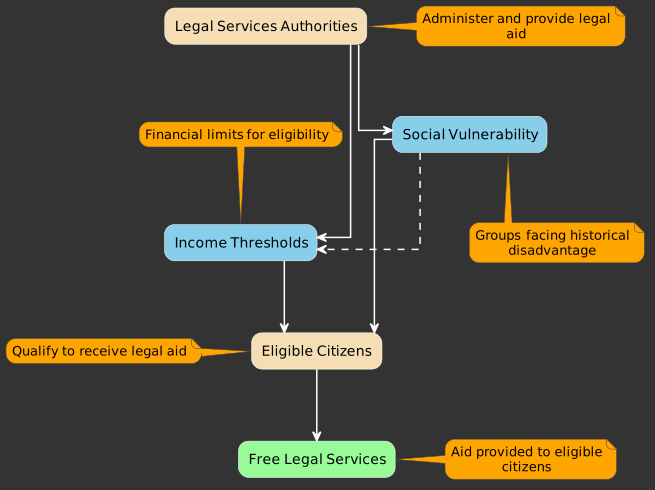
The Legal Services Authorities Act, 1987, and subsequent rules and notifications by the National Legal Services Authority (NALSA) define the categories of citizens eligible for free legal services. These typically include:
- Members of Scheduled Castes or Scheduled Tribes.
- A victim of trafficking in human beings or begar.
- A woman or a child.
- A person with a disability.
- A person in custody.
- An industrial workman.
- A person of unsound mind.
- Victims of mass disaster, ethnic violence, caste atrocity, flood, drought, earthquake or industrial disaster.
- A person whose annual income is below the amount prescribed by the respective State Government, or, if the case is before the Supreme Court, below an income of ₹5,00,000.
Let's examine the given statements:
1. Person with an annual income of less than ₹ 1,00,000: While income is a criterion, the specific threshold of ₹1,00,000 can vary by state and the level of court (District, High Court, Supreme Court). For instance, for the Supreme Court, the limit is ₹5,00,000. Some states have higher income limits for their Legal Services Authorities (e.g., ₹3,00,000 or more for general categories at the district level). Therefore, this statement is not universally or definitively correct in its narrow scope when compared to specific categories.
2. Transgender with an annual income of less than ₹ 2,00,000: This statement is correct. Following the Supreme Court's directives and in line with NALSA's commitment to inclusive legal aid, NALSA specifically included transgender persons as a distinct category eligible for free legal services, with an enhanced income limit of up to ₹2,00,000, notified in 2017.
3. Member of Other Backward Classes (OBC) with an annual income of less than ₹ 3,00,000: This statement is correct. While OBCs are not a distinct category for free legal aid based solely on their caste status (unlike SC/ST), many State Legal Services Authorities have specified income ceilings for eligibility for the general category, which often includes OBCs, and these limits can be up to or beyond ₹3,00,000 (e.g., Delhi State Legal Services Authority has an income ceiling of ₹3,00,000 for general category applicants). This makes a person from OBC falling within this income eligible.
4. All Senior Citizens: This statement is incorrect. While senior citizens are often given priority and easier access to legal aid services, they are not automatically entitled to free legal services regardless of income. Eligibility for senior citizens typically depends on falling into one of the other categories (e.g., being a woman, being below a certain income threshold, having a disability, etc.).
Therefore, statements 2 and 3 are correct.
CStrategy
For questions on legal aid and social welfare, pay close attention to specific categories of beneficiaries and the associated criteria, especially income limits. Be aware that such limits can vary by region or specific notifications. When faced with options involving 'all' or 'only', be cautious, as they often indicate an incorrect generalization.
DSyllabus Analysis
This question falls under the Indian Polity and Social Justice section, specifically focusing on legal services, welfare schemes for vulnerable sections of society, and the role of institutions like NALSA.
EQuestion Analysis
Difficult. The income thresholds for legal aid eligibility are dynamic and can vary by state and specific NALSA notifications, making it challenging to know the exact, nationally applicable figures for all categories at a given time. This requires very specific and updated factual knowledge.