
Question 93
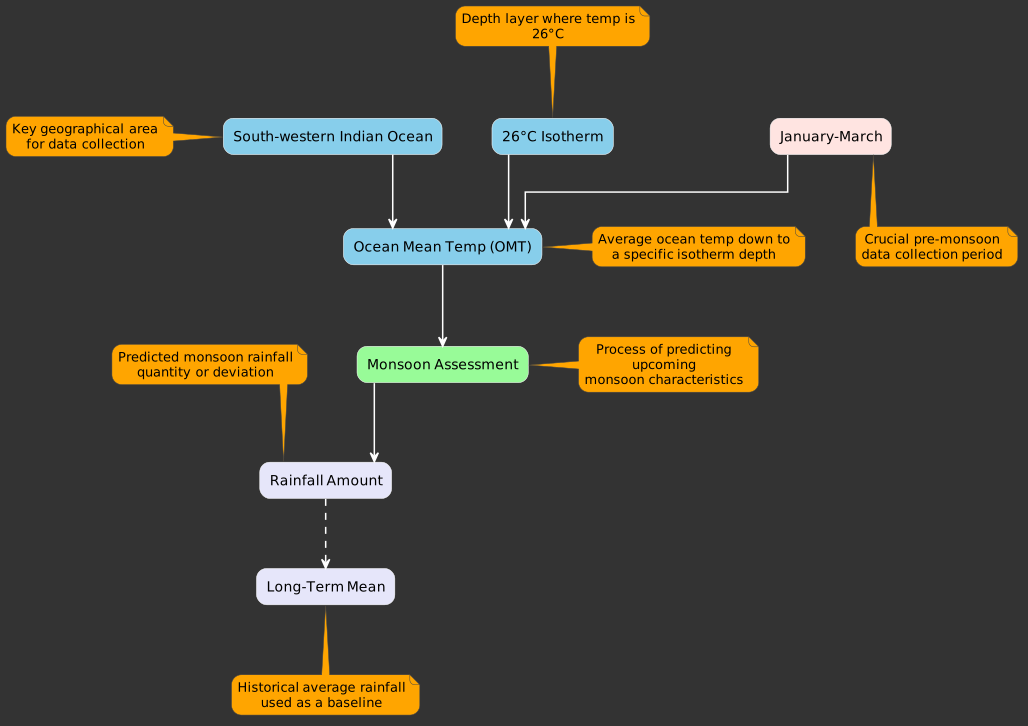
1. OMT is measured up to a depth of 26°C isotherm which is 129 meters in the south-western Indian Ocean during January - March.
2. OMT collected during January - March can be used in assessing whether the amount of rainfall in monsoon will be less or more than a certain long-term mean.
Select the correct answer using the code given below:
AOptions
BSolution
Let's analyze the statements concerning Ocean Mean Temperature (OMT) and its relation to the Indian monsoon:
1. OMT is measured up to a depth of 26°C isotherm which is 129 meters in the south-western Indian Ocean during January - March: This statement is incorrect in its precise numerical depth. While OMT is indeed defined as the average temperature of the ocean water up to a certain depth (often the depth of the 26°C isotherm), this specific depth (129 meters) is not a fixed or universal constant for the entire south-western Indian Ocean during January-March. The depth of the 26°C isotherm varies significantly with geographical location, ocean currents, and seasonal variations. Providing a precise, universal depth like '129 meters' makes the statement factually questionable. The important part of OMT for monsoon forecasting is the volume of warm water, not a fixed depth.
2. OMT collected during January - March can be used in assessing whether the amount of rainfall in monsoon will be less or more than a certain long-term mean: This statement is correct. Ocean Mean Temperature, particularly in the equatorial Indian Ocean and the South-West Indian Ocean during the pre-monsoon months (January to March or April), is considered a crucial predictor for the performance of the Indian Summer Monsoon. Higher OMT in these regions indicates a greater build-up of heat energy in the ocean, which can contribute to stronger atmospheric convection and moisture transport towards the Indian subcontinent, potentially leading to more rainfall during the monsoon. Conversely, lower OMT can indicate a weaker monsoon. Meteorological agencies, including the India Meteorological Department (IMD), use OMT as one of the key parameters for long-range monsoon forecasting.
Therefore, only statement 2 is correct.
CStrategy
For questions related to scientific concepts, especially those involving numerical values or very specific conditions, be cautious about absolute or overly precise statements. Understand the general principles and applications. In this case, the predictive capability of OMT for monsoons is a known phenomenon, while a fixed, precise depth for a dynamic oceanographic feature is less likely to be accurate.
DSyllabus Analysis
This question falls under Indian Geography, Environment & Ecology, and Science & Technology, specifically climatology, oceanography, and monsoon dynamics/forecasting.
EQuestion Analysis
Medium. This question requires knowledge of oceanographic concepts and their relation to climate, particularly the Indian monsoon. The precision in statement 1 is a typical trick used to test factual accuracy.