
Question 20
1. The President of India can summon a session of the Parliament at such place as he/she thinks fit.
2. The Constitution of India provides for three sessions of the Parliament in a year, but it is not mandatory to conduct all three sessions.
3. There is no minimum number of days that the Parliament is required to meet in a year.
Which of the statements given above is/are correct?
AOptions
BSolution
Let's examine each statement regarding Parliamentary sessions:
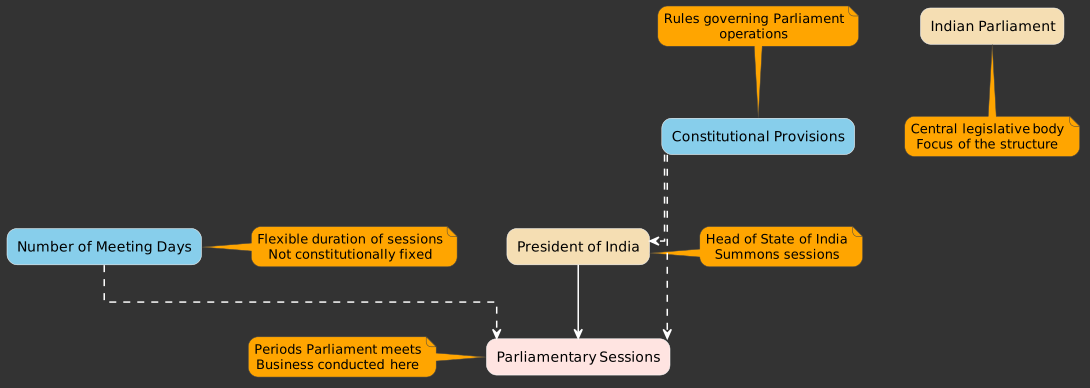
1. The President of India can summon a session of the Parliament at such place as he/she thinks fit. This statement is correct. Article 85(1) of the Constitution states: "The President shall from time to time summon each House of Parliament to meet at such time and place as he thinks fit, but six months shall not intervene between its last sitting in one session and the date appointed for its first sitting in the next session." This grants the President the power to determine the place of a session.
2. The Constitution of India provides for three sessions of the Parliament in a year, but it is not mandatory to conduct all three sessions. This statement is incorrect. The Constitution does not specify or mandate the number of sessions (e.g., Budget, Monsoon, Winter) that Parliament must hold in a year. It only mandates that there should not be a gap of more than six months between two sessions (Article 85(1)). This effectively means Parliament must meet at least twice a year. The practice of holding three sessions is a convention, not a constitutional mandate.
3. There is no minimum number of days that the Parliament is required to meet in a year. This statement is correct. The Constitution does not prescribe a minimum number of sitting days for Parliament in a year. It only specifies the maximum permissible gap between two sessions (six months). The number of days Parliament meets is determined by the government's legislative agenda and prevailing political circumstances.
Therefore, statements 1 and 3 are correct.
CStrategy
For questions on parliamentary procedures and sessions, differentiate between what is explicitly stated in the Constitution and what is a convention or practice. Pay attention to precise wording, especially regarding mandates ('provides for', 'mandatory') versus discretion ('thinks fit').
DSyllabus Analysis
This question falls under the Indian Polity section, specifically focusing on the functions and procedures of the Parliament, including summoning of sessions.
EQuestion Analysis
Medium. While summoning power is known, the nuance about the number of sessions and minimum sitting days (constitutional mandate vs. convention) can be confusing.