
Question 50
AOptions
BSolution
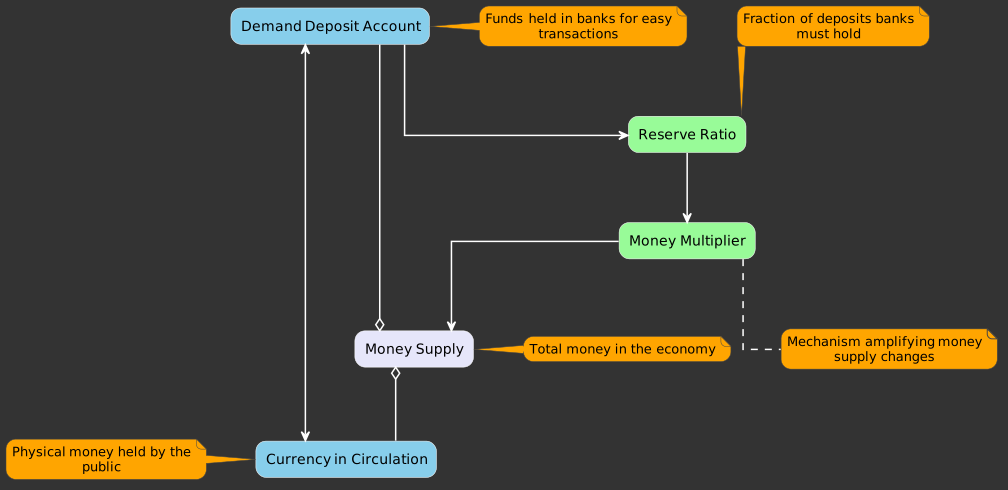
When you withdraw cash (currency in circulation) from your Demand Deposit Account at your bank, the immediate effect on the aggregate money supply in the economy is to leave it unchanged.
Here's why:
Money supply (typically measured as M1 or M3) includes both currency held by the public (cash) and demand deposits (money held in checking or savings accounts that can be readily accessed).
When you withdraw cash:
- Your demand deposit balance decreases by ₹ 1,00,000.
- The amount of currency in circulation increases by ₹ 1,00,000.
Essentially, you are converting one component of the money supply (demand deposit) into another component (currency). The total amount of money available in the economy, as defined by the aggregate money supply measures, does not change as a result of this transaction. It's a change in the composition of money, not its total quantity.
CStrategy
For questions related to money supply and banking, it's crucial to understand the components of money supply and how various transactions affect these components. Simple transfers between different forms of money within the aggregate measure generally do not change the total supply.
DSyllabus Analysis
This question falls under Economics, specifically Monetary Economics and Banking, focusing on the definition and components of money supply.
EQuestion Analysis
Easy to Medium. It tests a fundamental concept of money supply, which can be tricky if one doesn't understand the components clearly.